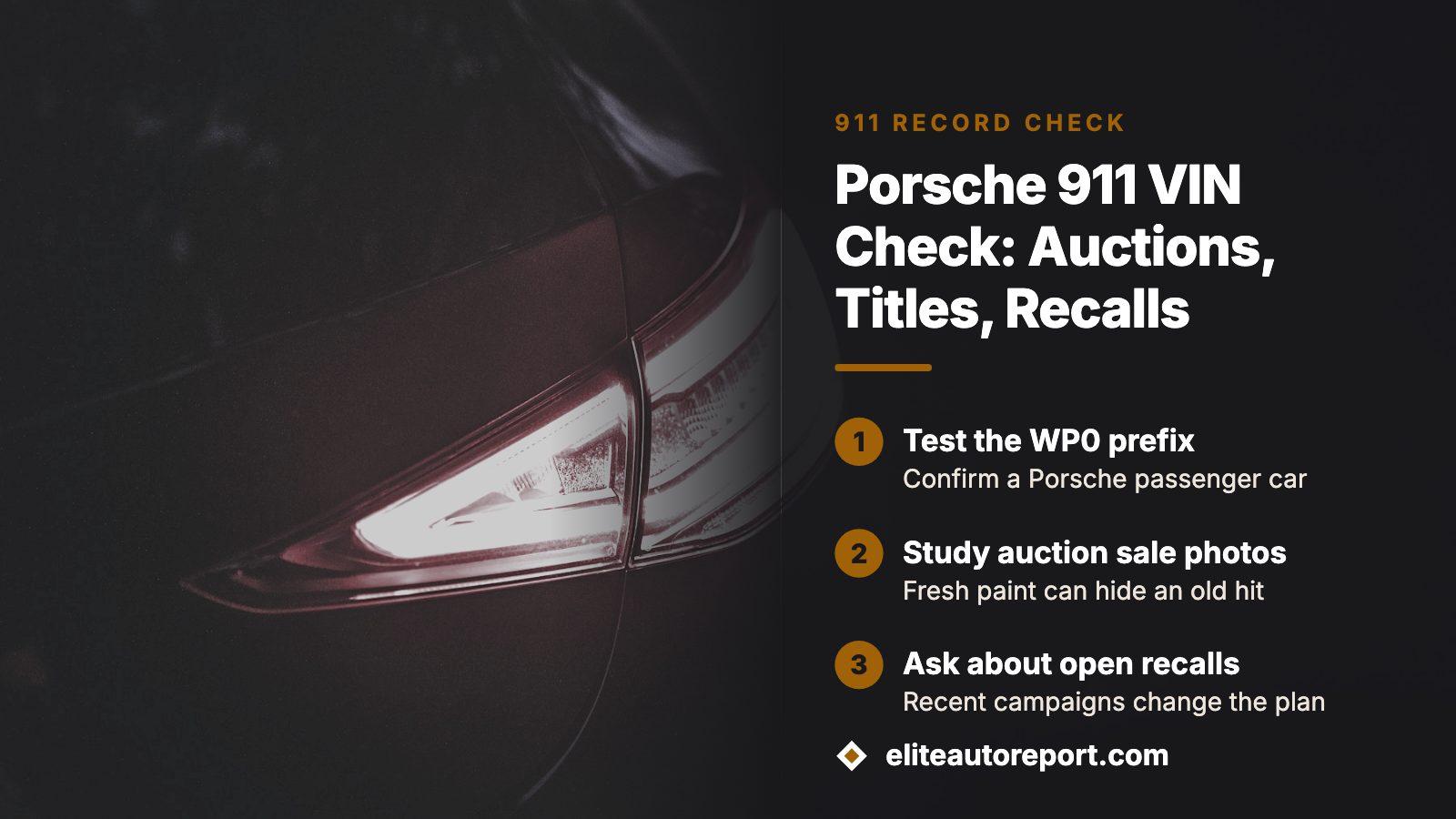
THE SHORT ANSWER
Copy the VIN from the windshield plate, confirm it decodes to a Porsche passenger car, then scan the record for auction or salvage sales with pictures, title brands, mileage that only rises, and recalls nobody completed. With a 911, the sale pictures carry the most weight, since fresh paint can cover an old hit. You pay nothing to view the preview, and the fuller report is a separate one-time purchase.
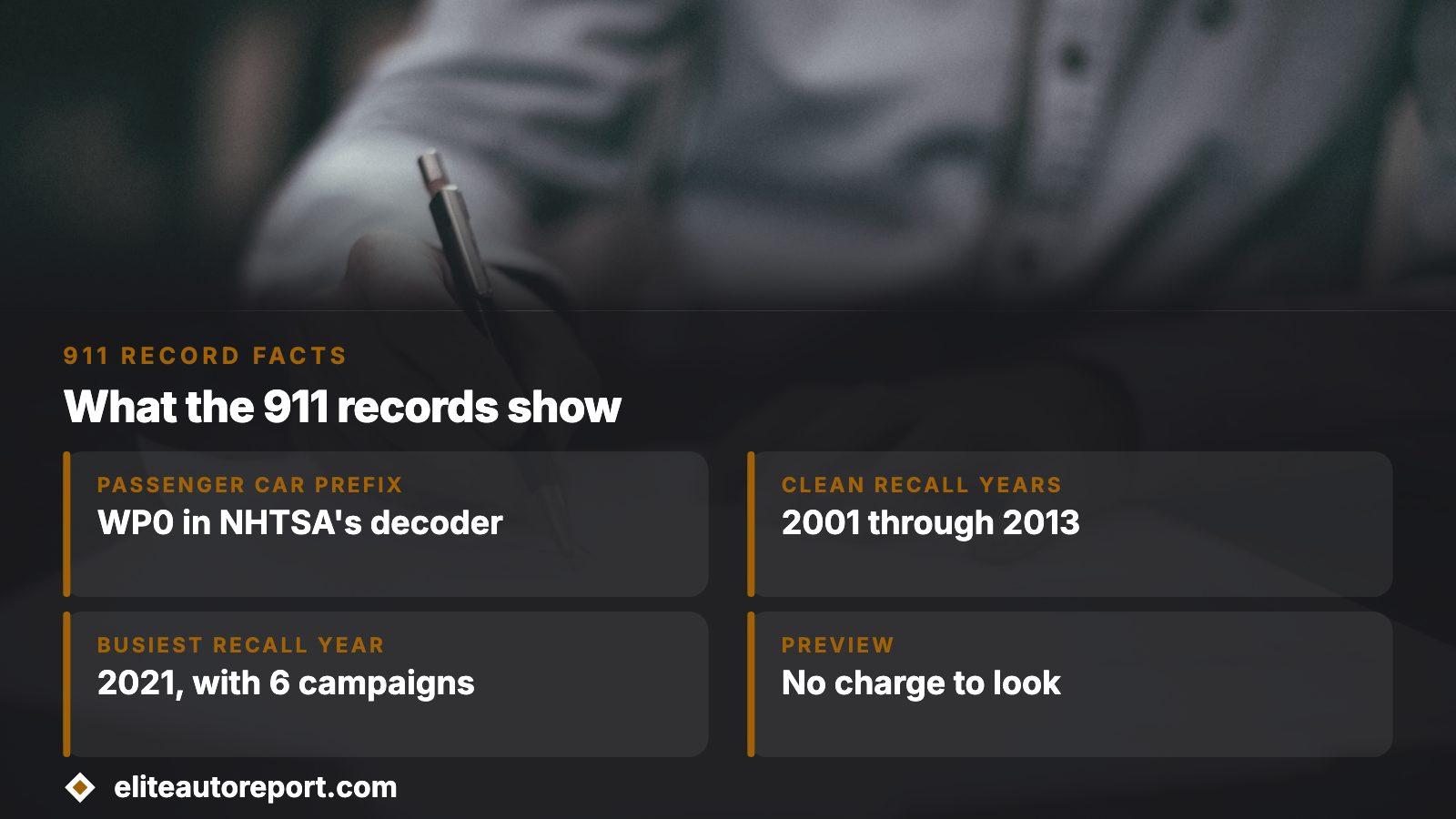
- Passenger car prefix
- WP0 in NHTSA's decoder
- Recall-free model years
- 2001 through 2013 on NHTSA's 911 list
- Busiest recall year
- 2021, with 6 campaigns
- Cost
- No charge to preview, one payment for the report
What a 911 lookup is for
A 911 is driven hard by some owners and babied by others, and from the curb you cannot tell which kind you are looking at. EliteAutoReport starts from auction history because that is where a damaged sports car usually leaves a trail: a salvage-yard sale, a dealer-auction lot, a set of photographs taken before any body shop touched it.
Those pictures are the part worth reading closely. A seller can describe a repair as cosmetic, but a photo of crushed metal at the front corner is hard to argue with. The surrounding records tell you how the car moved afterwards.
- Sales at salvage and dealer auctions, with lot photos where they exist
- Brands on the title, and which state issued each
- Dated odometer readings, so a stall or a drop stands out
- Theft entries and insurance total-loss entries
- Recalls that were announced and never carried out
Getting the number and testing it first
On a US-market car the plate sits at the base of the glass on the driver's side, as NHTSA describes it, and the registration repeats the number. Ask the seller to text you a sharp photo of each, then read them against each other character by character. Any difference means stop. The Justice Department's consumer page explains cloning: thieves take a number off a matching make, model and year and put it on a stolen car.
Then decode it. In NHTSA's lookup service the prefix WP0 belongs to Porsche's German manufacturing company and is typed as a passenger car, while WP1 is typed as a multipurpose vehicle, which is how the SUVs are filed. A 911 advertised with a WP1 start deserves a hard question. Under federal rules the seventh character of a passenger car number is a letter, a small detail that catches some typing mistakes.
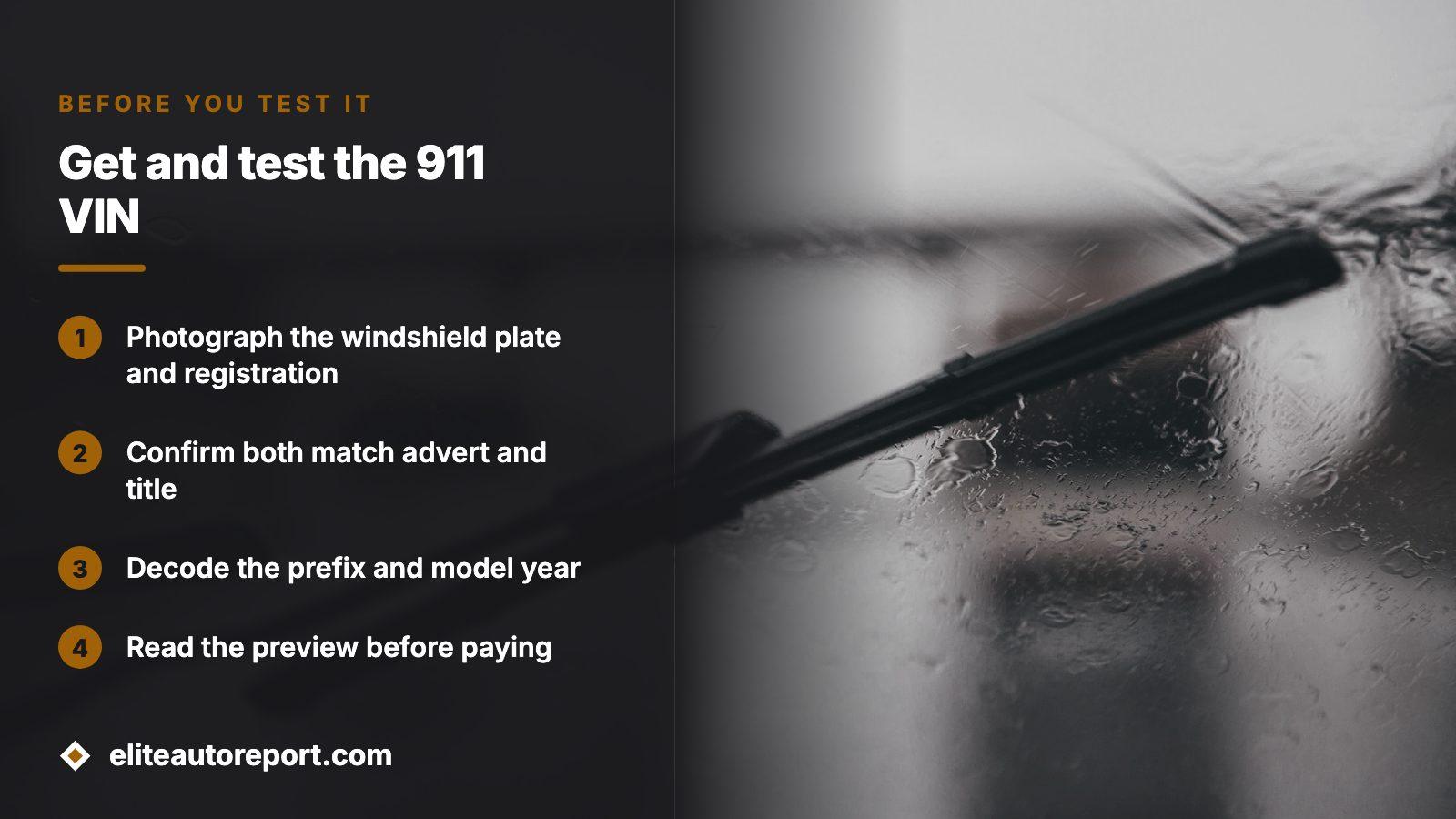
- Photograph the windshield plate and the registration
- Confirm both match the advert and the title
- Decode the prefix and the model year
- Look at the preview before paying
Recalls, year by year
I pulled NHTSA's recall list for the 911 from 1999 through 2025. The result is lopsided: every year from 2001 to 2013 is empty, and the campaigns bunch up from 2016 onward. That pattern says more about how much has been filed than about how well any one car was built, but it tells you which model years need the open-recall check most.
| Model year | Campaign | Issue | Fix |
|---|---|---|---|
| 1999, 2000 | 00V109000 | Instrument cluster software can show a wrong fuel level | Cluster software update |
| 2014, 2015 | 14V698000 | Front hood lock may not latch on cars built May to September 2014 | Replace the hood lock |
| 2016, 2017 | 19V533000 | Air bag control unit capacitor may deactivate or fire the bags | New software, replace unit if needed |
| 2017 | 17V135000 | Windshield bond on open-top cars may fail in a crash | Rebond the windshield |
| 2019 | 21V201000 | Rear axle upper control arm screw may be loose | Rework and tighten |
| 2021 to 2023 | 22V897000 and others | Dashboard console can break in a crash with air bag deployment (2022, 2023) | Replace the dashboard |
The recent ones that change what you do
Two recent campaigns are worth singling out because the maker or NHTSA tied them to loss of a wheel or a detached window. Campaign 24V809000 covers 2021 to 2024 cars, and owners were warned off driving until a dealer checks the center lock fastening and replaces any wrongly made parts. A second filing, 26V682000, repeats the wheel bolt issue for certain 2024 models, including the Turbo, GT3 and GT3 RS.
Campaign 24V155000 deals with the front windshield and rear window on 2020 to 2024 cars, which may not be secured properly, and dealers inspect and replace as needed. The newest broad one, 25V896000, is a rearview camera software fault listed for 2020 to 2025 cars, fixed by a free update. All of these repairs cost the owner nothing at a dealer.
What a VIN recall search leaves out
NHTSA's own page says a VIN search lists only unrepaired recalls. It skips recalls past 15 years of age, recent ones still being matched to VINs, and campaigns from small makers. A clean answer on an older 911 therefore proves less than it seems to.
What 911 owners reported to NHTSA
Complaints are individual reports, not findings of a defect, but the pattern in this model is plain. Under the name 911, NHTSA holds 8 complaints for 1999, 5 for 2000, 8 for 2001 and 2 for 2014. The 2007 year stands alone with 50, and 45 of those mention coolant, antifreeze or a fitting.
From an NHTSA owner complaint
Someone who bought a 2007 911 Turbo in New Jersey in September 2014 started the drive home to South Carolina. Roughly 30 minutes in, a coolant warning lit up and steam rolled from the back. A dealer confirmed the failure, and the owner says the maker would not call it a known problem.
Nothing in a VIN report shows a coolant fitting about to let go. What the record does show is whether the car has been sold at auction after an incident, one more reason to pair the history with a specialist inspection before money moves.
The warning on the early cars
Six of the early-year complaints describe trouble with the intermediate shaft bearing, three in 1999, two in 2000 and one in 2001. No recall exists for it, which is exactly why a VIN search cannot flag it.
From an NHTSA owner complaint
The owner of a 1999 car reported a seized engine at 95,500 miles, with no warning, and a mechanic blamed the bearing. The quote to replace the engine ran upwards of 13,000 dollars.
An owner of a 1999 car reported a seized engine at 95,500 miles, with no warning, and a mechanic blamed the bearing. The quote to replace the engine ran upwards of 13,000 dollars.
Red flags worth walking away over
National title records pull brands from state agencies, recyclers, salvage yards and insurers, and a brand, once applied, stays on the record. Definitions differ by state, so a car branded in one can look ordinary in the next. The danger is a retitle somewhere with looser rules.
- A salvage or flood brand, then a clean title issued by a different state
- Auction photos that show damage the advert never mentioned
- Odometer entries that fall, or a long silence ending in a low figure
- A theft or total-loss entry on a car described as accident-free
- A recall still open on a car sold as fully serviced
Even a spotless record can miss things. The federal consumer page says reporting is incomplete, so a search may come back empty when history exists.
Cost, and what to do next
Type the number in and the preview shows at no charge. If it points to records, the complete report is a single payment, with larger bundles for anyone comparing several cars. There is no subscription to cancel, and the pricing page holds the amounts.
Run it before the drive out to see the car. When an auction sale appears, buy the full report and set the photos beside the seller's account. When the preview comes back empty, a Porsche specialist should still go over the engine, suspension and underbody.
Where this information comes from
- NHTSA: recall lookup page — VIN location and the limits of a VIN recall search
- NHTSA recalls API: 2017 911 — air bag and windshield campaigns
- NHTSA recalls API: 2022 911 — wheel bolt, window and dashboard campaigns
- NHTSA vPIC: WP0 manufacturer code — which maker and vehicle type the prefix belongs to
- NMVTIS: information for consumers — brands, cloning and the limits of title data
- NHTSA owner complaint 10641993 — owner experience, paraphrased
- NHTSA owner complaint 11179953 — owner experience, paraphrased
Sources and photos: Facts checked against the sources above in November 2026. Photos by Maurice Sahl, Thibault Valjevac and Scott Graham on Unsplash; diagrams by EliteAutoReport.
Keep reading
- Car Auction Photos by VIN: Find Salvage Sale Pictures Before You BuyFinding the lot pictures that belong to one VIN, and reading them well.
- Nissan GT-R VIN Check: Auction Photos, Titles and RecallsA parallel walk-through for a Japanese supercar.
- Copart Damage Types: What a Lot's Damage Label Really Tells YouDecoding the damage codes used in salvage listings.
- VIN Market Value for Luxury, Exotic and Classic Cars: A Five-Step CheckPutting a number on the car after the history is clear.
Frequently asked questions
Will a VIN check show a wrecked 911?
It can hint at one, through an auction sale with photos, an insurer total-loss entry or a salvage brand. Damage fixed privately, with no insurer or auction in the picture, leaves no entry, so pair the history with a close look at body gaps, paint depth and the underbody.
Does a 911 lookup list open recalls?
Yes. The report lists recalls tied to that exact number. NHTSA's list shows none for 2001 through 2013 and several for recent years, so confirm any wheel, window or air bag work was done on the particular car you are considering.
Can I check a 911 from its plate?
This check works from the VIN only. With just a plate in hand, ask the seller for the VIN, or find it on the registration or the windshield, and use that.
Can I see the 911 preview without paying?
Yes. The preview only tells you whether any records exist for that number. Reading the whole report takes a single payment and nothing renews afterwards. Current amounts for one report or a bundle sit on the pricing page.
Do I still need an inspection after a clean report?
Yes. A record covers only what someone reported, and federal guidance warns that a search can miss history. Engine and cooling faults never appear in a title record, so a specialist's inspection finds what the report cannot.
Now check the car itself
The guide explains what to look for. The report shows what this VIN has on record.