THE SHORT ANSWER
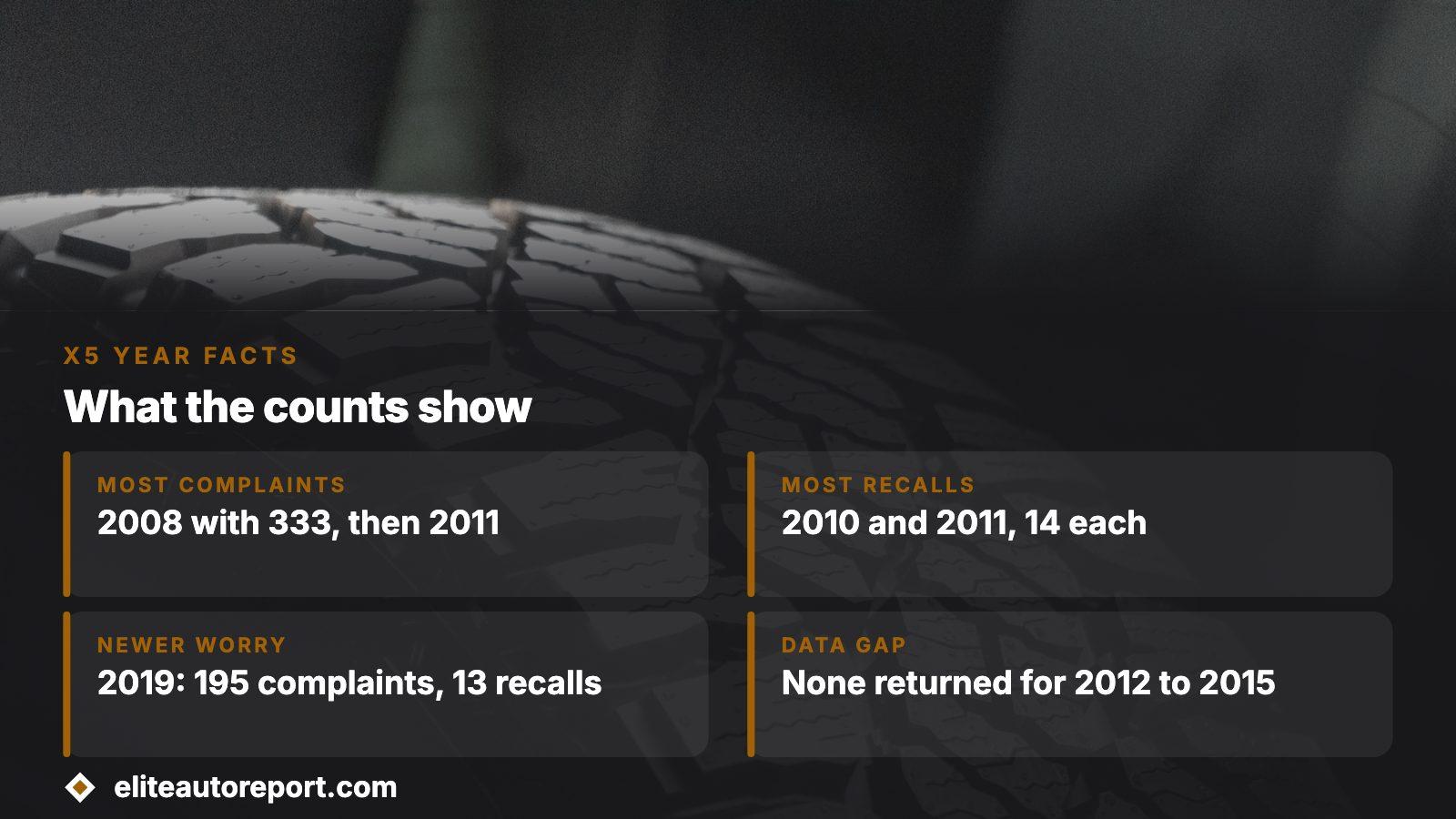
Skip 2008 and 2011 first: 333 and 309 owner complaints, with engine, fuel system and air bag problems recurring. 2006 (281 complaints, mostly air bags) and 2019 (195 complaints, 13 recalls) come next. Any year can be a good buy if the specific VIN shows recall work done and a clean title, and a bad one if it does not.
- Most complaints
- 2008 with 333, then 2011 with 309
- Most recalls
- 2010 and 2011 with 14 campaigns each
- Newer worry
- 2019 with 195 complaints and 13 recalls
- Data gap
- No complaint counts returned for 2012 to 2015
Method behind the ranking
Opinions about the X5 vary by owner and by mechanic, so this guide sticks to numbers anyone can reproduce. We queried the NHTSA complaints database for owner reports, and its recalls database for safety campaigns, under the X5 name for each model year in that span.
A complaint tally says nothing about how many cars failed. Age matters too, since early years had decades to gather reports, and an active owner community adds to the totals. Still, when a year leads on complaints and also carries many recalls, and the same parts keep showing up, it is a reasonable year to question before you pay.
We read this as an auction-history site would: a car's past matters more than its model-year reputation. A year with a bad record is only a warning flag until a VIN report says what happened to your particular X5.
Complaint and recall counts by model year
| Year | Complaints filed | Recalls listed |
|---|---|---|
| 2001 | 176 | 12 |
| 2004 | 127 | 4 |
| 2006 | 281 | 2 |
| 2008 | 333 | 10 |
| 2009 | 161 | 12 |
| 2010 | 149 | 14 |
| 2011 | 309 | 14 |
| 2012 to 2015 | none returned | 10, 6, 8, 6 |
| 2016 | 74 | 5 |
| 2018 | 73 | 5 |
| 2019 | 195 | 13 |
| 2021 | 114 | 12 |
| 2022 | 73 | 1 |
| 2024 | 145 | 8 |
The complaints database returned nothing for 2012 through 2015 under the X5 name, so those years cannot be ranked on complaints. Their recall counts are still real, which is why they appear as a split row.
2008 and 2011: the two years to skip first
Model year 2008 holds the highest complaint count of any X5 year, 333. Owners most often cited air bags (76 mentions), the engine (73), the fuel system (58) and the electrical system (52). Fifteen of those complaints reported a fire.
Model year 2011 is close behind with 309. Engine complaints dominate at 129, followed by air bags at 77 and the power train at 63, and 15 complaints again mention fire. It also shares the top recall count of 14 with 2010.
From an NHTSA owner complaint
A 2011 X5 owner wrote that the garage fire alarm sounded shortly after the car was put away. Smoke and flames showed under the hood; an extinguisher knocked them down with a fire report on record afterward. The cause was never determined, and the failure mileage was 140,000. The takeaway: on these years, ask for service records covering the engine bay and fuel system, not just an oil-change stamp.
The recalls that explain the early years
Several recalls cover the 2007 to 2013 range, which fits the pattern in the complaints. A fuel pump module campaign (16V746000) addressed loose wiring that could melt a connector and leak fuel or stall the engine. A passenger air bag inflator campaign (19V017000) carried a warning to park the car until the module was swapped.
- 16V311000 and 17V138000: front driveshaft universal joint could fail, leaving the front wheels undriven; remedy is a new front driveshaft.
- 18V336000: on the 2009 to 2013 diesel, an idler pulley bolt could break and cost power steering assist.
- 16V746000: fuel pump module replaced free at a dealer.
- 19V017000: passenger air bag module replaced free, with a do-not-drive warning until done.
Recall repairs are free, but only if someone did them. On a used X5 from these years, an unperformed campaign is a common reason a car is cheap.
2006 and the first generation
Model year 2006 drew 281 complaints but only 2 recall campaigns, an unusual gap. Air bags were named 134 times in those reports, far above brakes at 42 and the electrical system at 41. It also posted the highest injury total across complaints, 18, and 10 reports involved a crash.
The earliest years carry their own history. Model year 2001 logged 176 complaints and 16 fires, and a Takata driver air bag recall (25V748000) from late 2025 covers 2000 to 2001 trucks with a sport steering wheel. The remedy is an inspection and, if needed, a new driver air bag, with a park-it warning until it is complete. A 2001 that has never been checked against that campaign is a risk.
2019: newer, but not clean
The first year of the redesigned X5 produced 195 complaints and 13 recalls. Electrical problems led with 72 mentions, then the engine with 52. Recalls include a body domain controller that could short and overheat (18V732000), wheel bolts, steering column bearing plate, the brake system and a starter motor that could overheat after repeated start attempts (24V576000).
From an NHTSA owner complaint
An owner of a 2019 X5 described turning left on a residential street when the steering wheel locked, the brakes failed to stop the car and the engine would not shut off. The dash went dark, the car hit a house, and the air bags deployed. A tow driver noted that every system had stopped working. The takeaway: with newer cars, ask whether every open campaign has been performed, because recall work is software or hardware that you cannot judge by looking.
Years that look calmer in the data
Model years 2016, 2017 and 2018 produced 74, 75 and 73 complaints, with 5 or 6 recalls each. Those are the lowest counts in the run of years that have complaint data apart from 2023, which has 34 complaints and 4 recalls but is also the newest and has had less time to collect reports. Model year 2022 is a thin case: 73 complaints with a single recall campaign.
None of this clears a car. It only moves the odds. A 2017 with a salvage brand and unfinished recalls is a worse purchase than a 2011 with documented repairs and a clean title.
What a VIN check settles that the year cannot
Luxury SUVs often pass through auctions after trade-ins, lease returns and insurance losses. An EliteAutoReport check pulls the auction record and photos tied to the VIN, alongside brand labels on the title, mileage history, crash and damage notes and unresolved recalls. That shows whether the X5 in front of you was ever sold as a damaged unit, and what it looked like when it was.
Federal title data matters here. The federal NMVTIS database stores a car's title record, last reported mileage and any brands such as junk, salvage or flood. A saltwater soak tends to wear down wiring and air bag sensors, which fits the electrical and air bag complaints above.
The preview costs nothing to open. Going further means one payment, not a plan, and the amount is on the pricing page.
A short checklist before you pay
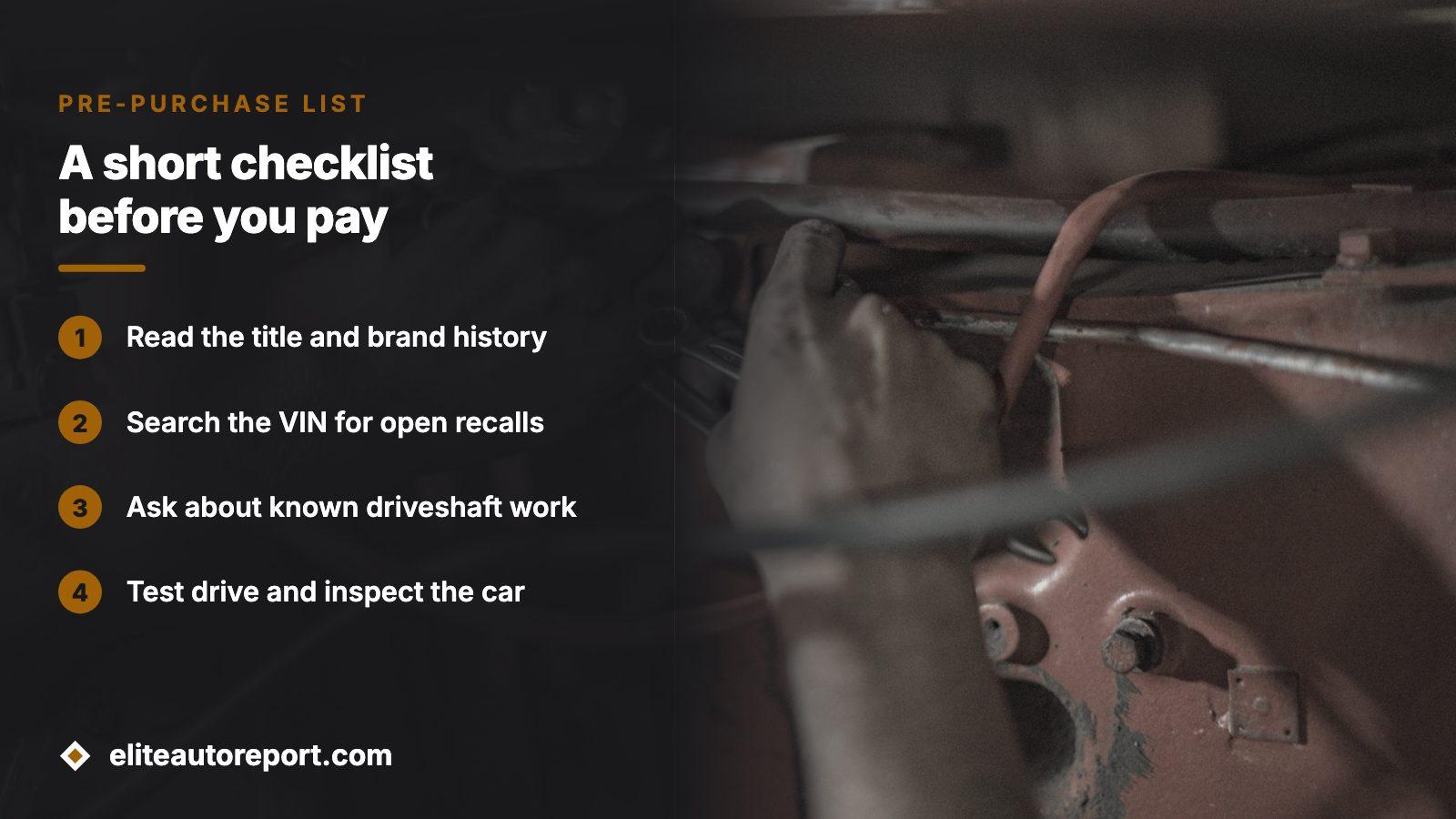
- Run the VIN and read the title and brand history first.
- Search the VIN for open recalls at NHTSA, then ask the seller to show paperwork for finished ones.
- For 2007 to 2013 trucks, ask specifically about the fuel pump module, driveshaft and air bag inflator campaigns.
- Check auction photos against the car's current condition, panel by panel.
- Get an independent inspection from a shop that knows BMW, not the seller's partner.
If the report shows a salvage or flood brand, the model-year ranking stops mattering and the price conversation changes entirely.
Where this information comes from
- NHTSA complaints API for the BMW X5 — source of the owner complaint counts and components by model year
- NHTSA recalls API for the BMW X5 — source of recall campaign counts, numbers and remedies
- NHTSA owner complaint 11231281 — owner experience, paraphrased
- NHTSA owner complaint 11522665 — owner experience, paraphrased
- NMVTIS consumer information — what federal title data holds and what a brand means
Sources and photos: Facts checked against the sources above in November 2026. Photos by Will Truettner, Nina Mercado and Rob Wingate on Unsplash; diagrams by EliteAutoReport.
Keep reading
- Auction History by VIN: Photos for Luxury, Exotic and Classic Carssee how auction records and photos attach to a VIN
- Flood Damage Car Check Before You Bid: A Step-by-Step Guide for Auction Carshow flood-damaged cars reach buyers, relevant to X5 electrical complaints
- Copart VIN Check: Auction Photos and History for Luxury and Classic Carscheck whether an X5 passed through a salvage auction
- BMW M3 VIN Check: Auction Photos, Titles and Recalls by Yearthe same VIN check approach for another BMW
Frequently asked questions
What is the worst year for the BMW X5?
By complaints, 2008 leads with 333 reports, followed by 2011 with 309. Both mention engine, fuel and air bag problems repeatedly. The data cannot rank 2012 to 2015 on complaints, so the history of the exact car beats the year as a guide.
Is the 2019 BMW X5 reliable?
It drew 195 complaints and 13 recall campaigns, led by electrical issues. Many recalls are fixed free at a dealer, so a 2019 with completed campaigns and a clean title can be sound. Ask for proof of the work before you buy.
Which BMW X5 years are best?
The 2016 to 2018 years show the lowest complaint counts among years with data, at 74, 75 and 73. Counts are only a signal. Any of them could still carry a salvage title, so check the VIN before you talk money.
How do I find out if an X5 has open recalls?
Enter the VIN in NHTSA's recall lookup at no cost, or read the recall section of a VIN report. Open campaigns are repaired at a BMW dealer at no charge, and some, like the air bag inflator ones, carry a park-it warning.
Can a VIN check show if an X5 was in an auction?
Yes. The report lists auction sales and photos tied to the VIN along with title brands, damage entries and mileage readings. The preview opens free, and unlocking the rest is a single purchase.
Now check the car itself
The guide explains what to look for. The report shows what this VIN has on record.