THE SHORT ANSWER
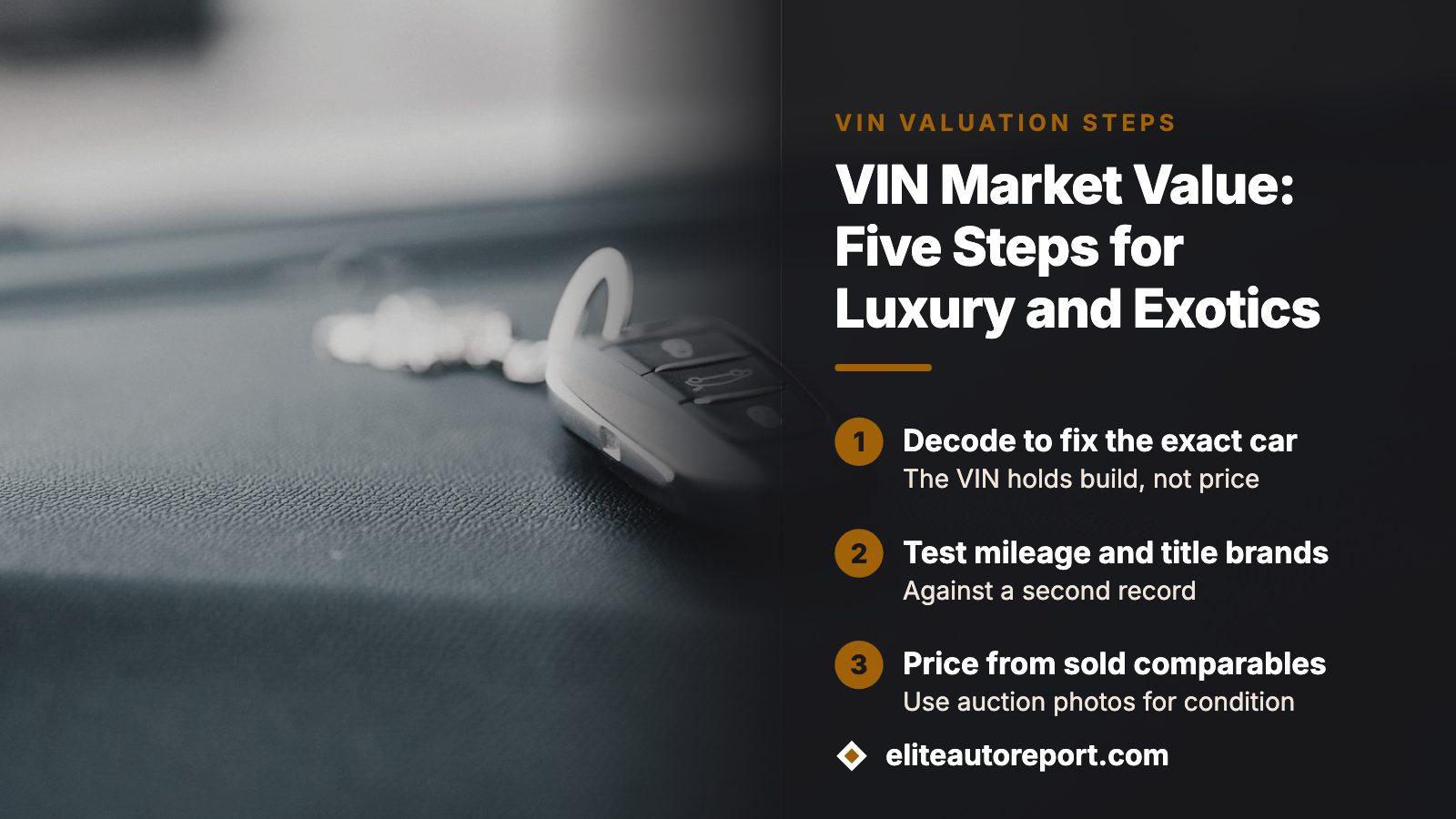
No lookup can hand you a trustworthy price from the VIN alone. Decode it to fix the exact car, test the mileage against a second record, read the title brands, study auction history and photos for condition, then compare sold prices for matching cars. Start the free preview on EliteAutoReport, and buy the report to see those records side by side.
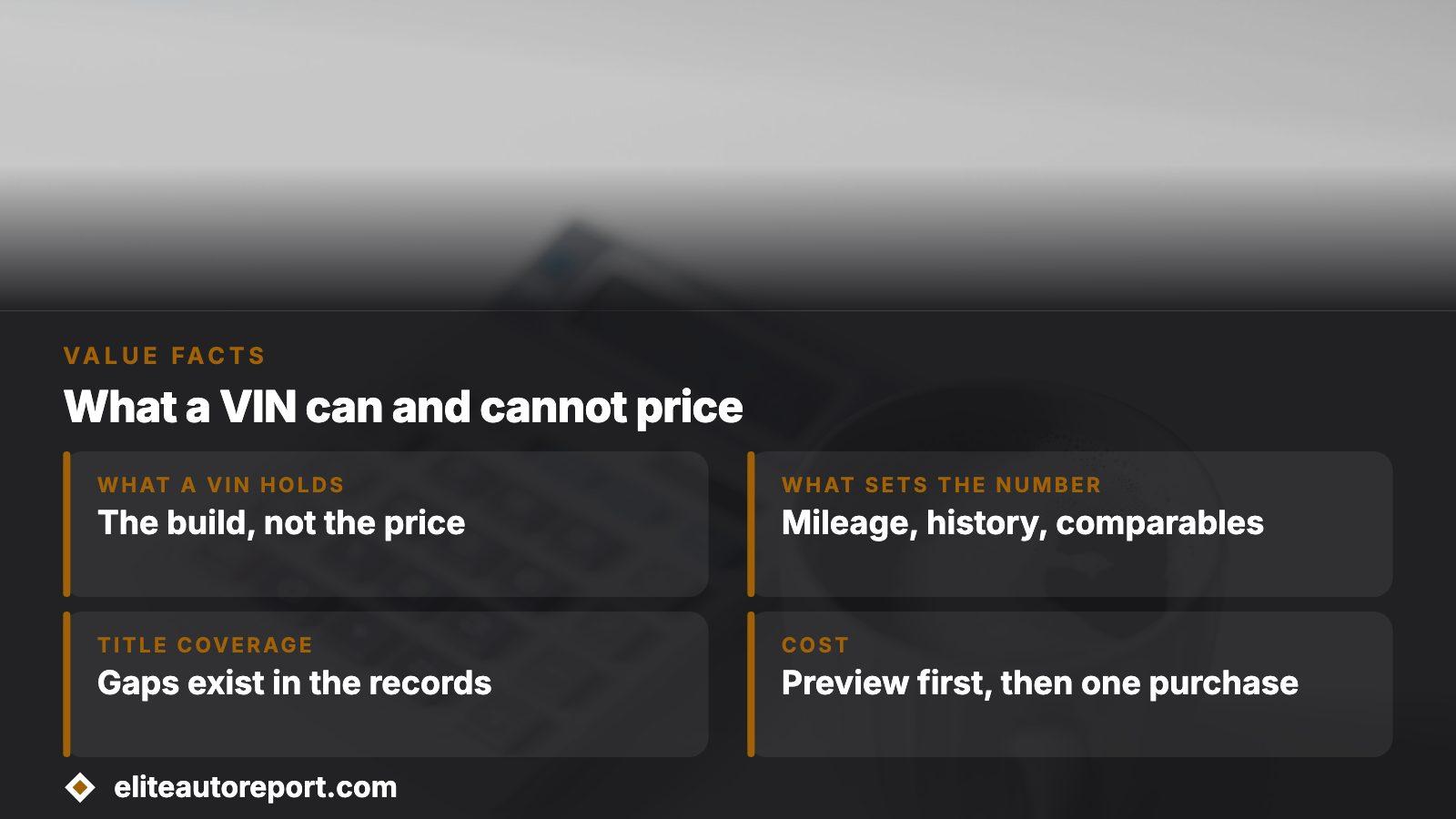
- What a VIN holds
- The build, not the price, mileage or condition
- What sets the number
- Mileage, history, condition and sold comparables
- Cost
- Free preview, then a one-time purchase
What the 17 characters hold, and what they leave out
Federal rules fix what each position means. The opening three characters point to the maker and vehicle type (small-volume makers add three more later), positions four to eight describe the build, position nine is a self-test character, and the last eight hold the model year, plant and production number. None of it is reserved for price, mileage or condition.
So a VIN cannot contain a market value, and any tool that returns one has paired the number with other data. Age matters too: the rule's year-code note starts at 1980, so an older classic may not carry a standard 17-character number at all.
Step 1: Confirm which exact car you are pricing
A value for the wrong specification is worth nothing. Settle first that the car you are looking at matches its advertisement.
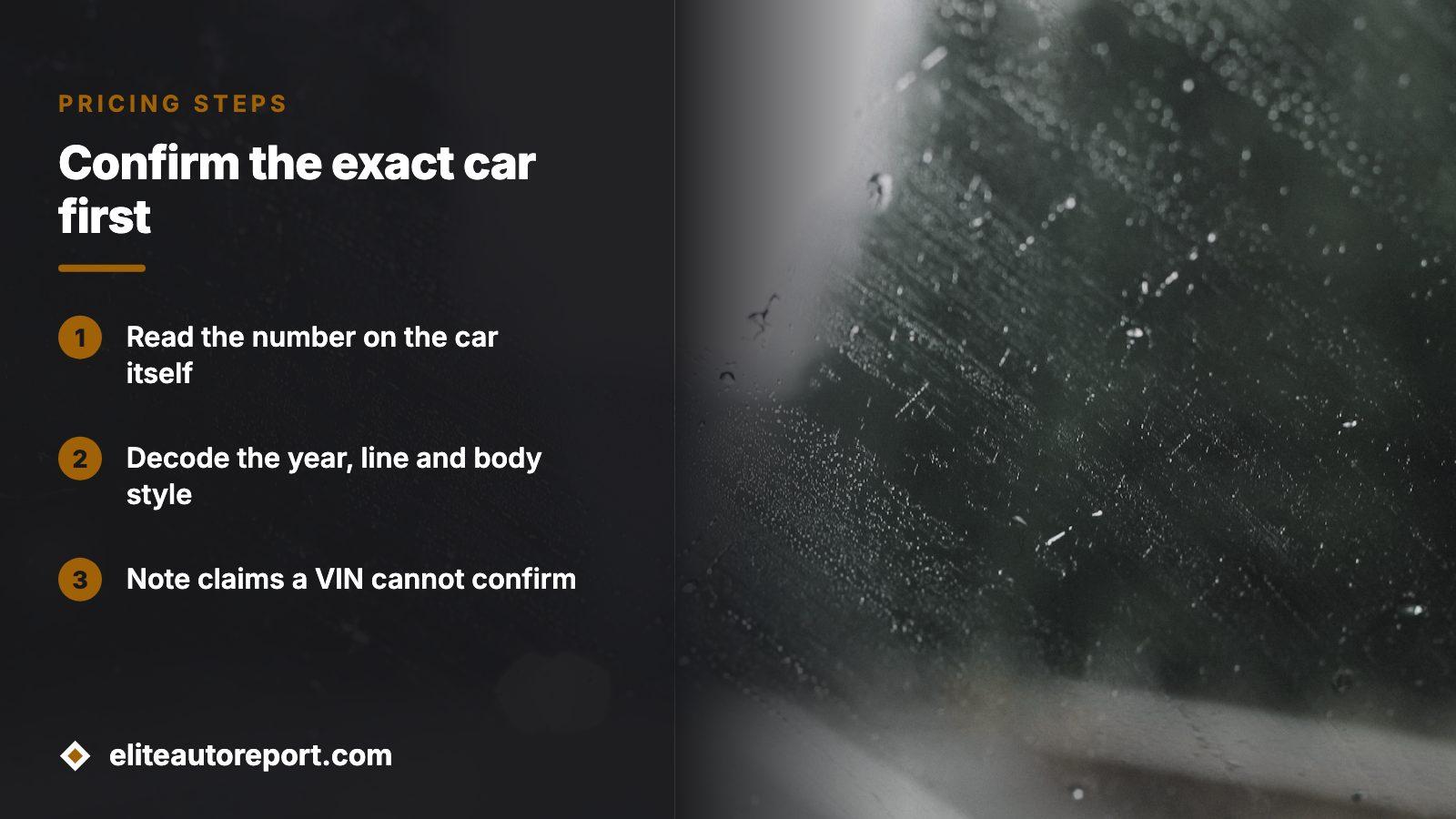
- Read the number on the car itself, never only the listing, and compare it with the seller's paperwork. A mileage statement has to name the VIN, so documents that disagree are a reason to pause.
- Decode it and note the model year, line, body style and engine. A car sold with a bigger engine or higher trim than its VIN describes has a price problem before mileage even comes up.
- Write down the claims a VIN cannot confirm, such as original paint or factory options, and verify them in person.
Step 2: Test the mileage against a second record
Mileage is the first input any price guide asks for, and the IRS says guides correct for odd equipment, high or low mileage and condition. A seller's number is a claim until another record agrees. At each sale the seller signs a statement giving the reading, the date and the VIN, certifying it or flagging a problem. The duty lapses with age: ten years for a 2010 model or older, twenty for newer ones, counted from January 1 of the model year.
Line up every reading in date order: title papers, auction entries, service invoices, the dash. Readings should only climb. A drop, a long freeze or a sudden jump needs a written explanation.
From an NHTSA owner complaint
The owner of a 2009 Porsche Cayenne says it came from a dealer showing 105,000 miles. A later diagnostic test listed 209,000, and the owner, on an attorney's advice, had not told the dealer.
Take from it: a valuation resting on one reading is only as sound as that reading, so find a second before you trust the first.
Step 3: Read the title history before you accept a price
The federal title system's consumer page says a buyer sold a car without its brand history disclosed may pay more than fair market value, so a brand is a pricing fact as well as a safety one.
- Coverage has gaps. Records exist for 87 percent of US vehicles, and with some states silent, a clean result can still be a false negative.
- Labels differ by state: a car branded salvage in one may be unbranded in another, and flood branding is not universal.
- A total-loss label is not a verdict. An insurer may apply it to a stolen car unfound after 30 days, and it stays if the car returns undamaged.
- Repair quality is invisible here: the listed contents are title data, brands, odometer readings, insurer determinations and salvage-yard transfers.
Each report links to the state's own title record, which holds more.
Step 4: Use auction history and photos as condition evidence
This is the step a price guide cannot do, and the one that matters most on a high-end car. Where a record exists, an auction entry can give the sale date, odometer reading, damage notes and photographs taken before any repair. Photos answer what a damage label cannot: which area was hit and whether the ad's story fits.
Treat an entry as a lead, never a ruling. Gooding Christie's terms call a condition report opinion, say that silence about repairs does not mean there were none, and tell bidders to rely on their own inspection.
From an NHTSA owner complaint
An owner reported that a 2007 Aston Martin DB9 came to a halt in an intersection at 2,319 miles and later needed a new engine. The owner asked the maker and dealer to buy the car back and says they replied that the work was done. In the owner's words, the replacement "substantially reduced the market value" of the car.
The lesson: repairs change what a car is worth, and build data will never show them, so ask for the paperwork behind every entry.
Step 5: Set the number from sold comparables
The IRS defines fair market value as the price a willing buyer and a willing seller would agree on, neither forced to act and both reasonably informed. For donated cars it adds a test worth borrowing: a guide's figure fits your car only if its listing matches on make, model, year, region, condition, options and warranty. The guides are unofficial, not an appraisal of a specific car.
Completed sales are often the best evidence, with limits. Liquidation prices and forced sales often fail to show fair market value, and a comparable must be close enough that informed buyers would have weighed it. Gooding Christie's terms add that a published estimate is an opinion that leaves out the buyer's premium and taxes, with the premium charged on top of the final bid.
Which source answers which part of the question
No single record covers all five steps.
| Source | What it adds | What it cannot do |
|---|---|---|
| VIN decode | Year, line, body style, engine | Give price, mileage or condition |
| Federal title data | Brands, odometer, total-loss and salvage-yard reports | Show repair quality or every state's records |
| Auction record and photos | Sale date, odometer that day, damage notes, early pictures | Prove how a repair was done |
| Price guide | A typical figure adjusted for mileage and condition | Fit a rare specification exactly |
| Sold comparables | What matching cars actually fetched | Match your car if the specification differs |
| Specialist inspection | Mechanical state and originality, in person | Show what happened earlier |
Warning signs that should stop the deal
- A mileage reading that falls between two dated records.
- A sale or damage entry the seller never mentioned.
- A decoded engine, body style or model year that contradicts the listing.
- A fresh title from another state with no explanation, the pattern a washed brand leaves behind.
- A price well under sold comparables, with no reason written down.
- A seller who will not allow an independent inspection.
One of these is a reason to ask for documents. Two together are a reason to walk.
Paying for the report, and what follows
Enter the full VIN on EliteAutoReport and begin with the free preview. If the car is worth pursuing, you pay once for the full report, for one car or a pack when several are on your list, and no subscription follows. The pricing page has the current figures. The report places a market value section beside auction history and photos, title brands and odometer readings, so each number can be tested against the rest.
Then take the findings to the car and have a specialist inspect it.
Where this information comes from
- NMVTIS: information for consumers — what the federal title system holds, its coverage gaps, state differences and the fair-market-value warning
- IRS Publication 561: determining the value of donated property — the fair market value definition, how price guides and comparable sales are weighed
- 49 CFR 565.15: VIN content requirements — what each VIN position identifies and the year-code note
- 49 CFR part 580: odometer disclosure requirements — the signed mileage statement and the age exemptions
- Gooding Christie's: terms of sale — how estimates, the buyer's premium, reserves and condition reports work at a collector auction
- NHTSA owner complaint 11744537 — owner experience, paraphrased
- NHTSA owner complaint 10224653 — owner experience, paraphrased
Sources and photos: Facts checked against the sources above in November 2026. Photos by Bence Balla-Schottner, Cole Keister and Ben Wicks on Unsplash; diagrams by EliteAutoReport.
Keep reading
- Auction History by VIN: Photos for Luxury, Exotic and Classic CarsHow an auction history check by VIN works and what its photos can show.
- Car Auction History Prices by VIN: Luxury, Exotic and Classic CarsWhy a sale price is the hardest auction detail to find, and where it does appear.
- Car Auction Results Database: Where Classic Car Results LiveHow collector-car results are posted and how to read them.
- PricingWhat one report or a larger pack costs, paid once.
Frequently asked questions
Can a VIN alone tell me what a car is worth?
Not by itself. The VIN identifies the build: maker, line, body, engine, year, plant and production number. Value needs mileage, condition, title history and sold prices for similar cars. A tool that returns a figure has paired the VIN with other data.
Should I use the dealer price or the private-party price?
They answer different questions. For donated cars the IRS accepts no more than a guide's private-party figure, not dealer retail, and less when the car suffers engine trouble, body damage or heavy mileage. A buyer dealing with an individual can start there.
Does an auction entry mean a car is worth less?
Not by itself, because an entry records a sale without ruling on condition. Even an insurer's total-loss label, the federal title system notes, can sit on a car that was never destroyed. Judge the car by its brand, damage notes, photos and inspection.
Can I value a classic that has no 17-character VIN?
You can, but not from a VIN lookup. The federal year-code note begins at 1980, so older cars may carry a different number. Use the chassis or serial number, the paperwork, sold results for similar cars and a specialist's appraisal.
If the report looks clean, can I skip an inspection?
No. One collector house tells bidders to rely on their own inspection, and a clean title record says nothing about workmanship or originality. Pay a specialist for that make to examine the car and put the findings in writing.
Now check the car itself
The guide explains what to look for. The report shows what this VIN has on record.