THE SHORT ANSWER
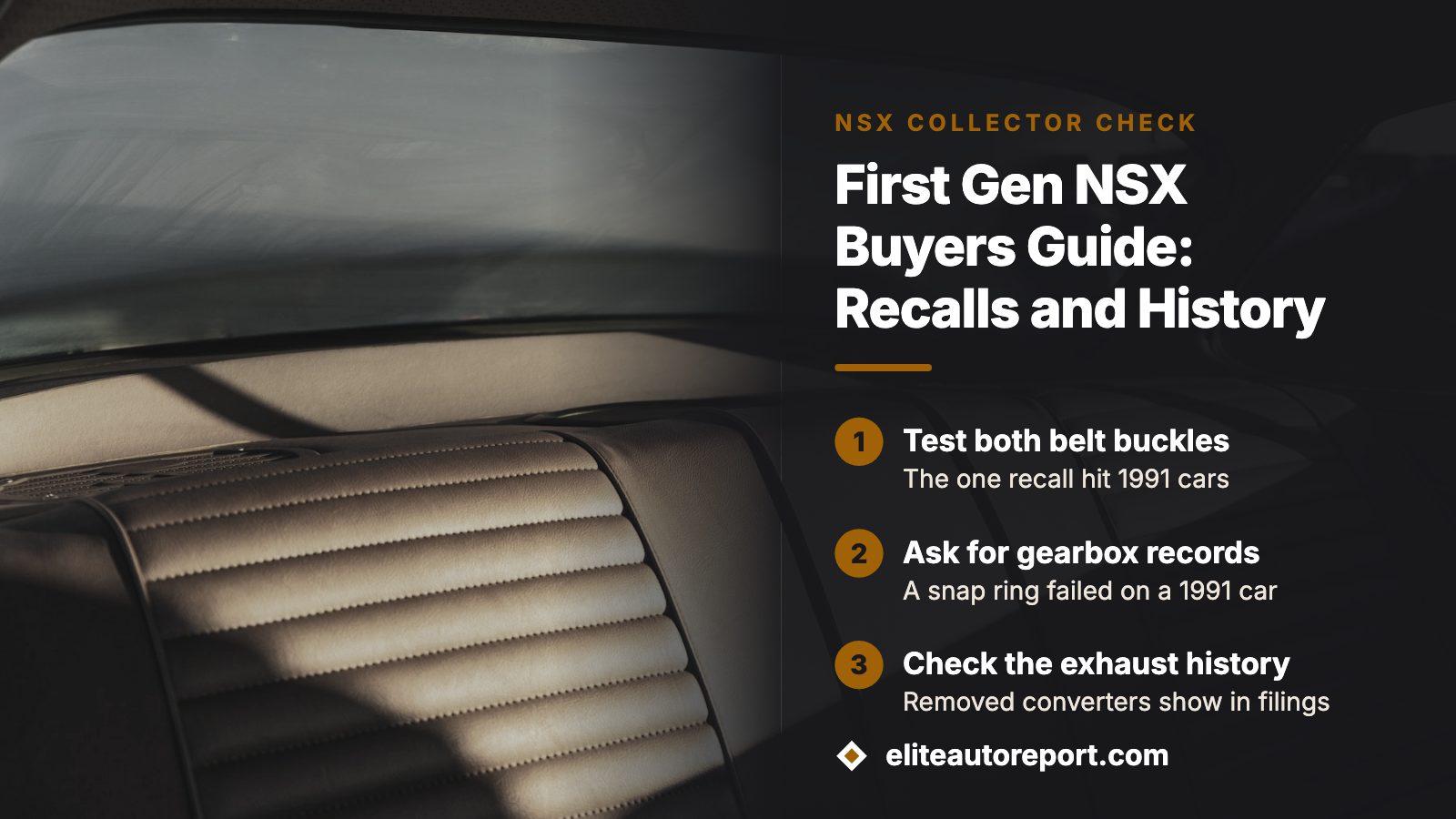
NHTSA lists one recall for the first-generation NSX, a 1995 seat belt buckle campaign on the 1991 model year, and 9 owner complaints across 1991 to 2005. Brakes, tires, a transmission snap ring and removed catalytic converters appear in those filings. Treat the clean record as a starting point, then check the car's title brands, auction photos and odometer history by VIN before you pay.
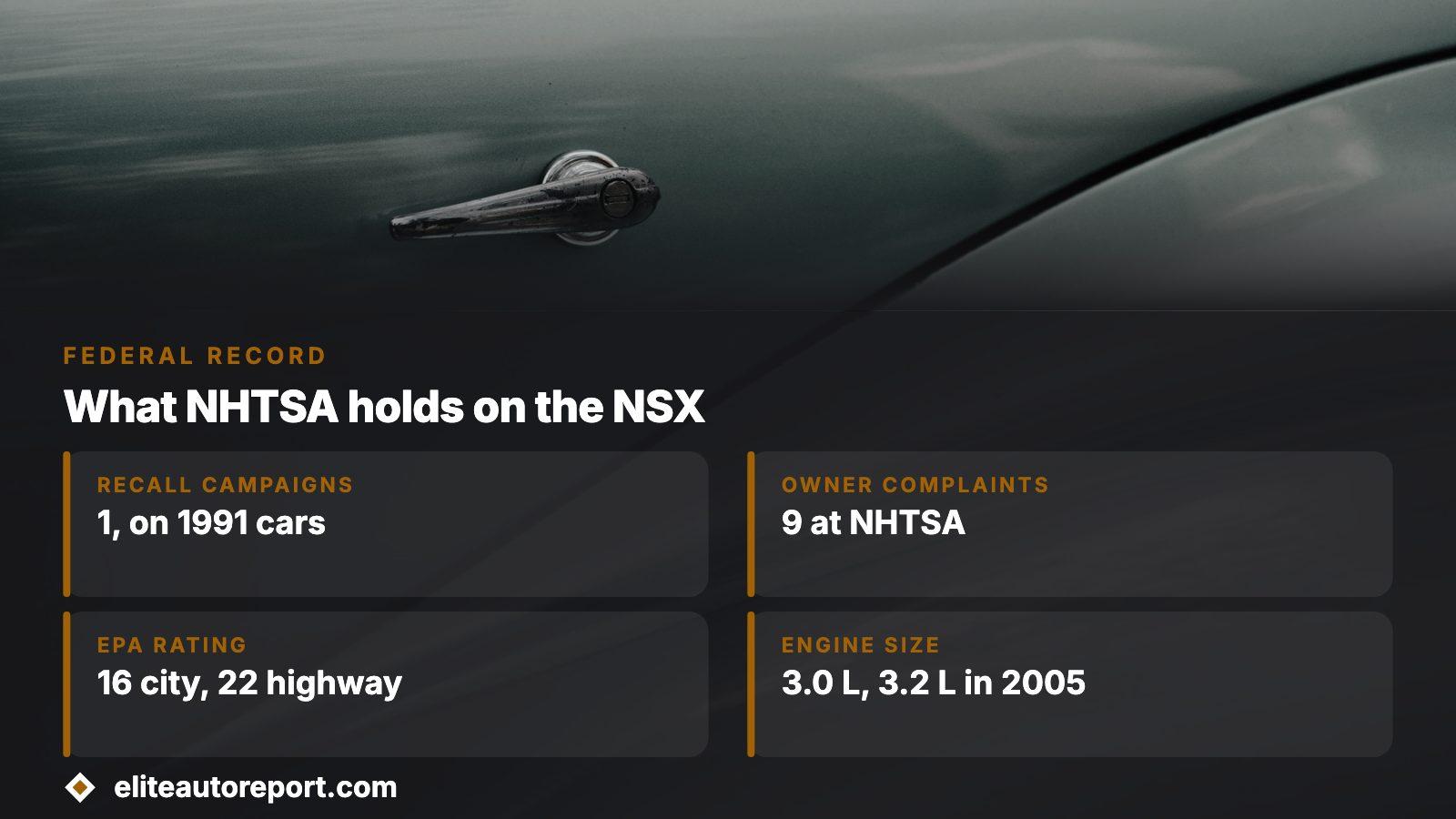
- NHTSA recall campaigns, 1991 to 2005
- 1, on 1991 cars
- Owner complaints, 1991 to 2005
- 9 at NHTSA
- EPA rating, 1991 and 2005
- 16 city, 22 highway, 18 combined
- Engine size
- 3.0 L, 3.2 L on the 2005 manual
What the federal record says about the original NSX
I queried NHTSA's recall and complaint APIs for every model year from 1991 through 2005 under the make Acura and the model NSX. The result is unusually quiet. One campaign exists, and it sits on the 1991 year. Every later year, 1992 through 2005, returned no recall at all.
Complaints are quiet too, with 9 filings in the whole span. Five belong to 1991, two to 1992 and one each to 1994 and 2001. A small number can flatter a rare car, because few owners file and many problems get fixed privately. Read the count as a sign that nothing alarming is on the public file, not as proof that every example is sound.
The second-generation car, sold from 2017, has its own recalls and does not belong in this comparison. Everything here concerns the original coupe.
Two engines, one fuel economy figure
EPA's fueleconomy.gov lists the 1991 car with a 3.0 L six-cylinder and a choice of 5-speed manual or 4-speed automatic. The 2005 listing shows a 6-speed manual with a 3.2 L six, while its automatic stays at 3.0 L. Every one of those versions carries the same rating: 16 city, 22 highway and 18 combined, on premium gasoline, as a rear-drive two-seater.
- Early cars (1991 on): 3.0 L, five-speed manual or four-speed automatic.
- Late cars (2005): 3.2 L with the six-speed manual, 3.0 L with the automatic.
- Body style in NHTSA's decoder: coupe, built in Japan by Honda Motor Co., Ltd.
If a seller's listing quotes an engine that does not match the year, ask why before you do anything else.
The single recall, and why it still matters
Campaign 95V103001 was received by NHTSA on 24 May 1995 and applies to the 1991 NSX. The red plastic PRESS button on a front seat belt buckle could break, and loose pieces might drop inside the buckle so the belt latches badly. NHTSA says the belts would then give an occupant inadequate protection in a crash. The belts in question were made by Takata.
| Item | What NHTSA lists |
|---|---|
| Campaign | 95V103001, action number EA94035 |
| Model year | 1991 |
| Part | Front belt buckle release button |
| Owner check | Look for cracks in the red button, latch the plate, tug, then press and watch it pop out |
| Remedy | Dealer replaces or repairs the buckle free of charge |
A campaign this old rarely shows up in a seller's story. Open both front buckles yourself and test them. A cracked button on a cheap-looking repair is a quick fix, but it tells you whether anyone ever read the paperwork.
Complaints by model year
The nine filings cover tires, brakes, drivetrain and emissions. Two 1991 owners described tires wearing early, and the 1995 filing says that wear led to a loss of control and a crash. A 1992 owner reported hydroplaning and a slide. Two more 1991 owners wrote in March 1999 that the ABS modulator leaked pump metal into its reservoir, and a 1994 owner said the ABS stopped working and stretched the stopping distance.
| Model year | Complaints | Topics |
|---|---|---|
| 1991 | 5 | Tires, ABS modulator, transmission part |
| 1992 | 2 | Hydroplaning, removed catalytic converters |
| 1994 | 1 | ABS failure |
| 2001 | 1 | Engine oil leak, loose rear sticker |
| 1993, 1995 to 2000, 2002 to 2005 | 0 | Nothing filed |
Brakes recur, so ask what has been done to the ABS and whether the pump has ever been replaced.
A transmission part that failed on a 1991 car
From an NHTSA owner complaint
A 1991 NSX owner wrote to NHTSA in March 2019 about a grinding noise under normal acceleration. The cause turned out to be a broken snap ring inside the transmission, shown in the attached photo as hardened metal pieces. The owner said the maker declined a goodwill request and that nothing open at the recall desk applied to it. This is one owner's account, not an agency finding.
Take from it a plain buying rule: ask for the service history of the gearbox, and have a specialist listen to it on a test drive. The recall database will not warn you about this one, because no campaign exists for it. A mechanic who knows the model will tell you what is normal.
Removed parts and emissions trouble
One 1992 filing, from June 2000, says the catalytic converters had been taken off the car. Colorado required an emission test that the car could not pass, so the owner called it unfit for the road. It is a different kind of experience from a recall, and it fits how many enthusiast cars live: someone modifies them, someone else inherits the problem.
From an NHTSA owner complaint
A 1992 NSX owner told NHTSA in 2000 that the converters were gone and the state emission test therefore could not be completed. The car, in the owner's words, was "not road worthy" until that was solved. The filing does not say who removed the parts or what the fix cost.
Inspect the exhaust for pipes that do not look factory, and ask whether the car has passed a recent emissions inspection where your state requires one.
Match the VIN to the car in front of you
The 17-character VIN on a first-generation NSX begins with JH4, which NHTSA's decoder ties to Acura and Honda Motor Co., Ltd. Position ten carries a letter for the build year, and M stands for 1991. One owner complaint on file carries the pattern JH4NA1159MT for a 1991 car, and a partial decode of JH4NA1150MT returned an NSX coupe with a 3 L six from Japan.
The decoder complains about a check digit whenever you type only part of a VIN, so that message alone means little. A full VIN that decodes to a different model, or a year that disagrees with the title, deserves a direct question to the seller.
What a VIN history report adds to a collector car
Government files describe a model. A vehicle history report describes one chassis. For an NSX the useful parts are auction appearances and the photos taken at them, a salvage or flood label stamped on the title, how the odometer readings climb over time, and theft or insurer entries. NMVTIS, the federal title database, gathers its records from several places, including state motor vehicle offices, scrapyards and insurance carriers. One stated aim is to keep a damage label from disappearing when an owner retitles the car in a different state.
EliteAutoReport specializes in auction history and photos by VIN for luxury and classic cars, and you can look at a free preview first. If the preview convinces you, you pay once for the rest, and the cost is on the pricing page. Use it on a car you already like, before the deposit, not as a way to pick between listings.
Order of operations before you pay
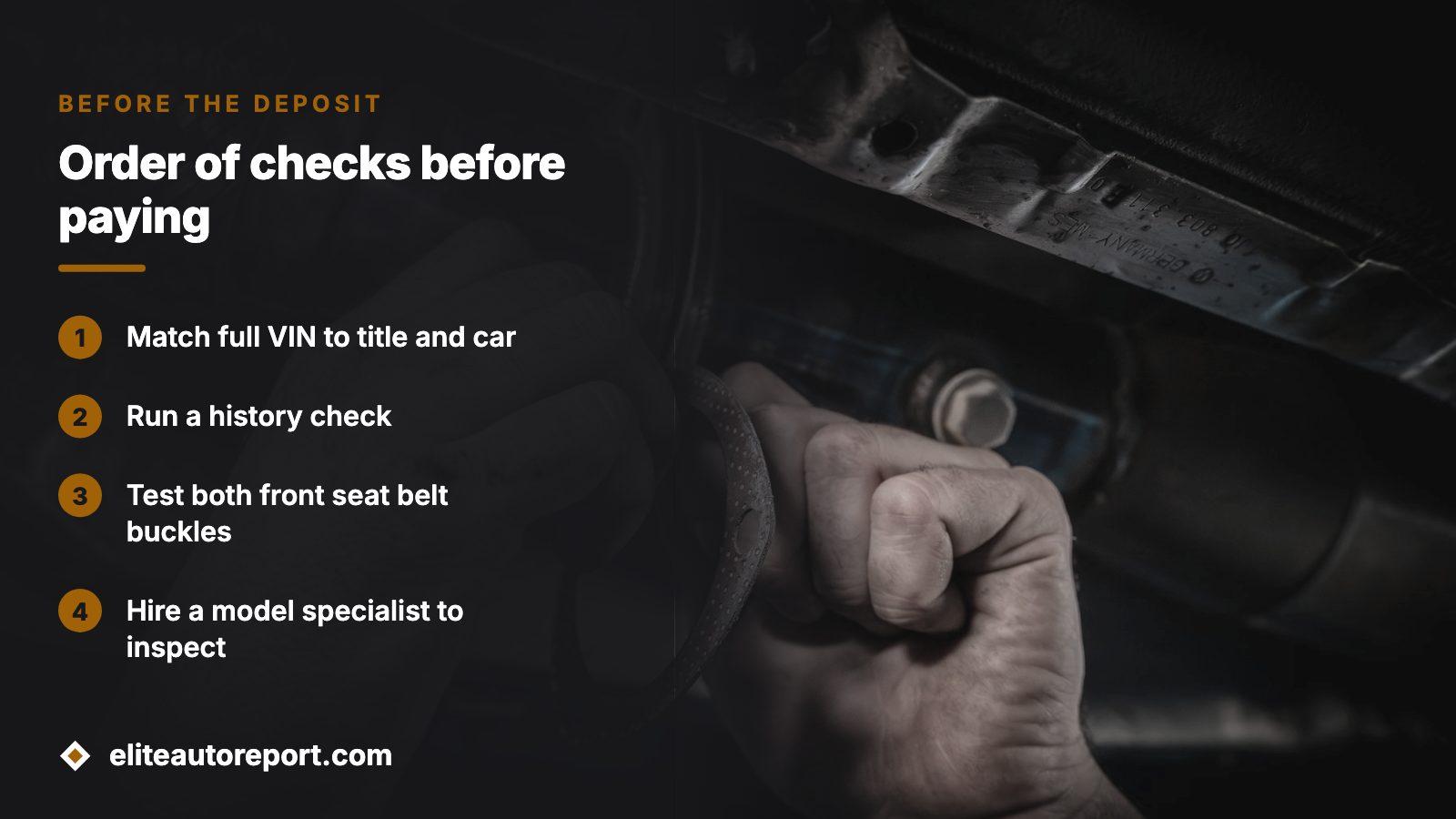
- Copy the full VIN from the car itself and from the title, and confirm they match.
- Decode it and compare the year, engine and country of build with the listing.
- Run a history check for title brands, auction photos and odometer readings.
- Test both front seat belt buckles, especially on a 1991 car.
- Ask for gearbox, ABS and exhaust records, not a general statement that it was maintained.
- Hire a model specialist to inspect it before the deposit leaves your account.
Where this information comes from
- NHTSA recalls API: 1991 Acura NSX — the seat belt buckle campaign and its remedy
- NHTSA complaints API: 1991 Acura NSX — owner complaint counts and topics by year
- NHTSA vPIC: VIN decoder API — how a partial VIN decodes to Acura NSX
- EPA fueleconomy.gov: 2005 Acura NSX — engine sizes and fuel economy ratings
- NMVTIS: information for consumers — what title and brand data a federal check holds
- NHTSA owner complaint 11187059 — owner experience, paraphrased
- NHTSA owner complaint 723439 — owner experience, paraphrased
Sources and photos: Facts checked against the sources above in November 2026. Photos by Brandon Russell, Martin Fennema and Anshul Gurjar on Unsplash; diagrams by EliteAutoReport.
Keep reading
- Acura NSX VIN Check: Auction Photos, Title Brands and Recallsrun the number on a specific NSX
- Classic Car Title Search by VIN: What Turns Up and What Doesn'tcheck the title side of an older car
- Car Auction Photos by VIN: Find Salvage Sale Pictures Before You Buysee how past auction photos help you judge condition
- Car Auction Results Database: Where Classic Car Results Liveunderstand where classic sales results come from
Frequently asked questions
Does the first-generation NSX have any recalls?
NHTSA lists one campaign for model years 1991 to 2005, number 95V103001, covering front seat belt buckle buttons on the 1991 car. Later years returned none. A short list does not rule out other problems, so check the car itself and its service records.
How many owner complaints exist for the original NSX?
I counted 9 across the original years: 5 for 1991, 2 for 1992 and one each for 1994 and 2001. The topics were tires, ABS, a transmission part, emissions equipment and an oil leak. Rare cars generate few filings, so absence is weak evidence.
What engine does a first-generation NSX have?
EPA lists a 3.0 L six-cylinder for the 1991 car and for the 2005 automatic. The 2005 manual lists 3.2 L. All versions carry a 16 city, 22 highway and 18 combined rating, and use premium gasoline.
Can a VIN check tell me if an NSX was in an auction?
A history report can show whether the VIN passed through an auction, along with photos and sale records where they exist. It cannot show repairs done privately or maintenance that was never recorded, so pair it with a specialist inspection.
Is the VIN check for an NSX free?
Only the preview costs nothing. Seeing more means paying once, nothing recurring, and the pricing page has the details. NHTSA's recall lookup and the federal NMVTIS pages are separate tools you can use on their own.
Now check the car itself
The guide explains what to look for. The report shows what this VIN has on record.