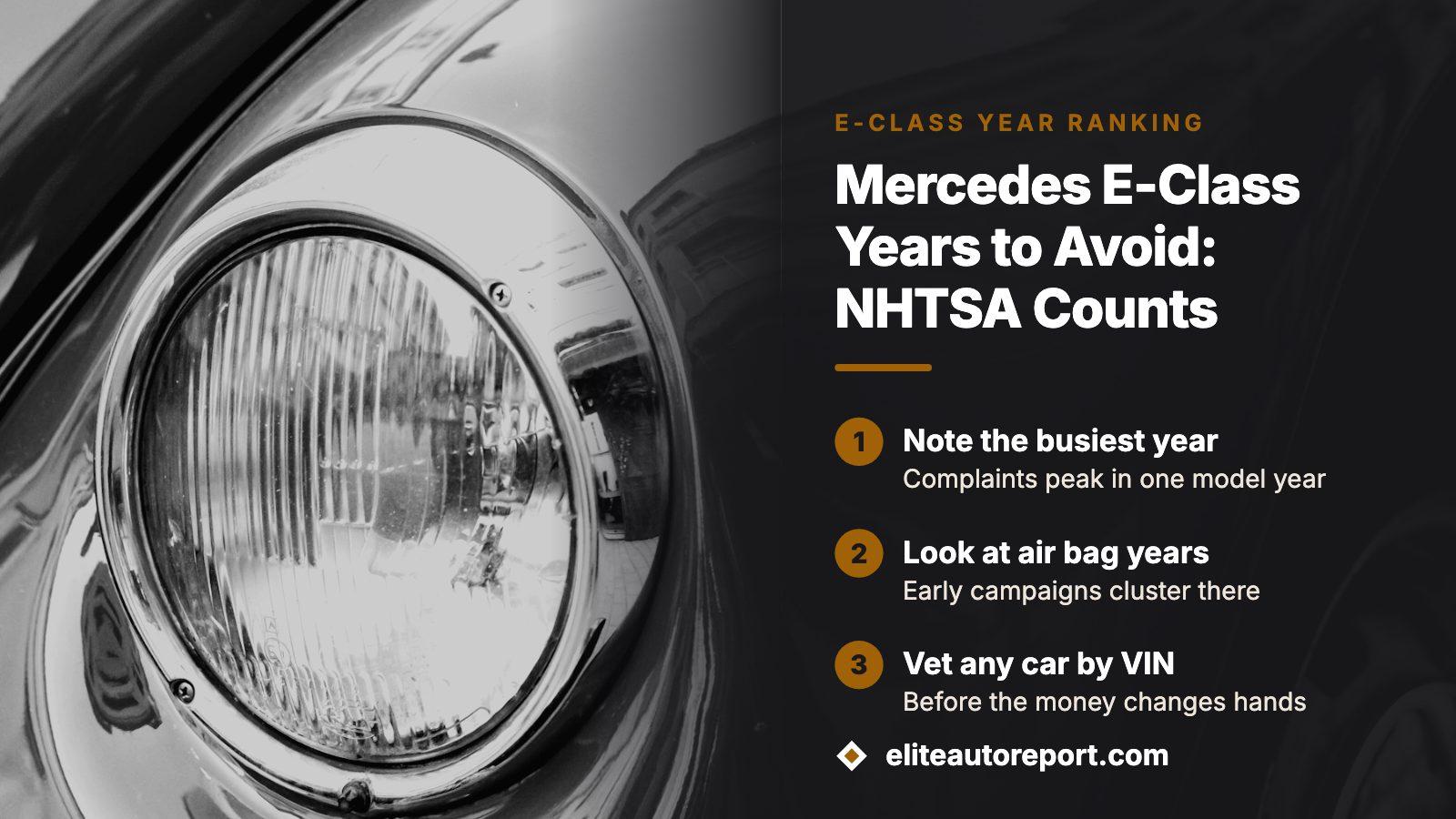
THE SHORT ANSWER
Pass on 2010 to 2014 unless the seller can show invoices covering inflator, subframe and brake line work. Air bags dominate the complaints for 2010 through 2013, and brake and electrical complaints climb in 2014. The 2015, 2016, 2018 and 2019 years are quieter, and 2017 sits in between at 167 complaints. Pull a VIN history on any of them first.
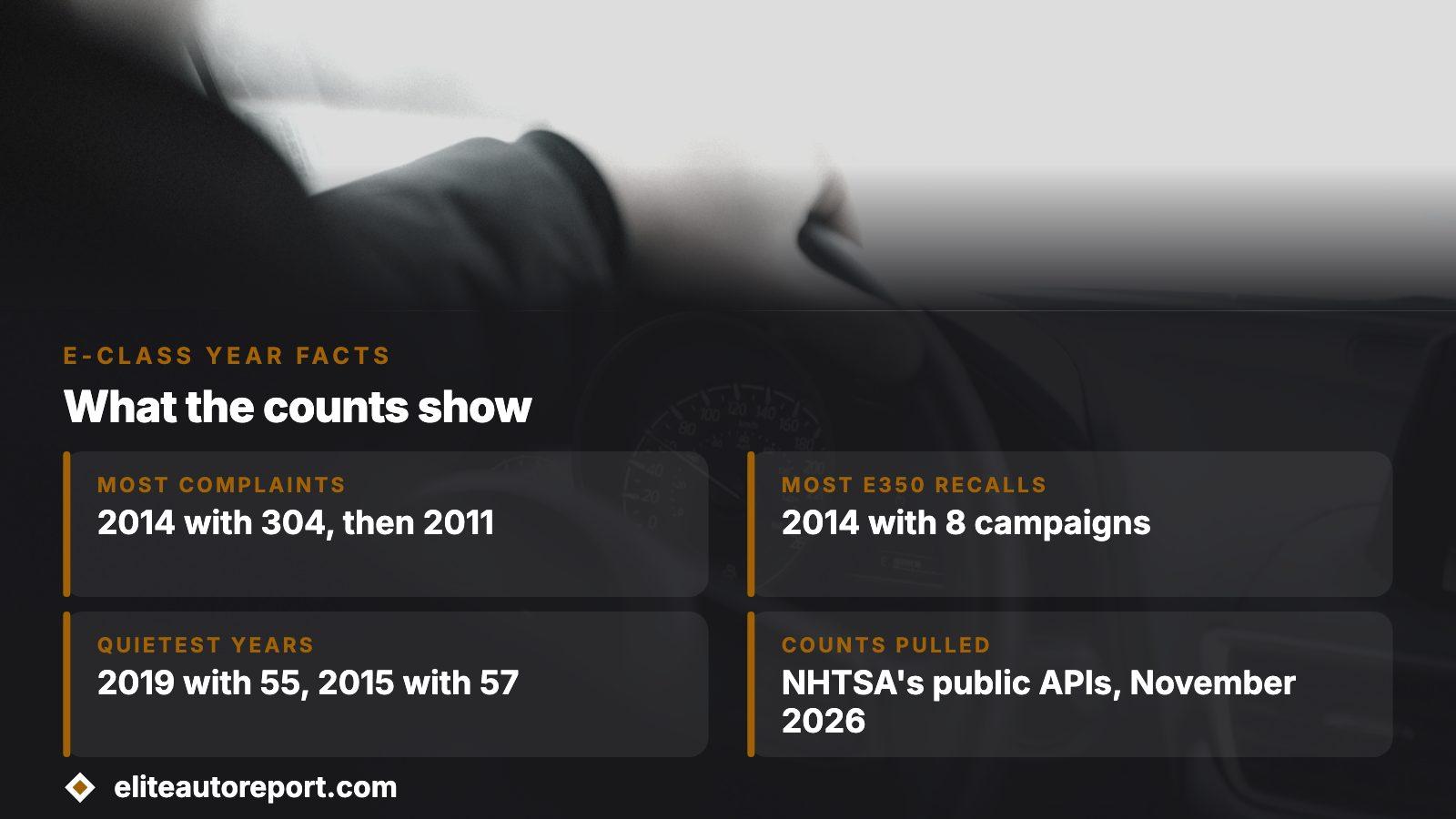
- Most complaints
- 2014 with 304, then 2011 with 296
- Most E350 recalls
- 2014 with 8 campaigns
- Quietest years
- 2019 with 55 and 2015 with 57 complaints
- Counts pulled
- From NHTSA's public APIs, November 2026
The years the numbers point away from
We went to NHTSA's public complaint and recall data and counted, model year by model year, for the E-Class sold in the United States from 2010 through 2019. Nothing here is a reliability survey or a repair-cost estimate. It is a count of what owners reported to the federal safety agency, plus the recall campaigns filed against the E350.
Five years stand out: 2010, 2011, 2012, 2013 and 2014. The three after them are calmer, and 2017 is a middle case. If you are shopping for a used E-Class, that split is a better starting filter than the sticker price or the trim.
Complaints by model year
These are owner complaints filed under the E-Class name. They keep growing as people file, so the older cars have had more time to pile them up. That caveat matters, yet the 2014 pile still dwarfs 2015 and 2016 even though only a year separates them.
| Model year | Owner complaints | E350 recalls |
|---|---|---|
| 2010 | 258 | 4 |
| 2011 | 296 | 5 |
| 2012 | 235 | 7 |
| 2013 | 188 | 6 |
| 2014 | 304 | 8 |
| 2015 | 57 | 6 |
| 2016 | 89 | 5 |
| 2017 | 167 | 0 |
| 2018 | 68 | 0 |
| 2019 | 55 | 0 |
The recall column covers only cars filed under the E350 name. E320, E550 and E63 cars are tracked separately, so a V8 or AMG car needs its own lookup.
2010 to 2013: the air bag years
Air bags carry the largest share of complaints on these cars. In 2011 the tag appears on 141 of the 296 complaints, in 2010 on 100 of 258, in 2012 on 92 of 235 and in 2013 on 56 of 188. A single complaint can carry more than one tag, but the pattern is plain.
The recall record backs it up. Campaigns 16V081000 and 16V363000 cover the driver and passenger inflator modules on 2010 and 2011 E350s, and 21V638000 reaches 2011 through 2014 cars. Campaign 12V557000 is a gasoline fuel system recall on 2011 and 2012 cars.
From an NHTSA owner complaint
An owner of a 2011 E-Class reported that the passenger headrest shot forward with no impact, then the driver's headrest did the same days later, and wrote that other owners had seen it too. If a seat or restraint warning lamp glows during your drive, make it a bargaining point.
Corrosion and brake lines on early cars
Suspension tags show up on 44 of the 2010 complaints and 37 of the 2011 ones, and several describe rust underneath. One 2010 E350 owner said the brake pedal went down and the car did not slow as intended; a mechanic then found a fractured brake line eaten by corrosion. The driver steered clear of a curb and the car went to a dealer.
From an NHTSA owner complaint
The owner of a 2014 E-Class described a rusted rear subframe, corroded rear brake lines and fuel dripping from a rusted steel line, all by roughly 105k miles. A minor blaze followed when yard crews touched the soaked ground, and the dealer proposed replacing the subframe.
Those are two cars, not a verdict on every E-Class. They do tell you where to look: lift the car, inspect the subframe and brake lines, and ask for repair invoices before you talk price. Cars from road-salt states deserve the closest look.
2014: the busiest year on record
No year draws more complaints than 2014, at 304, and no E350 year has more recall campaigns, at 8. Air bags drop to 58 here, while service brakes rise to 55, electrical to 41, suspension to 31 and steering to 29. Fire is flagged in 15 of the complaints, more than in any other year we counted.
- Campaign 17V627000 on the frontal air bag, shared with 2012 through 2016 cars
- Campaign 17V177000 on electrical software, also on 2012 through 2016 cars
- Campaign 16V899000 on electric power steering assist, covering 2014 through 2016
- Campaign 15V792000 on fuel delivery, filed against 2014 specifically
A 2014 with every campaign closed and clean service records can still be a good car. An unchecked one is the riskiest purchase in this group.
2015, 2016, 2018 and 2019 look calmer
The E-Class drew only 57 complaints for 2015, 89 for 2016, 68 for 2018 and 55 for 2019. Those same years carry fewer recalls: 2015 and 2016 show 6 and 5 campaigns, and 2017 through 2019 show none under the E350 name. Younger cars simply had fewer years for owners to report, so treat this as a lean rather than a promise.
The 2017 year is the odd one out. It has no E350 recalls but 167 complaints, with engine the top tag on 40 of them, followed by electrical on 28. If you are looking at a 2017, read its complaint list on NHTSA before you buy.
Vet any E-Class by VIN before you pay
Luxury sedans from these years often pass through dealer trade-ins and auctions. A VIN check on EliteAutoReport can show whether this exact car was sold at auction, what the sale photos looked like, and whether a state has branded the title. Those are things a complaint count cannot tell you.
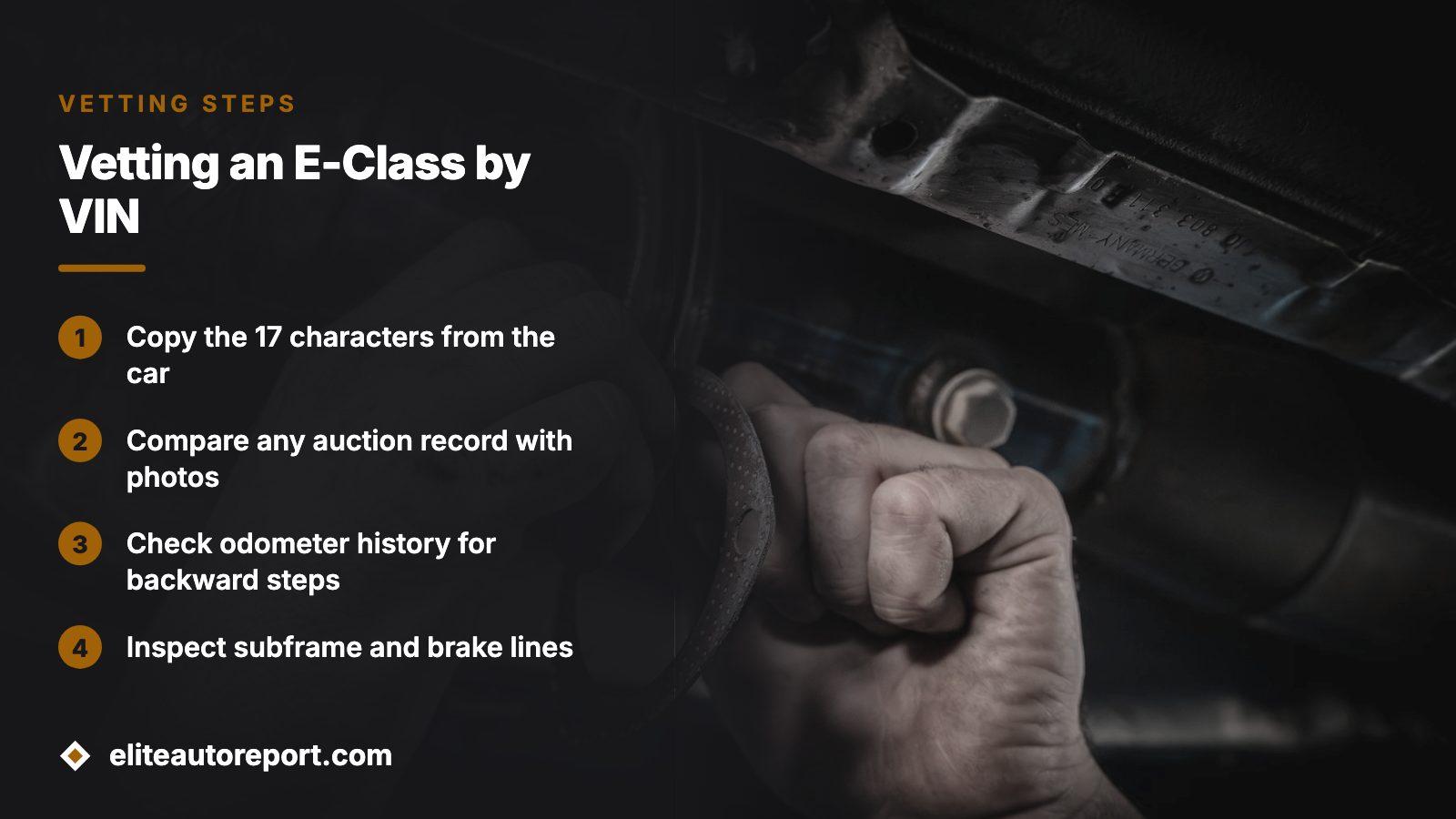
- Copy the 17 characters from the windshield corner or the driver's door post and run the free preview
- Look for an auction record with photos and compare the damage to the car in front of you
- Check the odometer history for any step backward
- Enter the VIN at NHTSA and get the seller to show dealer paperwork for every campaign marked open
- Lift the car and inspect the subframe and brake lines
The preview costs nothing to view. Buying the detailed report is one transaction, with amounts shown on the pricing page.
Where this information comes from
- NHTSA complaints API: Mercedes-Benz E-Class — source of the complaint counts and component tags by model year
- NHTSA recalls API: Mercedes-Benz E350 — source of the recall campaign counts and numbers
- NHTSA owner complaint 11749054 — owner experience, paraphrased
- NHTSA owner complaint 11643335 — owner experience, paraphrased
- NHTSA owner complaint 11753259 — owner experience, paraphrased
- NMVTIS: vehiclehistory.gov — the federal title information system, for the title-check step
Sources and photos: Facts checked against the sources above in November 2026. Photos by Rafał Karoń, Martin Fennema and Miles Loewen on Unsplash; diagrams by EliteAutoReport.
Keep reading
- Mercedes C-Class Years to Avoid, Ranked by NHTSA Complaint Countsthe same count for the smaller sedan
- Most Reliable Mercedes-Benz Models: What NHTSA Owner Data Showswhich Mercedes models hold up best
- Mercedes-AMG VIN Check: Auction Photos, Titles and Recallswhat to check on an AMG car before buying
- Salvage Exotic Cars: How to Check One by VIN Before You Bid or Buyhow luxury cars end up with branded titles
Frequently asked questions
Which Mercedes E-Class year has the worst record?
By NHTSA counts, 2014 is the heaviest year, with 304 owner complaints and 8 E350 recall campaigns. The year 2011 follows closely with 296 complaints, mostly tagged to air bags. Neither is a guaranteed bad car, but both need full service and recall records before you buy.
Which E-Class years are the most reliable?
The quietest years in NHTSA data are 2019 with 55 complaints, 2015 with 57 and 2018 with 68. Complaint counts are not a reliability survey, and recent builds have had fewer years in which owners could report, so use them as a filter and still inspect the car.
Are E-Class recalls a reason to walk away?
Not on their own. A recall that was closed at a dealer is a repair done for free. The risk is a car with open campaigns or no proof of completion. Run the VIN through NHTSA's lookup, then ask the seller for the dealer paperwork.
Does this count include the E550 or E63?
The complaint counts use the E-Class name and cover the line broadly. The recall counts come from the E350 name only. E320, E550 and E63 cars are filed under their own names, so look those up separately.
Will a VIN lookup show that a used E-Class went through an auction?
Yes, where the sale was recorded. A VIN check can show an auction sale with photos, a title brand and the odometer readings over time. Start with the preview and let what it shows decide whether that particular car merits the full report.
Now check the car itself
The guide explains what to look for. The report shows what this VIN has on record.