THE SHORT ANSWER
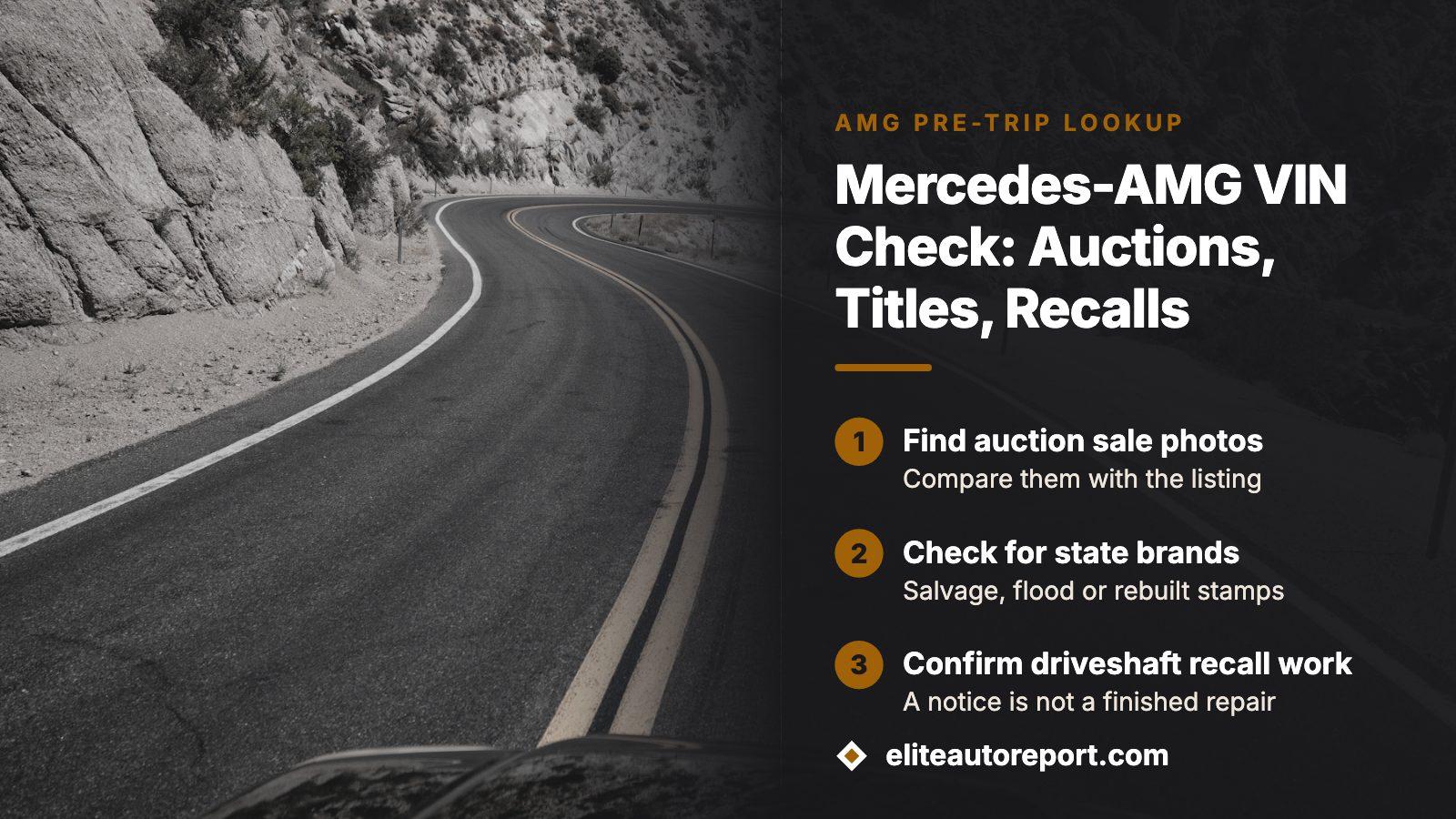
Before a road trip to view an AMG, a lookup should answer four things: was it sold at a salvage or dealer auction (and are there photos), has a state stamped it salvage, flood or rebuilt, does the mileage only ever climb, and are recalls still open. Seeing the preview costs nothing; the detailed report is bought once, on its own.
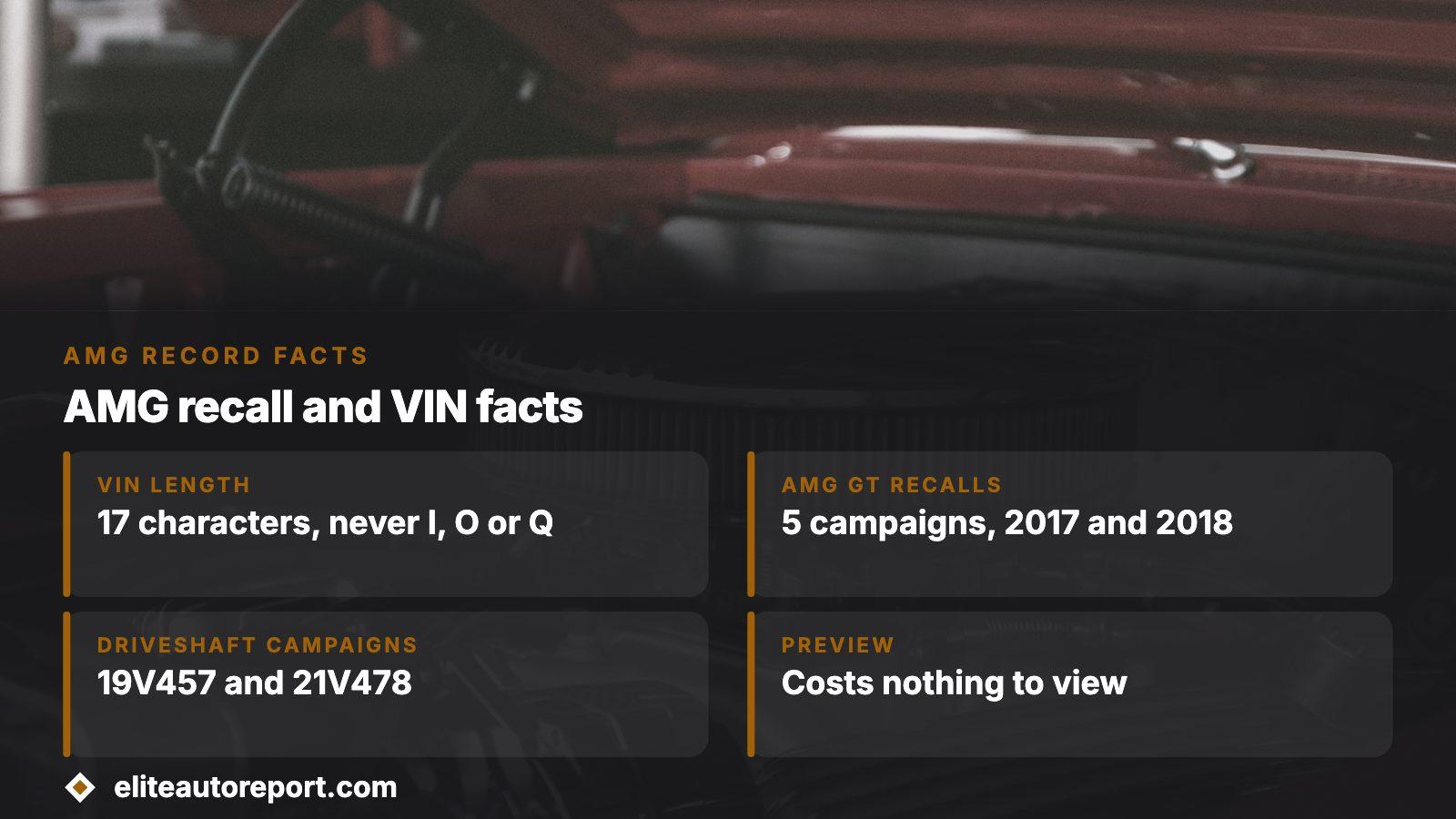
- VIN length
- 17 characters, never I, O or Q
- AMG GT recalls
- 5 campaigns on the 2017 and 2018 model years each
- Driveshaft campaigns
- 19V457 in 2019 and 21V478 in 2021
- Cost
- Free preview, then one payment
Why a fast Mercedes deserves a closer look
AMG cars are bought for what they do at speed, which is why their past matters. A twin-turbo sedan that spent a summer at track days, or a coupe that was written off after a wet-road spin, can come back to market looking spotless. Our angle at EliteAutoReport is auction history, so we start there: if the car was ever sold through a salvage or dealer auction, the entry and its photographs are the first thing you should see.
Sale photos are the most honest record a car has. They predate any body shop work, so a crumpled quarter or a wet cabin appears as it was.
- Auction listings with sale photos, where the car appeared in one
- Brands on the title, with the issuing state
- Dated odometer readings, so a stall or a drop stands out
- Theft and insurance total-loss entries
- Open recalls tied to that exact car
Reading the VIN off an AMG
Federal rules require the number to be readable from outside the car, looking in at the lower corner of the glass by the driver's pillar in daylight. That means you can often collect it without opening a door. Get a seller's photo of that corner plus one of the door-frame sticker, and compare each against the title and registration.
Count the characters. There should be 17, with a check digit in position nine, and three letters (I, O and Q) are barred outright. An advert showing one of them has a typo. If the dash and the paperwork disagree on even one character, stop and ask why.
A mismatch matters more on a car like this one. Federal title guidance describes cloned vehicles, stolen cars wearing a number lifted from a legitimate car of the same make, model and year. One investigation recovered about 250 of them.
What NHTSA has filed against the AMG GT
AMG is a performance division, and NHTSA files most of its cars under the regular model name, such as C-Class or E-Class. The AMG GT is the one with its own entry, so I pulled it for each model year from 2016 through 2020. The counts were 2 for 2016, 5 for 2017, 5 for 2018, 2 for 2019 and 4 for 2020. Several later ones are software or lighting items; the early ones are not.
| Campaign | Model years named | Problem | Remedy |
|---|---|---|---|
| 19V457 | 2016-2017 GTS, 2017 GT | Carbon-fiber driveshaft bond to the flange may be weak | New driveshaft with flange |
| 21V478 | 2016-2018 GT | Same driveshaft bonding concern | Inspect, replace as needed |
| 17V826 | 2018 GT, GT S, GT C, GT R | Seat belts can bind in their guides | Reconfigure belt guides |
| 18V208 | 2018 GT, GT C | Driver air bag inflator housing may be defective steel | Replace the air bag module |
| 20V775 | 2020 GT | Headlights may be aimed too high | Check and correct the aim |
Others exist, such as an occupant sensor update and an air bag software fix for 2018 convertibles. A report tied to the VIN is the quick way to learn which ones were carried out on the particular car you are considering.
The driveshaft that was recalled two times
The same part shows up in two separate filings. Mercedes-Benz USA reported the first on June 14, 2019, and replacements began on November 4, 2019. The second was received on June 25, 2021, with owner letters mailed on October 15, 2021. The second one covers an extra model year and tells dealers to inspect first, then swap the shaft where needed. NHTSA's wording on the consequence is blunt: a separated driveshaft means loss of drive power and a greater risk of a crash.
From an NHTSA owner complaint
A 2016 owner told NHTSA that two or three loud pops came from the car on an interstate, then it lost power and would not move. A dealership said the two-piece driveshaft had come apart. The owner added that the dealer called the recall closed and refused the repair, and felt lucky no other traffic was close.
Take from this that a recall number in a listing is not proof of a finished repair. Request the dealer invoice proving the shaft was replaced, then compare it with the open-recall line in the report.
When the notice arrives but the part does not
From an NHTSA owner complaint
Another 2016 owner got the 2021 driveshaft notice, took the car in, and had the dealer confirm the shaft needed replacing. Both the dealer and the maker said no parts existed yet. No failure had occurred, though the owner felt the delay was unreasonable.
A car can carry an open campaign for months through no fault of its owner, and a buyer inherits the wait. If a report shows an open driveshaft recall, treat the price as the starting point for a talk about who pays for downtime, not as a deal-breaker.
Brands, flood cars and odometer trails
A brand is a state's description of what a car is or was: junk, salvage, flood and so on. The federal title database collects these from state agencies, recyclers, salvage yards and insurers, and the brand follows the car when it is retitled somewhere else. The Justice Department's consumer page recalls flooded cars hauled out of one state after a hurricane and sold in states that did not brand flood damage. Saltwater makes electrical systems, air bag sensors included, more likely to fail, and an AMG is full of electronics.
- A salvage entry followed by a clean title issued in another state
- Sale photos showing body damage the listing never mentions
- A reading that falls, or a long silence ending in a smaller figure
- A theft or total-loss line missing from the seller's story
- An open recall on a car described as fully serviced
A clean result is not a guarantee. The same federal page admits coverage is incomplete and a search can miss history, so the report supports an inspection by an AMG specialist and never replaces it.
Low miles do not prove a healthy drivetrain
NHTSA has only a handful of owner complaints for the AMG GT, six for 2016 and one for 2017, so I would not read a pattern into the numbers. One of the 2016 entries is still useful as a caution. The owner described losing motive power several times, hearing grinding from the engine bay, and being told the transmission needed replacing. The car was not repaired, and the failure came at roughly 55,000 miles.
Use it as a prompt for questions, not as a verdict. Compare the mileage on the dash with the dated readings in the report, ask for service invoices for the transmission and driveline, and have a specialist inspect it on a lift before paying.
Cost, and the order to do things in
Entering the VIN produces a preview at no charge, enough to see whether records exist. The full report is one payment, available singly or in bundles for anyone weighing several cars. Nothing renews. The pricing page carries the amounts, so none appear here.
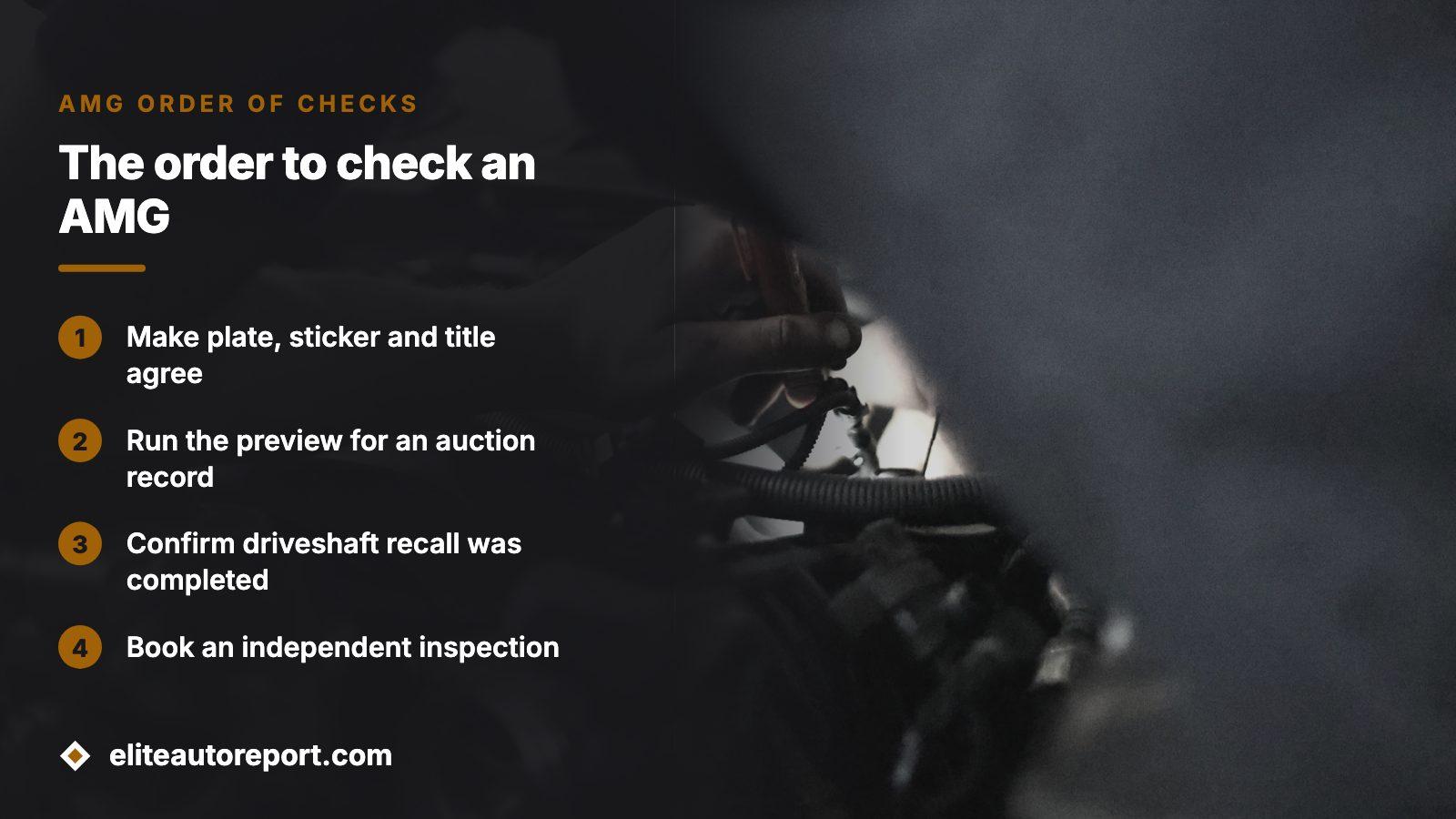
- Make the dash plate, the door sticker and the title agree
- Run the preview and look for an auction record
- Buy the report if one exists and read the photos against the listing
- Confirm any driveshaft or air bag recall was completed
- Book an independent inspection before you pay
Where this information comes from
- NHTSA recalls API: 2017 AMG GT — driveshaft campaigns and their dates
- NHTSA recalls API: 2018 AMG GT — seat belt, air bag and cabrio campaigns
- NHTSA owner complaint 11406344 — owner experience, paraphrased
- NHTSA owner complaint 11482052 — owner experience, paraphrased
- eCFR: 49 CFR 565.13 VIN requirements — length, check digit, letters and location of the number
- NMVTIS: information for consumers — what brands are, cloning and flood examples
Sources and photos: Facts checked against the sources above in November 2026. Photos by Will Truettner, Mustafa Sheikhmouss and Victor Hughes on Unsplash; diagrams by EliteAutoReport.
Keep reading
- Car Auction Photos by VIN: Find Salvage Sale Pictures Before You BuyHow to find and read the sale photos tied to a VIN.
- BMW M3 VIN Check: Auction Photos, Titles and Recalls by YearThe same check for AMG's German rival.
- Porsche 911 VIN Check: Auction Photos, Titles and RecallsA lookup for another high-performance coupe.
- Copart Damage Types: What a Lot's Damage Label Really Tells YouWhat the damage labels on a salvage listing mean.
Frequently asked questions
Does an AMG VIN lookup show crash damage?
Only indirectly. An auction sale with photos, an insurance total loss or a salvage brand can all point to a crash. Damage fixed privately, with no insurer or auction involved, leaves no record, so pair the report with a physical inspection of panel gaps, paint and the underbody.
Will it show open recalls on an AMG GT?
Yes, recalls that apply to that number are listed. NHTSA has campaigns across the 2016 to 2020 model years, including two for the carbon-fiber driveshaft, so confirm with paperwork that the replacement was actually carried out on the car you want.
Can I search an AMG by owner name or plate?
No. The check works from the 17-character VIN and reports on the vehicle, not on the person who owns it. A plate alone will not do: ask the seller for the number, or read it from the paperwork or an insurance card, then run that.
Is the AMG preview really free?
The preview carries no charge and only shows whether records exist for that number. The whole report is a single payment and nothing recurs. For today's amounts, single or bundled, see the pricing page.
Do I still need an inspection after a clean report?
Yes. Records only capture what was reported, and federal guidance warns that history can be missing from a search that looks clean. A specialist who knows AMG drivetrains and suspension will find things no database can.
Now check the car itself
The guide explains what to look for. The report shows what this VIN has on record.