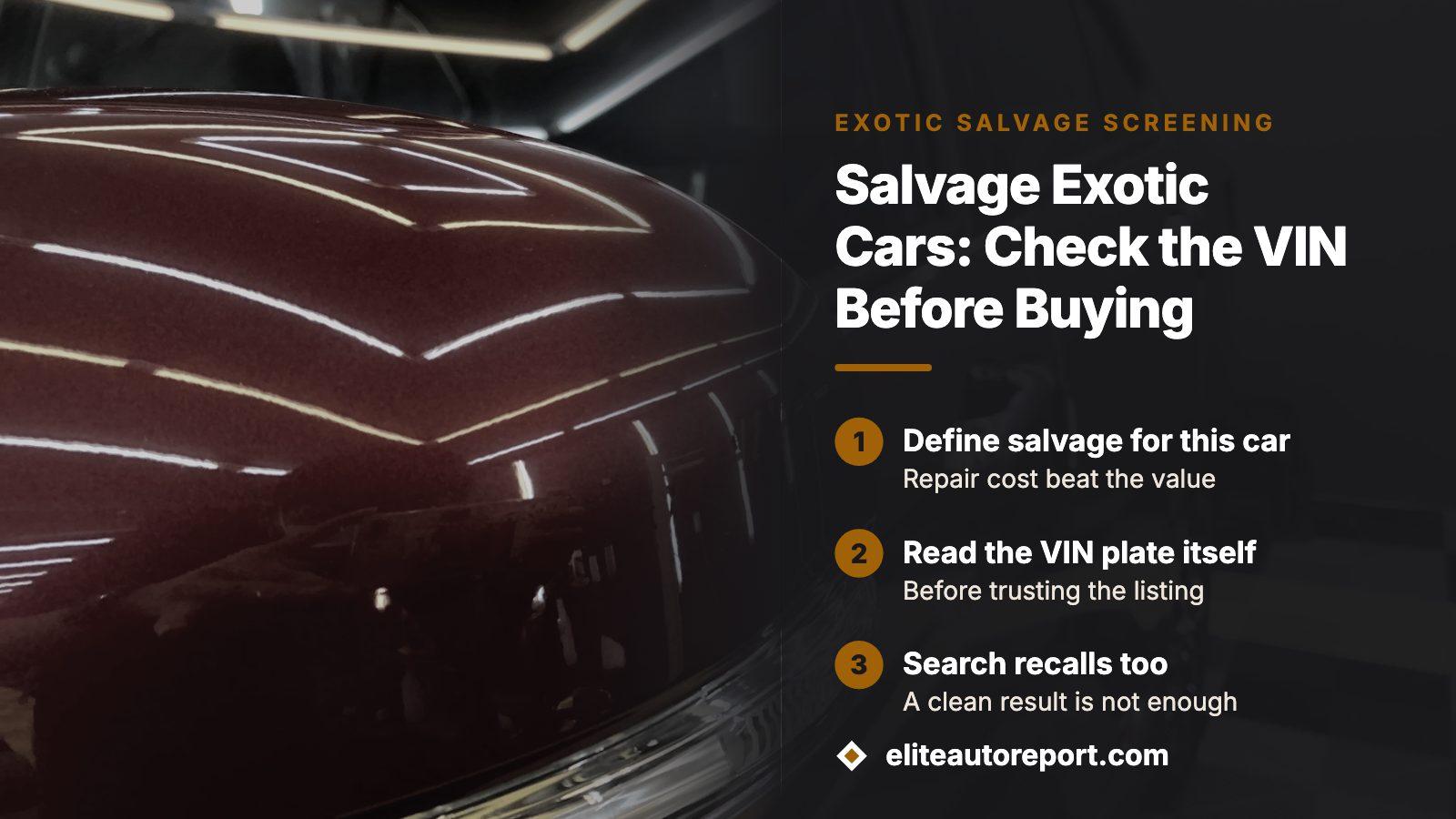
THE SHORT ANSWER
Treat a salvage exotic as a car you must prove, not one you trust. Take the VIN from the vehicle, search it, and look for the insurer's total-loss entry, the auction sale with its yard photos, any rebuilt brand and the odometer history. Then pay for an inspection by a specialist. The preview shows what exists on record; upgrading to the full report afterward is optional and happens once.
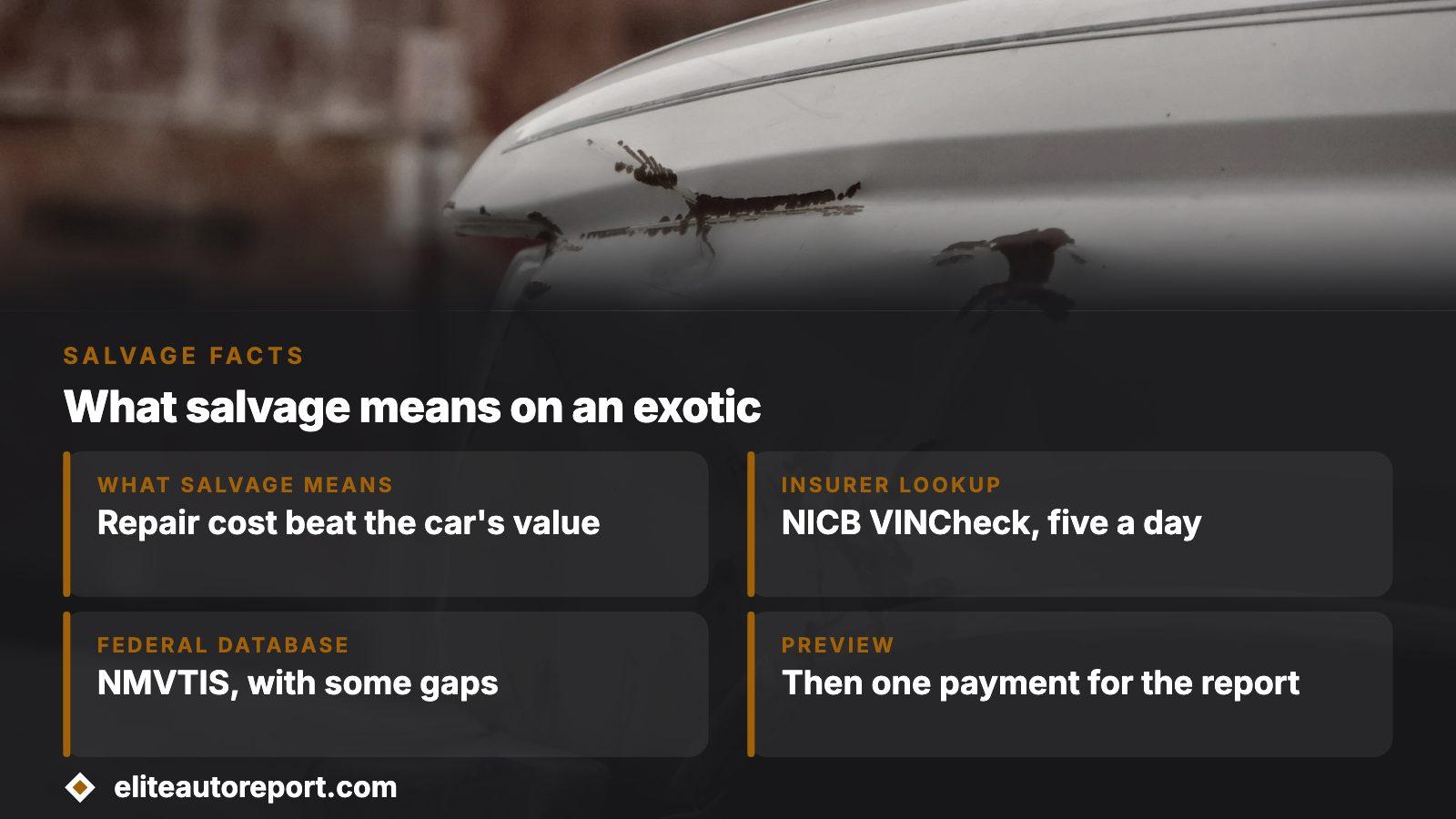
- What salvage means
- An insurer judged repair cost too high against the car's value
- Free insurer lookup
- NICB VINCheck, five searches per IP address daily
- Federal title database
- NMVTIS, with gaps while some entities do not report
- Preview on this site
- Free, then one payment for the report
What salvage means when the car is a Ferrari or a Lamborghini
The label has nothing to do with the badge. Under NICB's definition, salvage means the insurer decided repairs would cost more than a set percentage of the car's value, so it paid out the claim and skipped the repair. IAA, a large salvage auction operator, says much the same and adds that stolen or abandoned cars can receive the brand with little damage, depending on state rules. So a salvage exotic may be a crushed nose, a flooded cabin or a recovered theft that never had a scratch.
That spread is the reason to look at the record rather than the label. Identical brands can hide a bargain or a trap, and only the dated entries, the photos and the paperwork tell you which one you are standing next to.
Where the evidence sits and who can see it
No single database holds everything about a written-off car. Each source below answers a different question, which is why a careful buyer uses more than one.
| Source | What it can tell you | Limit to remember |
|---|---|---|
| NMVTIS (Justice Department) | State brands, insurer total-loss decisions, transfers to salvage or recycling yards, recent odometer readings | A search can come back falsely clean while reporting is incomplete |
| NICB VINCheck | Theft and salvage claims filed with member insurers | Insurance records only, and NICB says not to rely on it alone |
| Auction records on a full report | The sale itself and the photos taken at the yard | Covers sales that were recorded, not every private repair |
| NHTSA recall search | Open safety campaigns for that VIN | Says nothing about past damage |
Read the VIN plate on the exotic before trusting the listing
Read the number off the vehicle itself, through the glass at the lower corner beside the steering wheel, then check it against what the title and registration say. Ads contain typos, and numbers that disagree between car and papers are a finding on their own. Enter the full 17 characters in the search field and the preview opens before you decide to buy anything.
The opening three characters identify the manufacturer, and NHTSA's decoder lists a few codes for each exotic brand. If the start of the VIN does not fit the badge on the trunk, stop there.
| Maker | Codes in NHTSA's decoder |
|---|---|
| Ferrari | ZFF, ZFD, ZSG |
| Lamborghini | ZHW, ZA9A12, ZPB |
| Maserati | ZAM, ZC2, ZN6 |
| Aston Martin | SCF, SD7 |
| McLaren | SBM |
| Bentley | SCB |
| Lotus | SCC, LJU |
Reading the auction photos and the fine print around them
Photos from the sale are the closest thing to a witness. Compare the damaged corner with the car you are inspecting: panel gaps, paint texture, replaced lights and a freshly cleaned engine bay are the places a rushed repair shows. The listing carries its own warning, though. IAA's rules say images are not meant to show the full condition, that hidden frame, suspension, electrical or water damage may exist, and that the buyer should verify title type and brand before repairing.
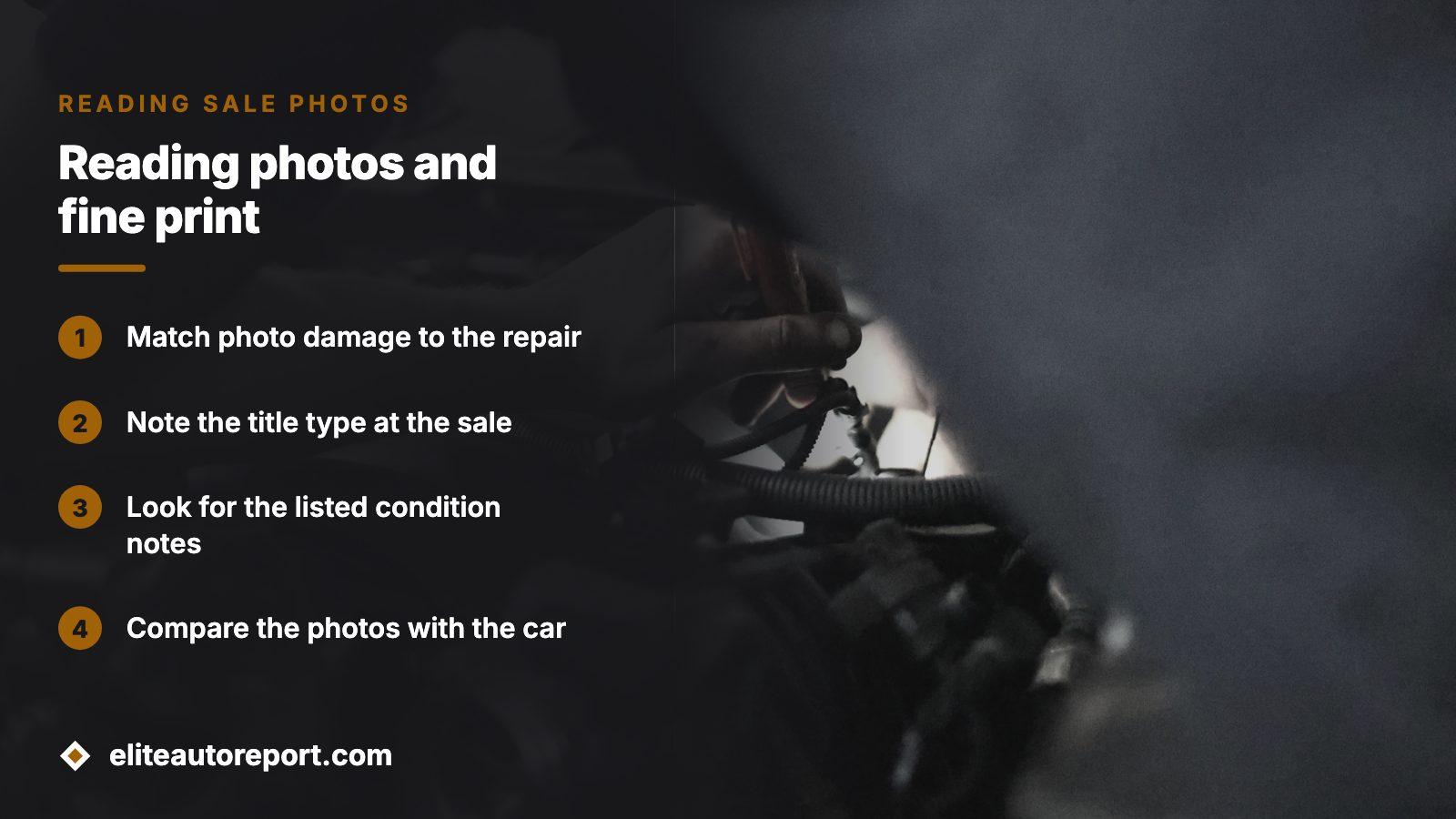
- Match the damage zone in the photos to the repaired area, panel by panel
- Note the title type shown at the sale and compare it with today's title
- Look for the listed odometer figure and compare it with later readings
- Treat missing photos as something to put to the seller
Mileage deserves its own pass
Low mileage drives the asking price of most exotics, so the readings matter. IAA says in its rules that it takes no responsibility for mileage or odometer discrepancies and suggests a history report to anyone who cares about the figure. Line up every reading the report holds. A sale at the yard that shows a higher figure than the dash does today, or a long gap with no readings between a wreck and a sale, deserves an explanation in writing.
When a clean result is not clean
The Justice Department is direct about this. Over half of states send data to NMVTIS, which leaves room for a search to show no junk or salvage history on a car that has one. Each state draws its own damage line, so the same repair invoice can bring a brand across one state line and not across another. Salvage-yard storage alone does not force a state to apply a brand.
What this means for you
A history report narrows the risk, it does not close it. If the record is silent but the paint, the panel fit or the seller's story is off, believe the car. A specialist who knows the model should inspect it, ideally on a lift.
Rebuilt titles, loans and state rules
Fixing the damage does not make the car road-legal again. According to IAA, every state writes its own path to a rebuilt or restored title, and loans may be off the table for salvage-title cars. A state can also change a title or brand after a purchase. Before bidding, read the motor vehicle agency's page for wherever you plan to register it, and ask what inspection the rebuilt brand requires.
- Confirm whether your state will register the car at all in its current brand
- Ask your lender and insurer in advance; some decline salvage or rebuilt cars
- Keep repair receipts and photos of the work, since they support a later sale
Do not skip the recall search
Exotics get recalls like any other car, and a neglected one can be the least maintained. NHTSA's database shows, for example, a Ferrari campaign covering 2010 to 2015 458 models and 2016 to 2019 488 models for a brake fluid leak, fixed at no charge by swapping the fluid reservoir cap and reflashing the software. It also shows a Lamborghini campaign for 2007 to 2009 Gallardo cars with carbon ceramic brakes, where rotor screws can fail after salt exposure. A write-off that sat outdoors for months is the sort of car where that matters. The preview lists open recalls for the VIN, and the fix itself is free at an authorized dealer.
What the check costs and what to do next
Seeing the preview costs nothing. If it shows a salvage entry or an auction sale and you want the photos and dated details, you pay a single time for the full report and nothing recurs. Current packs and amounts are on the pricing page.
- Pull the VIN off the Ferrari or Lamborghini and read the preview
- Buy the full report if the car has an auction or total-loss entry
- Run the free NICB VINCheck as a second view of insurer records
- Book a specialist inspection before you pay a deposit
- Walk away if any date, mileage figure or photo cannot be explained
Where this information comes from
- NMVTIS for consumers (U.S. Department of Justice) — what the federal title system covers and where its gaps are
- NICB VINCheck — free insurer theft and salvage lookup, with its daily limit and caveats
- IAA: clear and salvage titles — how an auction operator describes salvage titles, loans and rebuilt steps
- IAA auction rules — limits on listing photos, mileage and title details
- NHTSA vPIC VIN decoder — maker codes for the exotic brands listed
- NHTSA recalls — recall search by VIN and the example brake campaigns
Sources and photos: Facts checked against the sources above in November 2026. Photos by Clarence Tioh, Mustafa Sheikhmouss and Everett Pachmann on Unsplash; diagrams by EliteAutoReport.
Keep reading
- Copart Damage Types: What a Lot's Damage Label Really Tells YouWhat the damage labels on a salvage lot actually describe.
- Car Auction Photos by VIN: Find Salvage Sale Pictures Before You BuyHow to find and read yard photos for a specific car.
- Salvage Auction Title Codes: How to Read Them on a Luxury or Classic LotDecoding the title codes you will meet on a lot listing.
- Ferrari VIN Check: Auction History, Photos, Title and RecallsA model-specific check for a Ferrari you are considering.
Frequently asked questions
Are salvage exotic cars worth buying?
Sometimes, for a buyer with a specialist's eye and cash. The discount reflects real risk: hidden frame or electrical damage, harder financing, and a rebuilt brand that follows the car to every later sale. Read the record and the photos first, then pay for an independent inspection.
Can I see the original auction photos of an exotic?
Where the sale was recorded, yes. Run the VIN, and the preview will show whether an auction entry exists. The full report then holds the details and pictures. If no entry appears, it does not prove the car never sold, only that this record is not on file.
Does a clean NICB result mean the exotic was never totaled?
No. NICB itself says VINCheck is not a full history report. It reads participating insurers' theft and salvage records only, so an uninsured loss or a non-participating company's claim would not appear. Treat it as one free check among several.
Can a salvage exotic be financed or insured?
It can be difficult. IAA says a salvage-title car may not qualify for an auto loan, and insurers set their own rules for rebuilt cars. Ask your lender and insurer before you bid, and get the answer in writing.
Is the history report free?
No. You see the preview without paying, while the report itself is a single purchase per VIN or per pack, with nothing to cancel afterward. Free tools such as NICB VINCheck and NHTSA's recall search exist too, though each covers only part of the picture.
Now check the car itself
The guide explains what to look for. The report shows what this VIN has on record.