THE SHORT ANSWER
Going by NHTSA owner complaints, the S-Class has the thinnest files, with 7 to 35 complaints per year from 2016 to 2021, and the C-Class and E-Class settle down from 2019 onward. The GLC and GLE draw longer lists. This is complaint volume, not a failure rate, and one car's own history matters more than its badge.
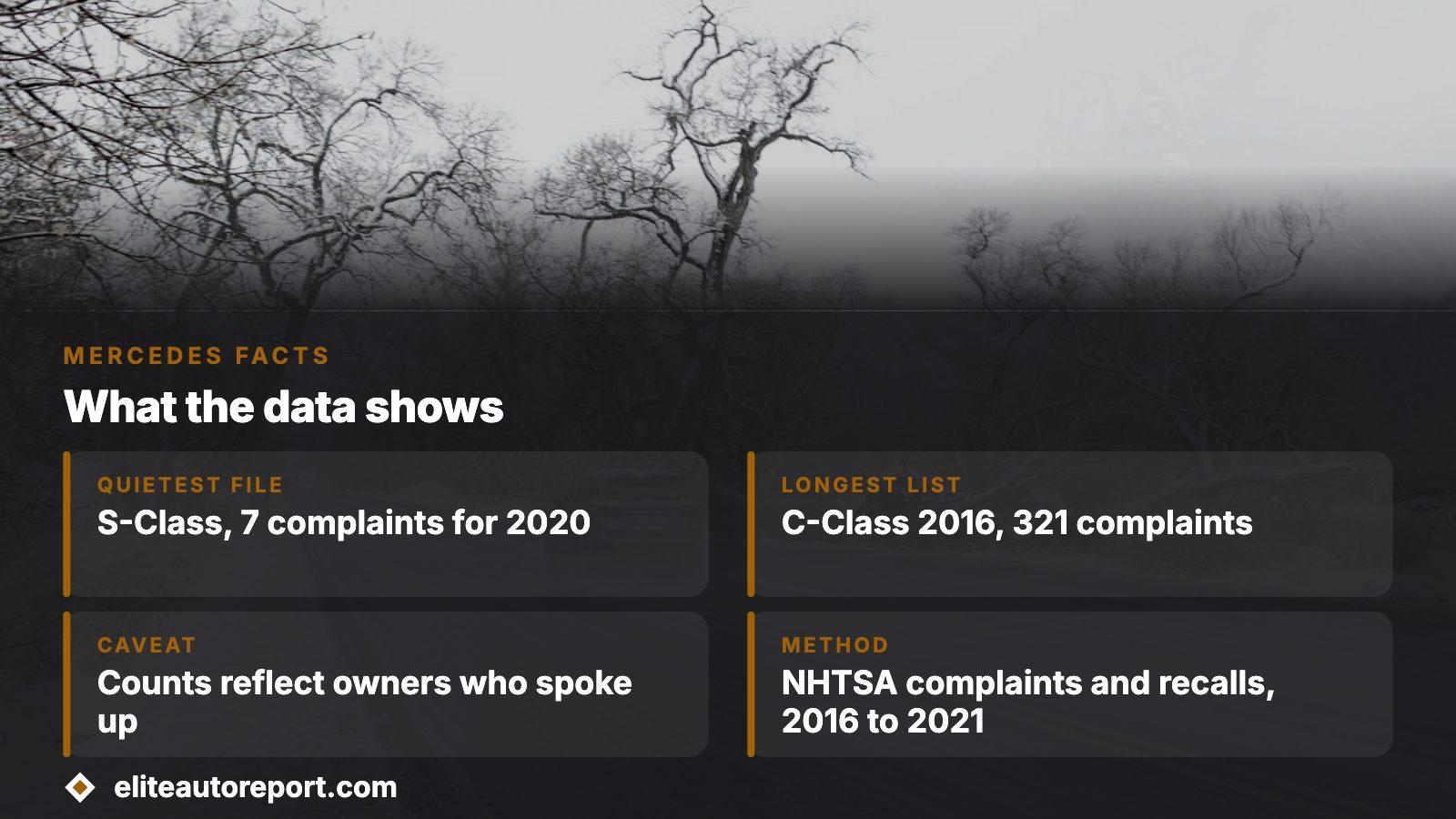
- Quietest file
- S-Class, 7 complaints for 2020
- Longest list in range
- C-Class 2016 with 321 complaints
- Caveat
- Counts reflect owners who spoke up, not failures per car
- Method
- NHTSA complaints and recalls APIs, 2016 to 2021
What a reliability answer can honestly rest on
Magazines and owner surveys publish reliability rankings, but I did not use them here. They are not public records, and the methods vary. What anyone can check is what NHTSA holds: complaints that owners filed about a specific make, model and year, and the recall campaigns the maker registered.
Both sets of records have limits. A complaint is a person's account, and popular models collect more of them simply because more of them were sold. Newer years have had little time to gather any. So read the counts below as a map of where to look harder, never as a score.
Complaint counts by model and year
I pulled complaints for five Mercedes-Benz lines from NHTSA's public complaints API, covering 2016 through 2021. The GLC returned nothing for 2021 under that model name, so it stops at 2020.
| Model | 2016 | 2017 | 2018 | 2019 | 2020 | 2021 |
|---|---|---|---|---|---|---|
| S-Class | 29 | 22 | 29 | 16 | 7 | 35 |
| E-Class | 89 | 167 | 68 | 55 | 21 | 20 |
| C-Class | 321 | 253 | 131 | 80 | 47 | 16 |
| CLA | 68 | 28 | 47 | 53 | 25 | 7 |
| GLC | 140 | 119 | 99 | 70 | 81 | none |
| GLE | 107 | 75 | 57 | 34 | 125 | none |
The S-Class never passes 35 in any year, which is the quietest run of the six. The C-Class starts the range at 321 and falls steadily to 16. The GLE jumps back up to 125 for 2020, a reminder that a new design year can reset the pattern.
The S-Class and the later sedans
If the question is which Mercedes has the cleanest paper trail, the S-Class answers first. Its 2021 spike to 35 is led by electrical complaints (10), then wheels (6) and forward collision avoidance (5), which fits a car loaded with driver-assist hardware.
The E-Class has one bad year in this window, 2017, with 167 complaints, and then eases to 21 and 20 for 2020 and 2021. The C-Class follows a similar slope, with only 16 on file for 2021. Both are the sensible places to shop if you want a mainstream Mercedes with a short complaint list.
- S-Class 2016 to 2021: no year above 35 complaints
- E-Class 2019 to 2021: 55, 21 and 20
- C-Class 2019 to 2021: 80, 47 and 16
- CLA 2020 and 2021: 25 and 7
Where the SUVs stand
The GLC and GLE lines draw longer lists. The 2016 GLC has 140 complaints and the 2016 GLE has 107, and the GLE 2020 total of 125 is higher than any other 2020 figure above. Engine is the most named component for GLC 2016 (40) and GLE 2020 (44), and service brakes (29) rank second on the GLC.
That does not make an SUV a bad buy. It means the records deserve a closer read before you sign. Brakes and engine complaints on a vehicle that might have towed, hauled or sat in traffic for years are exactly what a service history should explain.
From an NHTSA owner complaint
A 2016 GLC300 owner told NHTSA in February 2022 that the car lunged forward on the interstate with every dashboard light dark. Days later, creeping through a parking lot, the brakes faded and the car lunged again, climbing a curb and ending in a hedge. She noted a sore neck, fuel odor, and a dealer that hauled the car in without finding a cause. Odometer: roughly 45,000 miles. Complaint number 11453712.
One complaint proves nothing about every GLC. The takeaway is narrower: ask whether the car you are buying was ever diagnosed for a brake or throttle fault, and get the answer in writing.
Recall campaigns, trim by trim
Recall counts tell a different story. For 2017, NHTSA lists 16 campaigns on the E300, 12 on the GLC300, 10 on the S550 and the CLA250, and 7 on the GLE350. A busy recall list is not automatically a bad sign, because it shows the maker is finding and fixing problems.
It does mean paperwork matters. A 2017 E300 alone carries campaigns for the passenger air bag inflator module, the transmission control module, the starter and the power steering assist. A used car is only as fixed as its VIN says it is.
The lookup keys on exact trim names and has gaps. It returned nothing for the GLC300 in 2019 and 2020, or the C300 in 2020, yet an empty result there says little about a particular car. Enter the VIN on NHTSA's recall page for a real answer.
What a history report adds to the model data
Model-level data cannot see how one car lived. An EliteAutoReport check can show whether this VIN ever sold at salvage or insurance auction, with photos of the damage, along with its title brands, odometer readings and theft records. A luxury sedan with a clean reputation and a rebuilt-title past is still a rebuilt car.
Paste the VIN into the free preview and you will see which record categories turned up, auction photos included. Reading the whole report costs one payment, quoted on the pricing page.
A shopping order that uses the data
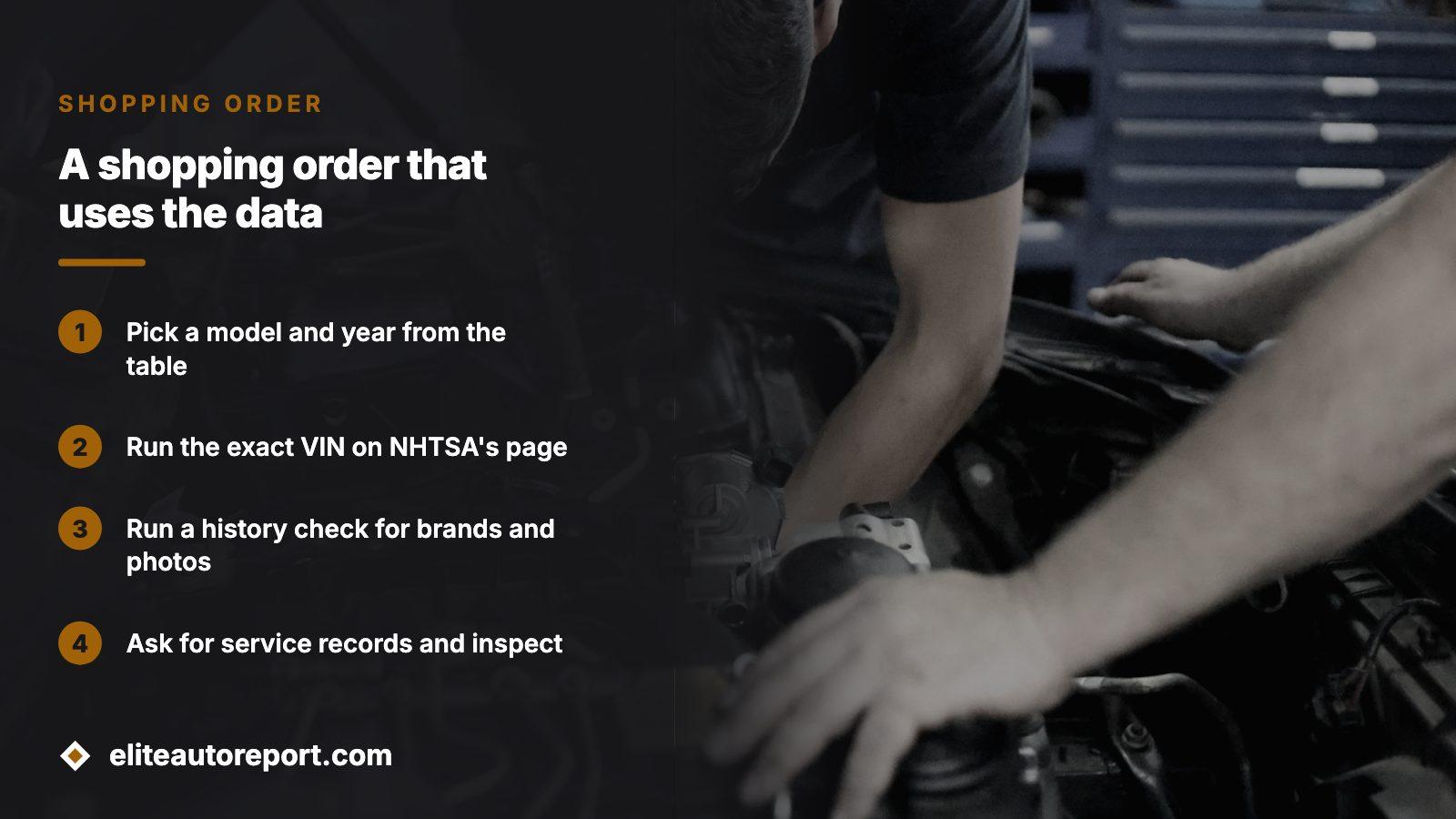
- Pick the model and year range from the complaint table, favoring the quieter rows.
- Run the exact VIN on NHTSA's recall page and note every open campaign.
- Run a history check for title brands, auction photos and odometer trouble.
- Ask for service records covering brakes, engine and electrical faults.
- Have an independent mechanic who knows Mercedes inspect the car.
For a federal view of title records, the Justice Department's VehicleHistory.gov site explains the NMVTIS database and points shoppers to flood-damage notices and used-car tips.
Where this information comes from
- NHTSA complaints API: GLC-Class 2016 — complaint counts and the GLC owner experience
- NHTSA complaints API: E-Class 2017 — E-Class counts by year and component
- NHTSA recalls API: GLC300 2017 — recall campaigns by trim and year
- VehicleHistory.gov (NMVTIS) — federal description of title history data
- NHTSA owner complaint 11453712 — owner experience, paraphrased
Sources and photos: Facts checked against the sources above in November 2026. Photos by Iain, Mustafa Sheikhmouss and Zoshua Colah on Unsplash; diagrams by EliteAutoReport.
Keep reading
- Mercedes C-Class Years to Avoid, Ranked by NHTSA Complaint CountsModel-year complaint counts for the C-Class across many model years.
- Mercedes E-Class Years to Skip, With NHTSA Complaint and Recall TalliesThe same method applied to the E-Class.
- Most Reliable Used Luxury SUV: What Federal Records ShowHow luxury SUVs compare outside the Mercedes badge.
- Mercedes-AMG VIN Check: Auction Photos, Titles and RecallsWhat to check on an AMG car before buying.
Frequently asked questions
Which Mercedes is the most reliable?
No agency ranks it. In NHTSA complaints for 2016 to 2021, the S-Class has the lowest yearly counts, from 7 to 35, and recent C-Class and E-Class years are also quiet. Complaint volume reflects sales and age as well as faults, so use it to shortlist cars, then verify each VIN.
Are newer Mercedes more reliable than older ones?
The C-Class suggests so: 321 complaints for 2016 against 16 for 2021. But recent years simply had fewer months for owners to file, so part of that drop is age. Treat it as encouraging, not proven.
Does a long recall list mean a bad car?
Not by itself. A 2017 E300 has 16 campaigns on file, covering air bags, steering and the starter, which also means fixes exist. What matters is whether the repairs were done on your VIN.
Why did a recall search show nothing for my Mercedes?
NHTSA's lookup works by exact model name, and some trims return zero while still being covered by campaigns. Enter the full VIN on NHTSA's recall page for the real answer.
What should a VIN check tell me about a used Mercedes?
Whether the car has a salvage or rebuilt title, sold at auction with damage photos, shows odometer inconsistencies or was reported stolen. Model reliability data cannot see any of that.
Now check the car itself
The guide explains what to look for. The report shows what this VIN has on record.