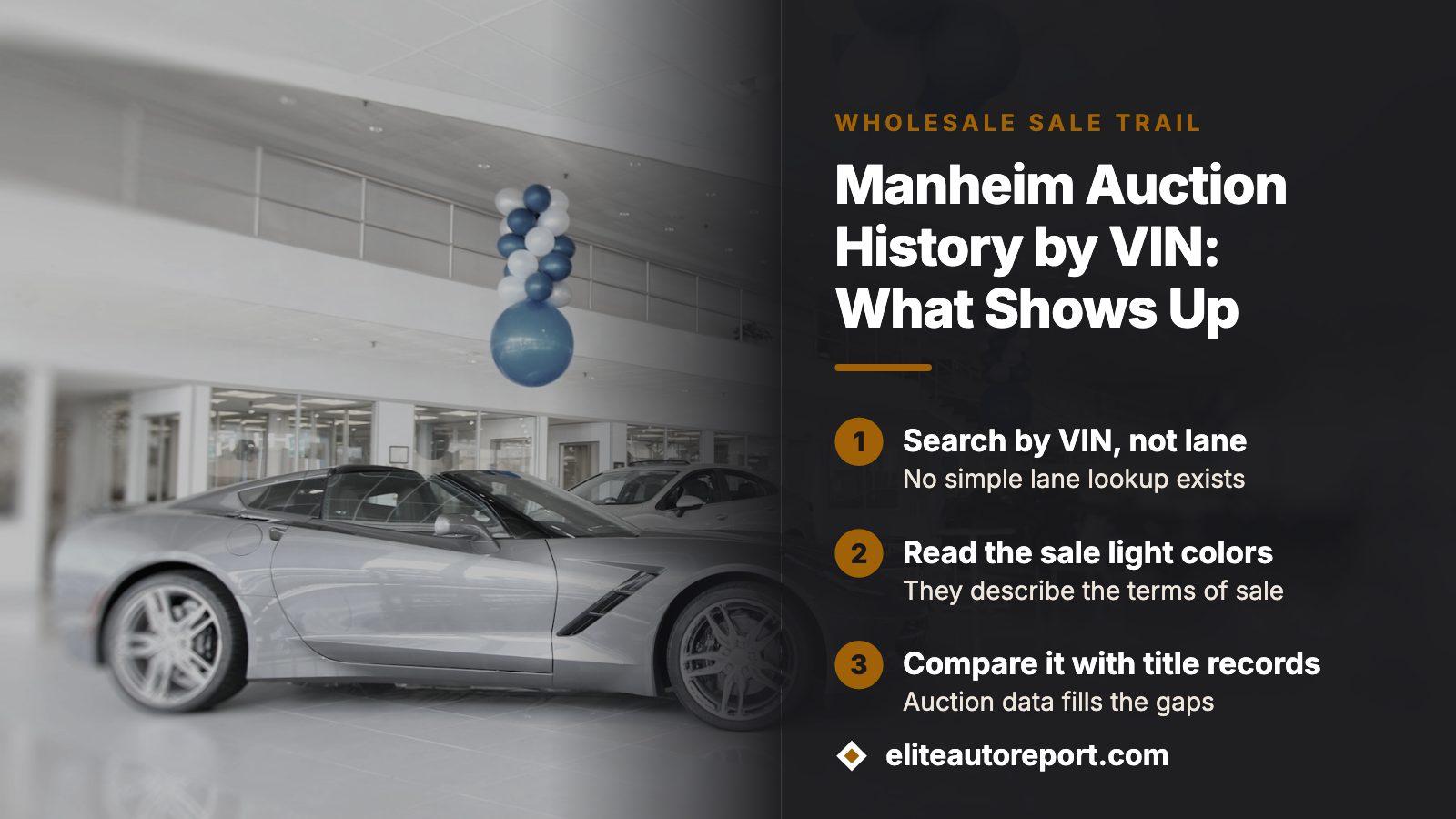
THE SHORT ANSWER
Type the 17-character VIN into EliteAutoReport. The preview is free and indicates whether auction activity is on file. The paid report, a single payment, lays out any sale entry and its pictures next to the title brands and mileage history. A blank result is not proof the car never went through a lane, so confirm with the seller's paperwork.
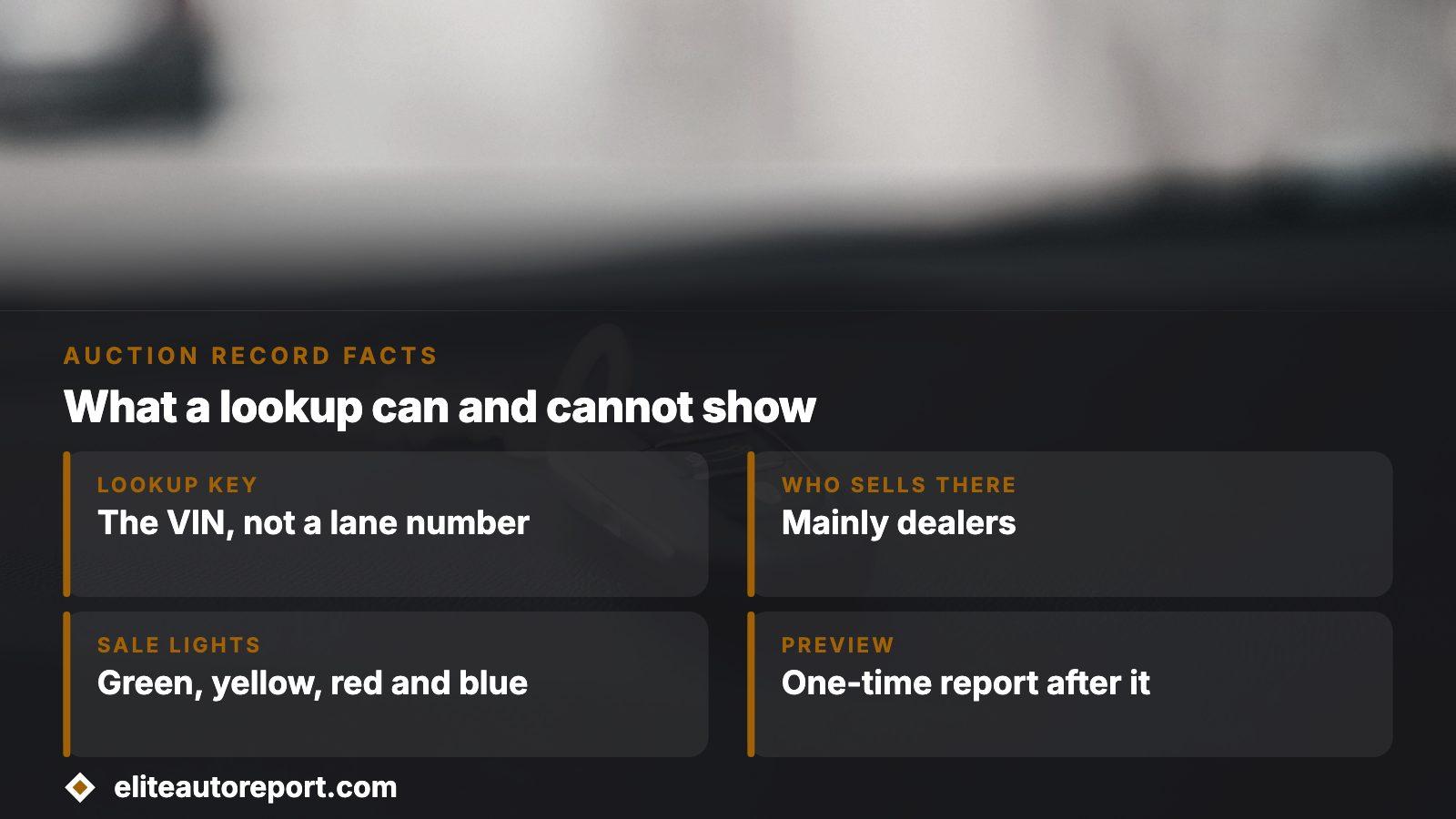
- Lookup key
- The VIN, not a lane or run number
- Who sells there
- Mainly dealers; public access is limited to select units
- Sale lights
- Green, yellow, red and blue describe the terms of sale
- Preview
- Free preview, one-time report
Why there is no simple Manheim lookup
Manheim's own materials describe a wholesale operation built around dealers. Its Maryland public-sale guide says the dealer is the main client there, and that under state law the public may bid only on select repossessed units. Everything in that sale goes as is, and every sale is final.
So the record of a sale lives with the auction, the selling dealer and whatever data feeds a report company can reach. Nothing I opened on Manheim's pages offered a per-VIN sale search for the public, and the condition-report and market-report addresses I tried came back as not found. If a listing promises exact Manheim bids for any car, treat that as a claim to test, not a fact.
What an auction record can tell you
When a sale shows up on a VIN report, the value is in the pattern around it. You are looking for a car that moved through a wholesale lane just before landing on a retail lot, particularly a luxury or exotic one where a quiet wholesale hop can hide a fix or a dispute.
- Whether the car sold at auction at all, and roughly when.
- Photos from the sale, where the report has them, compared with the car in front of you.
- Odometer readings before and after the sale, which should only climb.
- Any title brand that appeared around the same dates.
- How many owners or listings sit between the sale and today.
A single wholesale appearance is ordinary for a dealer trade-in. Several in a short span, or one that lines up with a brand, deserves questions.
Reading the sale lights before you trust a car
Manheim announces the terms of each sale with a light system, and the colors matter when you later try to learn what happened. In a lane sale you watch above the block for them; in a simulcast, look to the upper right corner of the video feed.
| Light | What it signals |
|---|---|
| Green | No known defects, backed by the seller |
| Yellow | Seller announced conditions that narrow a claim |
| Red | Sold as is; arbitration only in narrow cases |
| Blue | No title in hand when the car sold |
Each auction's own policy can send cars red by default, keyed to price, age or odometer. Online-only sales skip the lights: cars count as ride and drive unless labeled as is. A seller who mentions a red-light sale is telling you the car carried no guarantee when it changed hands.
What federal records do and do not capture
The federal title system is fed by motor vehicle offices, scrap and salvage operators, and insurers. What comes out is brand labels such as junk, salvage or flood, the newest odometer figure on file, and an insurer's total-loss ruling. Nothing in that description says it logs ordinary wholesale dealer sales.
That gap is why an auction-aware report exists as a separate product, and why it still cannot be perfect. A repair that never touched insurance, or a title that was never branded, leaves a clean trail. Read the absence of an entry as a limit of the data, not as a clearance.
Luxury, exotic and classic cars at wholesale
On a high-value car, the auction step is often where a problem gets hidden or packaged. Sellers may spend on reconditioning first: Manheim itself sells sellers on detailing, light mechanical fixes, paint and bodywork that lift a car's condition grade ahead of the sale. A glossy finish should send you to the history, not put you at ease.
For older cars the picture thins. Records before the electronic era are patchy, so lean on documents: the original title, service invoices and the seller's own account, checked against the VIN on the car.
From an NHTSA owner complaint
One owner complaint filed in early 2026 concerns a 2016 Audi A3 rear-ended late the year before. The car then went through an auction still carrying a clean title, and the filer put the structural damage above the car's value. The worry was a dealer reselling it without any crash record. The lesson: a clean title at the block says little about what happened before it.
Running the search
- Copy the VIN from the car's own plate or door jamb, then match it to the paperwork.
- Enter all 17 characters into the search box on this site.
- Review the free preview to see whether auction and title activity is on file.
- Buy the full report if you want the sale entry, pictures and mileage log.
- Line the dates up against the seller's story.
Pay attention to mismatches: a sale date the seller never mentioned, photos showing damage the listing skips, or an odometer that sits oddly against the years.

If you already bought and something is off
If the car sold through Manheim and you are the buyer in that sale, arbitration is the formal route. Manheim says it acts as a neutral go-between, and if it holds up the outcome can be a lower price or a voided deal. Claims must meet the filing period in the arbitration policy, are started online under Purchases, and may carry a fee.
Once a case opens the clock runs fast: paperwork, the vehicle for inspection and the title are each wanted right away, and never later than 5 calendar days. Sometimes pictures or a video can stand in for hauling the car back. A retail buyer who bought from a dealer has no such claim against the auction, so your bargaining position is the dealer contract and the report you ran before signing.
Cost and what to do next
Starting with the preview costs nothing. After that it is a single payment per report, nothing recurring; see the pricing page for amounts and bundles if you are shopping several cars.
Run the VIN before you negotiate, not after. If the report shows a wholesale sale you were not told about, ask the seller for the sale paperwork, any announcements made at the lane, and repair invoices. A seller with nothing to hide produces them quickly.
Where this information comes from
- Manheim: Arbitration — sale lights, arbitration steps, filing windows
- Manheim: Maryland public sale guide — dealer-focused wholesale sale open to the public only on select units
- NMVTIS: Information for consumers — who reports to the federal title system and what it holds
- VehicleHistory.gov: Consumers — what the federal title database is for
- NHTSA owner complaint 11714479 — owner experience, paraphrased
Sources and photos: Facts checked against the sources above in November 2026. Photos by Richard R, Michal Biernat and Bence Balla-Schottner on Unsplash; diagrams by EliteAutoReport.
Keep reading
- Dealer-Only Car Auctions: Who Can Bid and How to Check a Lot's VINWho may bid at a wholesale sale and who may not.
- Auction History by VIN: Photos for Luxury, Exotic and Classic CarsThe same question for any auction company, not only this one.
- Car Auction Condition Report: What It Tells You and What It HidesHow to read a condition report next to the history.
- Car Sold at Auction Multiple Times: How to Check a VIN for RelistsWhy a car shows up at sale after sale.
Frequently asked questions
Can I look up a Manheim sale price by VIN?
Not directly from Manheim as a member of the public. Its materials point to dealers as the main client. A VIN history report may include a sale record where its data sources captured one, so run the preview and see what is on file for that car.
Does a Manheim sale mean a car was damaged?
No. Dealers send trade-ins and off-lease cars through wholesale lanes all the time. What matters is the pattern: repeat appearances, a sale near the date of a brand, or pictures showing harm the seller skipped.
What does a red light at a Manheim sale mean?
It means the car sold as is, with arbitration limited to certain conditions. Local policy decides which cars go red automatically, based on price, model year or mileage. It describes the sale terms, not necessarily the car's condition.
Can the public buy at Manheim?
Only in limited cases. The Maryland guide says the public can bid just on select repossessed units there, with every sale final. Rules differ by location, so check the specific auction before planning around it.
What if the report shows no auction history?
That lowers the odds, but no database is complete. Ask the seller how they acquired the car, request the purchase paperwork, and check the title and mileage entries against the actual vehicle.
Now check the car itself
The guide explains what to look for. The report shows what this VIN has on record.