THE SHORT ANSWER
An auction condition report is a snapshot of a vehicle's cosmetic and mechanical state at the sale, often with a grade, notes and photos. It is prepared for the transaction, so treat it as the seller's account. Pair it with a VIN history check for title brands, earlier auction records, odometer readings and damage that no one mentioned on the day.
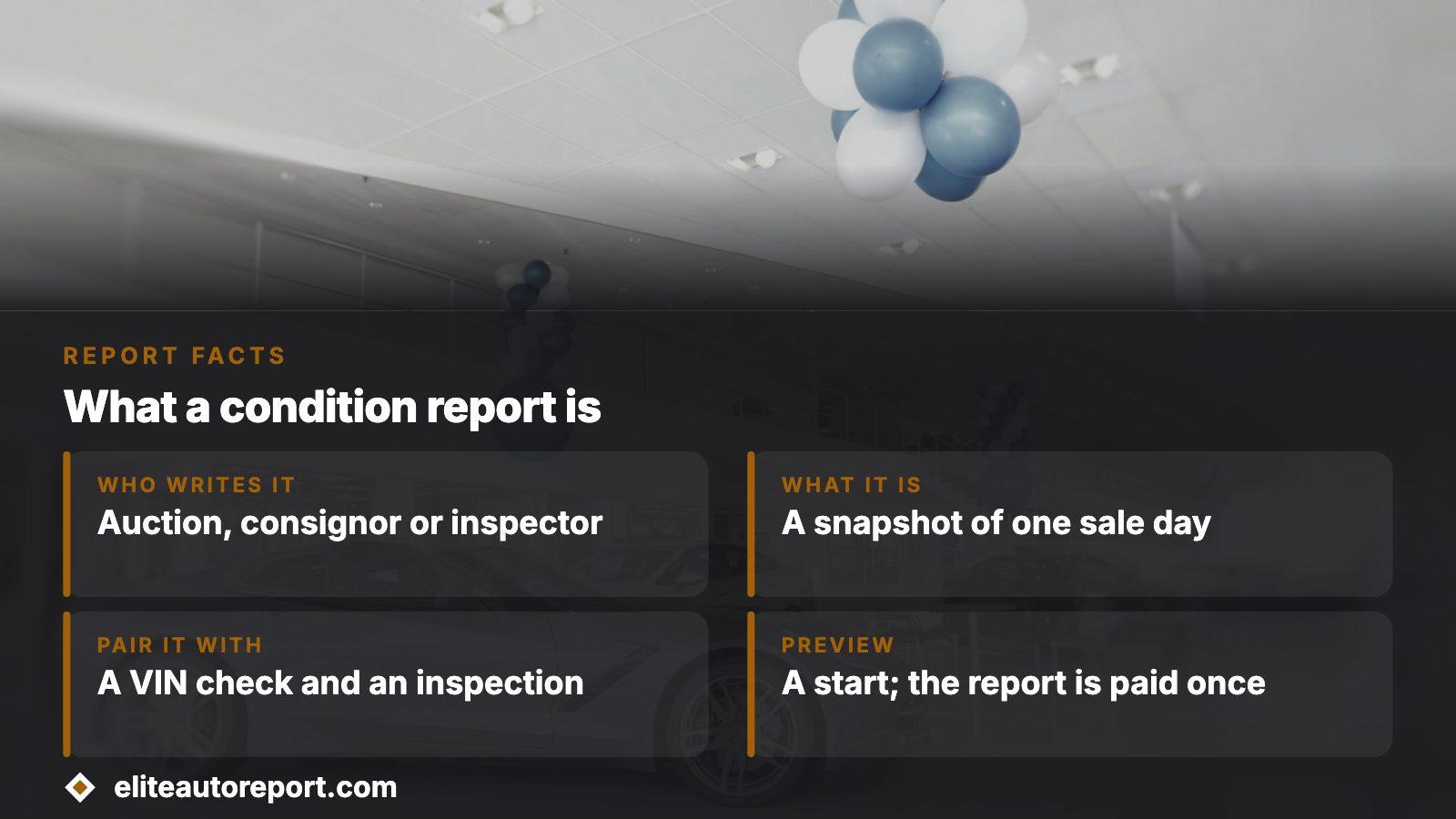
- Who writes it
- The auction, the consignor or an inspector working for them
- What it is
- A snapshot of one sale day, not a history
- Pair it with
- A VIN check and your own inspection
- Preview
- Free to start; the full report is paid once
What an auction condition report actually is
Think of it as a listing sheet with a clipboard behind it. Someone walked around the car, noted dents, paint flaws, interior wear and warning lights, sometimes assigned a numeric grade, and attached photos. The result helps a bidder who is not standing next to the car decide whether to raise a hand.
What it is not matters just as much. It does not cover where the car has been, whether it was ever branded, how many owners held it, or whether the odometer has always told the truth. A report can be accurate in every line and still leave out the one fact that decides the purchase.
For the cars this site focuses on, that gap is wider than usual. A low-volume exotic or a collector car may have passed through several sales, shops and states, and each stop leaves a trace the sale-day sheet never mentions.
Who writes it, and whose interests it serves
Condition reports come from the auction house, the selling dealer, the consignor or a hired inspector. Each has a reason to get the car sold. That does not make the author dishonest, but it does mean the document is an input to a sale and not an independent audit.
One high-end collector auction house puts this plainly in its terms of sale: a condition report is opinion and not fact, creates no warranty, and the house disclaims liability for what it says or leaves out. It also states that it relies on what the seller supplies. If a house that sells six-figure cars writes that into its rules, a buyer should read the same caution into every report.
How to take it
Read a condition report the way you would read a seller's description on a classified ad: useful detail, written by someone who gets paid when you say yes.
Grades, lights and announcements decode part of the story
At dealer wholesale sales, the report is only half of the disclosure. The other half is spoken or lit up in the lane. Manheim, for example, runs a sale light system, and the colors change what rights a buyer has afterward.
| Signal | What Manheim says it means |
|---|---|
| Green | No known defects; the seller stands behind the car under the guidelines |
| Yellow | Sold with announced conditions that narrow arbitration |
| Red | Sold as-is; arbitration only in limited cases |
| Blue or no title present | Title is not in hand at sale; practice varies by region |
Online-only listings on its OVE platform skip the lights. There, a car is treated as drivable unless the listing says as-is, and a third label covers drivable cars sold with stated conditions. A condition grade without the matching light or label is only half a sentence.
Why a good grade can still sit on a rough history
Sellers are allowed to fix cars before the sale, and the big auctions sell the services to do it. Manheim's own reconditioning page advertises a 153-point retail inspection, paint and body repair and visual merchandising for consignors. That is a legitimate business, and it also means a clean grade can describe a car that was cosmetically prepared days earlier.
Fresh paint on an exotic is a good example. It may cover a respray after a parking-lot scrape, or it may cover structural repair. The sale-day sheet will say the paint is excellent either way. A VIN check can show an earlier damage record, a prior auction listing with photos from before the work, or a title brand that explains the panel gaps.
What a VIN check adds to the report
Our check starts from the 17-character VIN and looks backward. It is built for people buying cars where the history carries as much weight as the paint.
- Title brands and salvage records, including earlier sales where the car was offered as damaged
- Past auction listings with photos, to set beside the lot you are bidding on
- Odometer readings over time, to test whether the mileage on the sheet fits the trend
- Damage and accident entries, plus lien, impound and theft flags
- Unrepaired safety recalls and factory specs, so trim and options match the ad
You can peek at the preview without paying, and it signals whether records exist. Opening the entire report takes one purchase, never a subscription, and bundles help if your shortlist has several lots. Amounts live on the pricing page.
Running the check before you bid
- Copy the VIN from the listing or the report header, then match it against the number stamped on the vehicle. Dash plate, door jamb label and the title should all agree.
- Run the free preview and note which kinds of record it found.
- Buy the full report when the preview turns up something: a brand, a damage entry, a prior sale or an odometer gap.
- Lay the history beside the condition report and look for contradictions, such as a clean description of a car with a damage record.
Do this while the lot is still open. After the hammer falls, most of your bargaining power is gone, and arbitration, where it exists, has strict time limits and rules about which problems qualify.

Red flags when the two documents disagree
- The report says no structural damage, but the history shows a total-loss or salvage entry
- Photos in the lot gallery show different panels, wheels or interior trim from earlier auction photos
- Mileage on the sheet is lower than a reading recorded in an earlier year
- The title is missing at sale, or the seller is vague about when it will arrive
- A flood-prone region appears in the ownership trail and the report is silent on water damage
Washington runs NMVTIS partly to keep buyers out of title scams and unsafe cars, and partly to stop thieves from reselling stolen ones. Its site lists flood-damage notices sent to reporting businesses. A car that moved through a flood zone and then through an auction deserves a closer look than any grade can give.
Special cases: exotics, luxury cars and classics
Collector sales add another layer. Many are written as-is, bidders are told to inspect for themselves, and the description of a restored car may say little about who did the work or what was replaced. A reported number matching engine does not tell you whether the frame was ever straightened.
Newer exotics have the opposite problem. Late-model cars are well documented in databases, so a salvage or damage entry is likely to exist if the car was ever hurt, and a seller's silence is easier to catch. In both cases, a VIN check and a specialist inspection do different jobs: the first covers the paper trail, the second covers the metal.
What to do next
If a condition report is in front of you now, find the VIN on it and run the preview. If the car has a history, you will know before the bidding starts. If it shows nothing, that is a useful result too, though it is not proof that nothing happened, since not every event is reported.
Then book an in-person or third-party inspection if the platform allows one. A report from the seller, a history from independent records and a mechanic's own eyes make a buying decision with three separate sources behind it.
Where this information comes from
- Manheim: Arbitration and sale lights — Explains the light colors, OVE labels and how arbitration claims work.
- Manheim: Reconditioning — Shows that sellers can buy inspection, paint, body work and merchandising before a sale.
- Gooding Christie's: Terms — Shows how a collector auction house treats condition reports as opinion.
- VehicleHistory.gov: NMVTIS for consumers — Federal background on the title information system and its flood-damage notices.
Sources and photos: Facts checked against the sources above in November 2026. Photos by Mustafa Sheikhmouss, Jakub Żerdzicki and Richard R on Unsplash; diagrams by EliteAutoReport.
Keep reading
- Auction History by VIN: Photos for Luxury, Exotic and Classic CarsHow earlier auction listings and photos turn up by VIN.
- What Happens When You Buy a Car at Auction: Fees, Title and Hidden HistoryThe wider process, from registration to payment.
- Sample reportSee what a finished report looks like before you pay.
- PricingEach purchase option, with no subscription attached.
Frequently asked questions
What is a car auction condition report?
It is a written summary of a vehicle's condition at the time of sale, usually with notes on body, interior, mechanical items and sometimes a grade and photos. The author is the auction, the seller or an inspector hired for the sale, so it reflects their view on that day and nothing earlier.
Can I rely on an auction condition report alone?
No. At least one major collector auction house calls its reports opinion, not fact, and disclaims responsibility for omissions. Use the report for detail, then confirm the car's past with a VIN check and, ideally, an independent inspection before you place a bid.
Does a condition report show accident history?
Usually only damage that is visible or that the author chose to note. Records of past claims, total losses, brands and earlier auction sales live in separate data sources. A VIN history report is how you reach them.
Where is the VIN on an auction listing?
Most auction listings print it near the top, beside the lot number. Verify it against the dash plate and the door label on the car, and against the title, since a mismatch is itself a warning sign.
Is the VIN check free?
Only the opening preview costs nothing. Reading the whole report means a single purchase, and bundles exist for shoppers with several candidates. See the pricing page for each option.
Now check the car itself
The guide explains what to look for. The report shows what this VIN has on record.