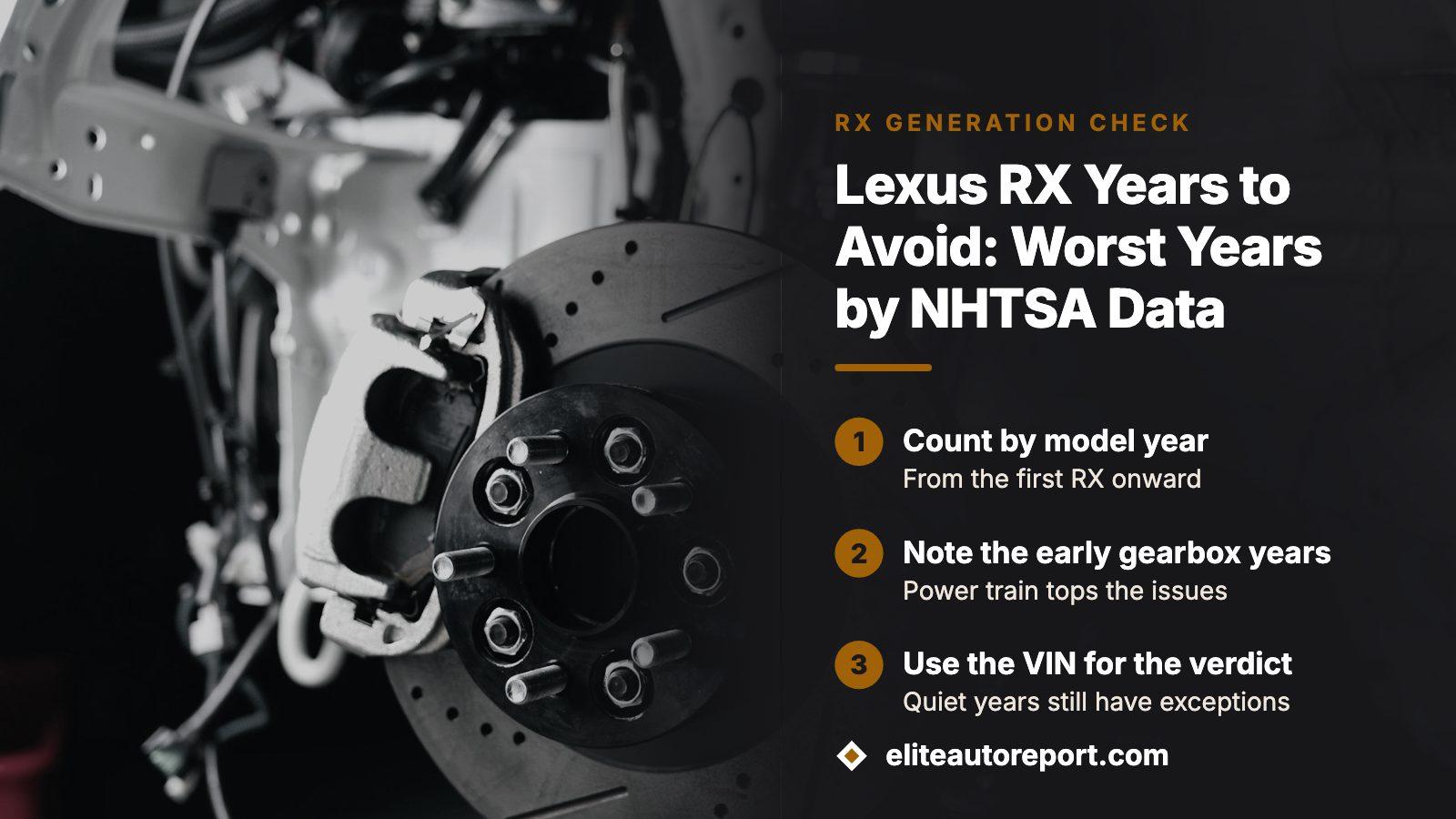
THE SHORT ANSWER
Skip the 1999 to 2001 RX 300 unless the transmission has paperwork behind it: those years drew 224, 216 and 176 complaints, mostly power train. The 2004 RX 330 has the single highest count at 327. The 2010 RX 350 carries an accelerator pedal recall. The 2014 model drew only 27 complaints and no recalls.
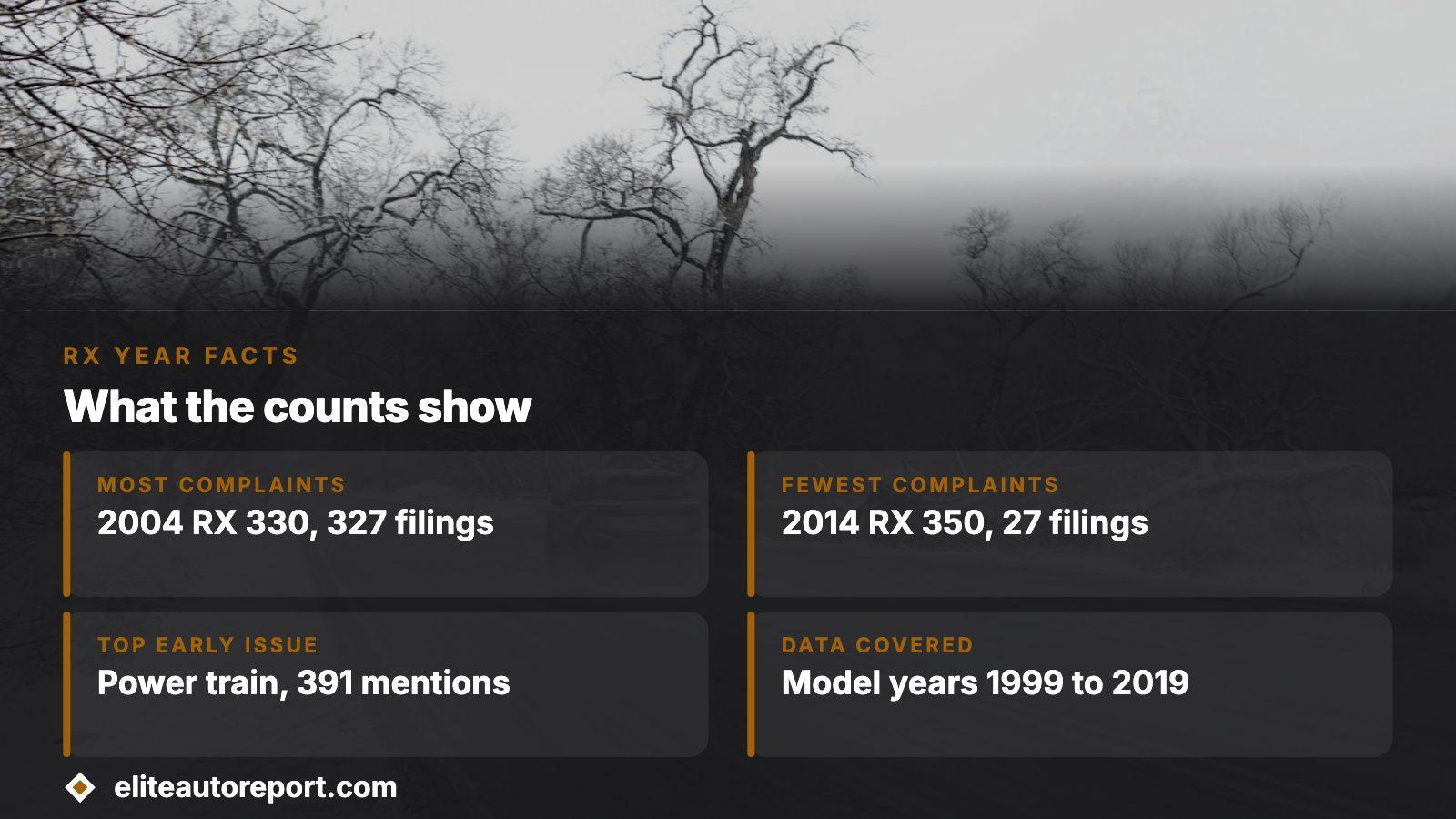
- Most complaints
- 2004 RX 330, 327 filings
- Fewest complaints
- 2014 RX 350, 27 filings
- Top early-year issue
- Power train, 391 mentions across 1999 to 2001
- Data covered
- Model years 1999 to 2019
How we counted, and what the numbers can't say
Every figure here comes from two public NHTSA feeds: owner complaints filed by model year, and recall campaigns by model year. We queried the RX 300 for 1999 to 2003, the RX 330 for 2004 to 2006 and the RX 350 for 2007 to 2019. Hybrids were not pulled under their own names, and 2020 to 2022 came back empty, so the verdict stops at 2019.
Complaints are raw filings. We had no sales figures, so a high count may partly reflect how many cars were sold that year. Treat the numbers as a pattern in what owners reported, not a failure rate.
Read the counts as a pattern
A year with few complaints is not proof of a good car, and a year with many is not proof of a bad one. Only the VIN in front of you tells you what happened to that vehicle.
The counts in one table
Here are the complaint totals by group of years, with the recall situation beside each. The recall column counts campaigns that Toyota ran on its own cars, not aftermarket parts recalls from other companies.
| Model years | Complaints | Recall picture |
|---|---|---|
| 1999 to 2003 RX 300 | 751 across five years | Two 1999 campaigns: rear brake tubes, auto headlight switch |
| 2004 to 2006 RX 330 | 618 across three years | Brake light switch, seat belt bolt, carpet cover, crankshaft pulley |
| 2007 to 2009 RX 350 | 552 across three years | Carpet cover for 2007; none for 2008 or 2009 |
| 2010 to 2013 | 348 across four years | Accelerator pedal, brake actuator, brake software |
| 2014 to 2019 | 378 across six years | Fuel pipe, air bags, brake actuator, vacuum pump, fuel pump |
The early cars and the first RX 330 years carry the heaviest load.
1999 to 2002: the RX 300 and its gearbox
The first-generation SUV drew 224 complaints for 1999, 216 for 2000, 176 for 2001 and 105 for 2002. In the first three of those years the power train was named in 391 filings, far ahead of engine cooling, air bags or brakes. Owners describe automatic transmissions that slip, hunt or quit, often after a rebuild or a long run of normal use.
The 2003 model drew only 30 complaints, the calmest year of that generation.
From an NHTSA owner complaint
An owner of a 1999 RX 300 told NHTSA the transmission went out on the freeway with an infant in the car, only a year after a rebuild. The owner said failures like this were widely reported and asked for a recall. No recall for it appears in the federal record.
What to take from that: ask any seller of an early RX for a receipt showing who did the transmission work, and when. A rebuilt unit with no paperwork is a bargaining point, not a bonus.
2004 and 2005: the RX 330 peak
The 2004 model year holds the highest count in the whole run: 327 complaints. Power train led with 74, then service brakes at 65, hydraulic at 59 and structure at 46. The count dropped to 192 in 2005 and 99 in 2006.
This is also the busiest recall stretch. The 2004 car was recalled for a brake light switch whose contacts could build up deposits and fail, and for a rear seat belt anchor bolt that fell short of the federal anchorage standard. Cars from 2004 and 2005 were called back for floor carpet cover clips that could let the cover lean into the accelerator pedal, and in 2011 that campaign widened to the 2004 to 2007 RX 330, RX 350 and RX 400h. A crankshaft pulley campaign in 2011 also covered the 2004 and 2005 cars.
Owners also report cracked and melting dashboards near the passenger air bag. One owner described severe cracking at about 116,000 miles and worried that debris could become shrapnel in a deployment, while the maker treated it as cosmetic.
- Ask whether the carpet cover, pulley and brake light switch work was done.
- Look at the dashboard around the air bag cover for cracks or a sticky surface.
- Check that the recall lookup for the VIN shows no open campaigns.
2007 to 2010: engines, steering and a pedal recall
The first RX 350 years kept the numbers high: 225 complaints for 2007, 196 for 2008 and 131 for 2009. The 2007 filings lean toward the engine at 44, followed by structure at 31, steering at 29 and air bags at 28. One owner reported a ruptured engine cooler hose at about 99,000 miles, with oil and smoke at 30 mph.
Neither 2008 nor 2009 has a recall entry, which reads like good news. Yet owners still filed 196 and 131 complaints, so these were problems that never turned into campaigns.
The 2010 car brings a new theme. Vehicle speed control accounts for 48 of its 171 complaints, and NHTSA lists a 2012 campaign covering the accelerator pedal and driver floor mat on 2010 RX 350 and RX 450h cars built between November 28, 2008 and September 1, 2010. Thirty-two of the 2010 complaints mention a crash.
2011 to 2019: the quieter stretch, with exceptions
This is where a used-SUV shopper usually lands, and the record is kinder. The 2014 model year is the lowest in the run at 27 complaints with no recall entries. The 2018 car drew 44 complaints and one fuel pump campaign, and 2012 drew 45.
Exceptions matter. The 2011 car was recalled for a brake actuator whose valve calibration was wrong, with units made between late August 2010 and mid May 2011. The 2012 and 2013 cars received brake software updates, and the 2015 car was recalled for a fuel delivery pipe that could leak. The 2016 model has three campaigns, covering the knee air bag weld, a brake actuator and air bag sensors. The 2017 car added a brake booster vacuum pump campaign.
- Best pattern: 2014, then 2018, then 2012.
- Needs proof of recall work: 2011, 2015, 2016, 2017.
- Highest risk if paperwork is thin: 1999 to 2001, 2004, 2007.
Where a VIN check changes the verdict
Model year narrows the list; the VIN decides the car. A 2014 RX with a salvage sale on its record may cost you more than a tidy 2007. Luxury SUVs that were flooded or hit often pass through dealer auctions, and the photos from those sales show damage a clean-looking listing hides.
Run the VIN through our auction history lookup before you drive out. The free preview shows whether auction and damage records exist, and the paid report adds the photos, odometer readings, title brands and any open recall.
If the preview points to an auction sale, read the condition notes and hold the photos up against what the seller told you. Then have a mechanic you chose look at the transmission, dashboard and brakes, the weak spots this data points to.
A short buying plan
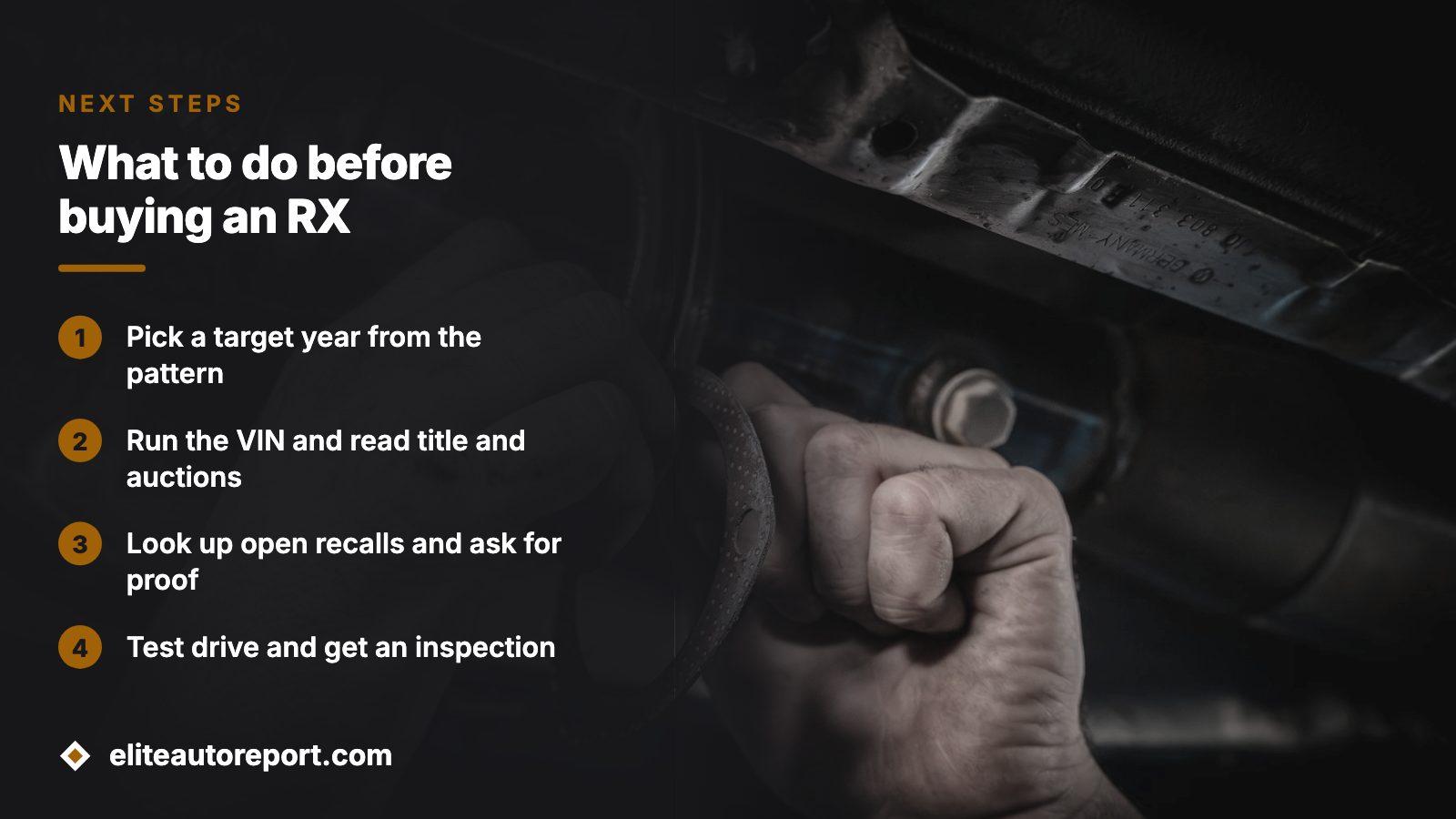
- Pick a target year from the pattern above, not from price alone.
- Run the VIN and read what it says about title, auctions and mileage.
- Look up open recalls and ask for proof of the finished ones.
- Test drive for gearbox hesitation, pedal behavior and dashboard condition.
- Get an independent inspection before you pay.
If two cars of different years cost the same, take the one with the cleaner record and better paperwork.
Where this information comes from
- NHTSA complaints API, 2004 Lexus RX330 — complaint counts and components by model year
- NHTSA recalls API, 2010 Lexus RX350 — campaign numbers, dates and remedies by model year
- NHTSA owner complaint 10446923 — owner experience, paraphrased
- NHTSA owner complaint 11585738 — owner experience, paraphrased
- NHTSA owner complaint 11128719 — owner experience, paraphrased
Sources and photos: Facts checked against the sources above in November 2026. Photos by Erik Mclean, Martin Fennema and Zoshua Colah on Unsplash; diagrams by EliteAutoReport.
Keep reading
- 1996 Lexus LS 400: What to Check Before You Buy Onethe same maker's earlier flagship, read the same way
- Range Rover years to avoid, by NHTSA complaint and recall countsthe same year-by-year method for a luxury SUV rival
- Car Auction Photos by VIN: Find Salvage Sale Pictures Before You Buysee what the photos from a sale can show
- Salvage Auction Title Codes: How to Read Them on a Luxury or Classic Lotdecode the title codes you may meet on an auction record
Frequently asked questions
Which Lexus RX year has the worst record?
By raw NHTSA complaint count the 2004 RX 330 is highest at 327 filings. The 1999 to 2001 RX 300 is the worst for one specific issue, power train, with 391 mentions across those three years. Neither count adjusts for sales, so read them as a pattern.
Which Lexus RX years are most reliable?
The 2014 RX 350 has the lowest complaint count, 27, and no recalls. The 2018 and 2012 cars follow at 44 and 45. Reliability is not measured here, only what owners reported to NHTSA, so confirm any specific car with its history and an inspection.
Are the Lexus RX hybrid years covered here?
No. We queried the RX 300, RX 330 and RX 350 names. Some campaigns shared with RX 400h and RX 450h cars show up in the recall notes, but hybrid complaint counts were not pulled, so check the hybrid separately.
Is a car with a recall a bad buy?
Not on its own. A finished recall means the maker paid for a fix, while an open one means the work is still owed. The real warning sign is a recall with no proof of completion, so run the VIN lookup before any money changes hands.
Can a VIN check show if an RX was sold at auction?
Yes, a report can list salvage and auction sales with photos, which a seller may leave out. You get a free preview first, then pay once for the full report, with rates on the pricing page. It cannot replace a mechanic's look at the gearbox.
Now check the car itself
The guide explains what to look for. The report shows what this VIN has on record.