THE SHORT ANSWER
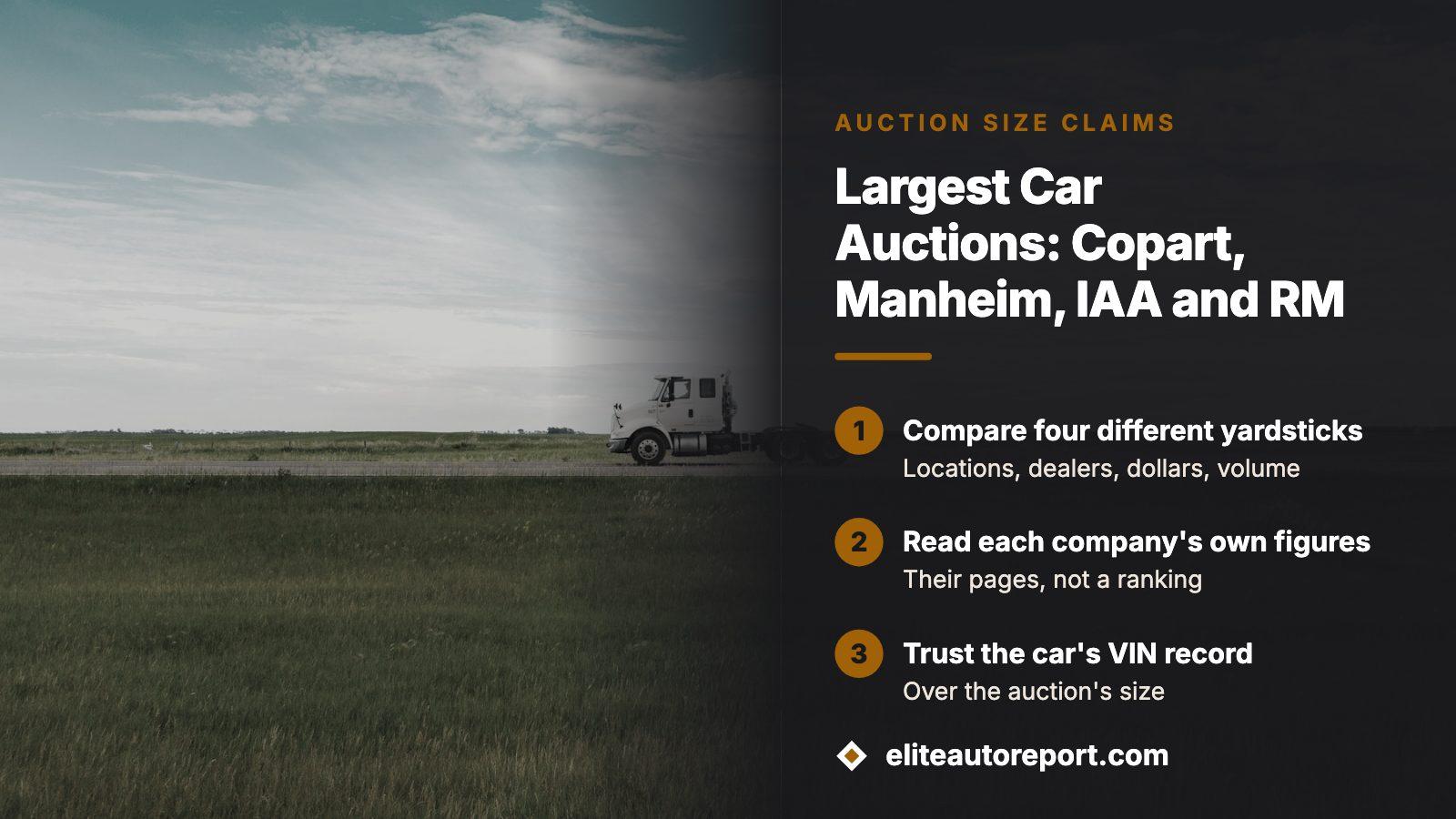
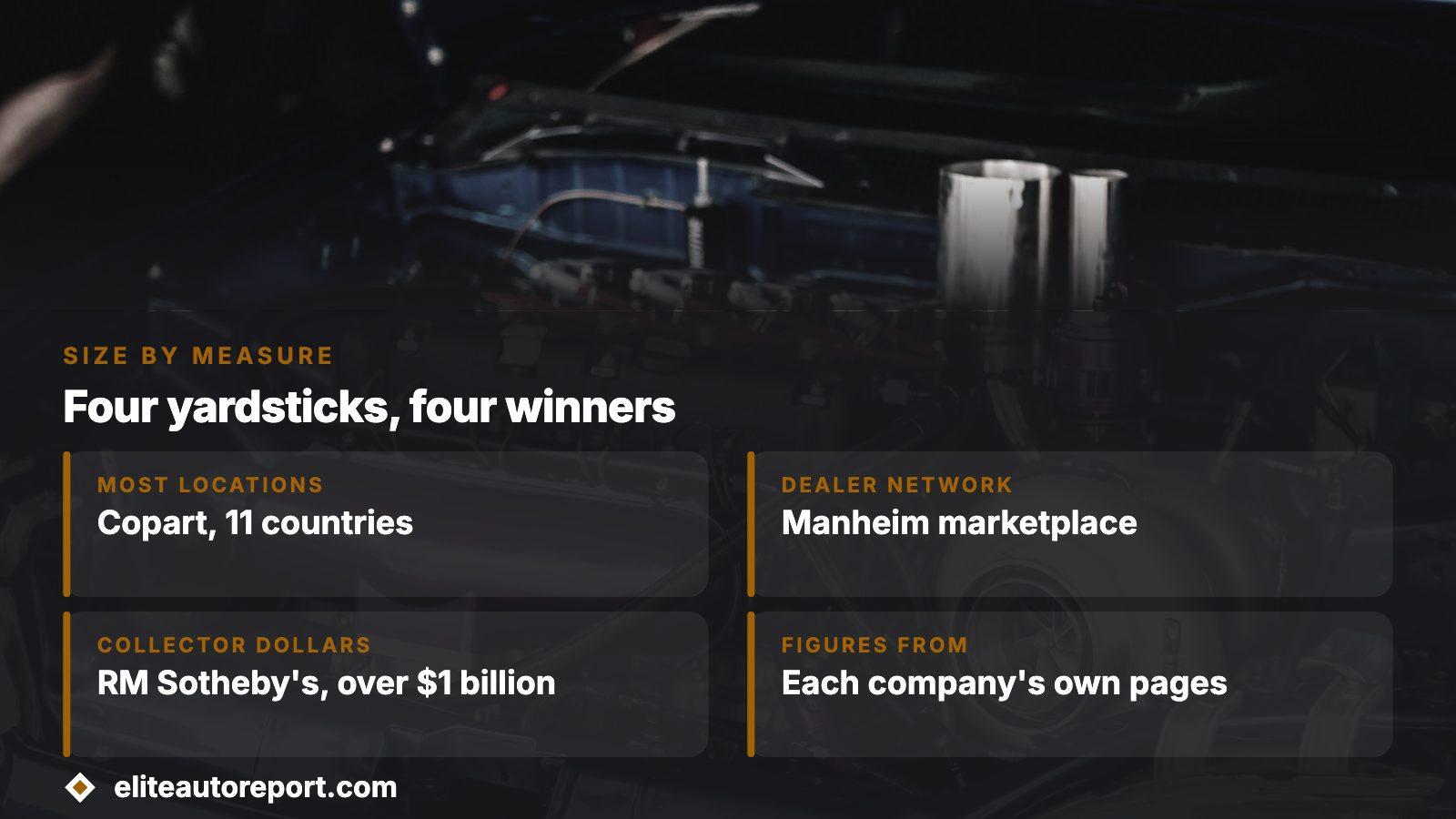
There is no single largest car auction, because the claims use different yardsticks. By locations, Copart's published count of 275 across 11 countries is the highest among the companies that print one. By dealer network, Manheim calls itself the nation's largest wholesale network. By dollars, RM Sotheby's claims the top spot among collector-car houses. Whatever the size, the VIN record for the exact car tells you more than the auction's rank.
- Longest location list
- Copart, 275 locations in 11 countries
- Dealer network
- Manheim, 80k+ active dealers on its marketplace
- Collector-car dollars
- RM Sotheby's, more than $1 billion in 2025
- Source of every figure
- The company's own pages, read 5 November 2026
Four yardsticks, four different winners
Auction companies count different things. Copart counts locations and cars listed per day, Manheim counts dealers and auction sites, and the collector-car houses count dollars. A company with the most yards may sell the cheapest cars, while a house with fewer sales can still move more money. Every figure below was read on the company's own pages on 5 November 2026, and nobody outside the company has audited any of it.
| Company | Lane | Its own size claim |
|---|---|---|
| Copart | Online salvage, wholesale and used | 275 locations in 11 countries; over four million vehicles sold a year |
| Manheim | Dealer wholesale | 81 physical auction locations; 80k+ active dealers; 3.9M+ vehicles inspected a year |
| IAA | Insurer, lender, dealer and fleet vehicles | Locations in all 50 states; no count printed |
| RM Sotheby's | Collector cars | Over $1 billion in 2025 sales; says it leads collector-car houses by total sales |
Copart and IAA: where write-offs and surplus land
Copart says insurers, rental firms, municipalities and charities sell through it, and that its buyers include dismantlers, body shops, dealers and individual consumers. IAA names donors, lenders, dealers, rental companies and fleet sellers on its side, and asks for a Registered Buyer account before full bidding. Its vehicle-type list includes Luxury and Classics, so an exotic can sit in the same lane as a wrecked commuter.
These lanes leave the clearest paper trail. Salvage auctions count as reporting yards under the federal title-record system. A yard that handles five or more salvage cars a year reports each one it took in during the prior month, with the VIN, the date, where the car came from and what became of it. That entry is what lets a VIN search find a car's trip through a write-off lane.
Manheim: the dealer lane
Manheim's brand page is written for dealers. It lists 80k+ active dealers on its marketplace and 81 physical auction locations. Its 3.9M+ figure counts inspections, not sales, so it cannot be set beside Copart's sales claim. For a buyer, the practical point is that a car sold in this lane usually reaches a private buyer only after a dealer has resold it, and the auction step may not be mentioned in the dealer's ad. Ask where the car was bought, then let the VIN show whether a salvage sale sits behind it.
Collector-car houses count dollars
RM Sotheby's calls itself the world's largest collector-car house by total sales and reports more than $1 billion for 2025. Its results page lets you pick any year from 2026 back to 2002; each sale has a results link but no printed total. Gooding Christie's conditions of sale add the part that surprises first-time bidders: published bid amounts leave out the buyer's premium. For vehicles sold live in the US it is 12% of a final bid up to $250,000, then 10% on the amount above. Online-only sales take 10% flat.
| Final bid | Sale type | Premium | Cost before taxes and fees |
|---|---|---|---|
| $200,000 | Live, US | $24,000 | $224,000 |
| $400,000 | Live, US | $45,000 | $445,000 |
| $400,000 | Online only | $40,000 | $440,000 |
The table is simple arithmetic on those published rates, not a quote from any sale.
What a famous hammer does not promise
Gooding Christie's sells as is, where is. Its terms call condition reports opinions, leave inspection to the bidder, and give no assurance about a lot's title or registration, so the bidder must investigate the papers. Estimates are opinions too: they can change, and they exclude the premium. On a six-figure car, the house's reputation sits beside the paperwork, not in place of it.
- The seller's title papers, read before sale day rather than after it
- The VIN or chassis number, matched against the car, the catalogue and the paperwork
- Your own inspection, or a specialist's
- The VIN record, for any earlier sale the catalogue never mentions
A clean title at auction is not a clean car
Size does not close gaps in the records. A federal title-record report carries title and odometer data, brands, theft and salvage history, but not a car's repair history, and states send their data on different schedules, so a recent sale can lag behind. A car that took a hit and was sold on can reach a buyer looking tidier than it is.
From an NHTSA owner complaint
A complaint filed with NHTSA in January 2026 describes a 2016 Audi A3 that was part of a late-2025 rear-end crash and then sold at auction showing a clean title. The filer said the frame damage would cost more than the car itself, and feared a dealer would resell it with no accident history.
Take the point, not the make: the title said one thing and the damage said another. Compare sale photos with any damage entry, and treat a spotless brand field as one input, not the verdict.
A check to run before you bid
- Copy the 17-character VIN from the lot listing and match it to the one on the car's own paperwork.
- Run a VIN preview and look for a title brand, an earlier auction or salvage entry, and a mileage history that climbs in a straight line.
- Set any sale photos beside the seller's account of repairs and the dates on the record.
- When the record shows a brand or a gap, get the seller's explanation in a written message before you place a bid.
- Book your own inspection, because title data holds no repair history.

Where a full report earns its place
EliteAutoReport is built around auction history and photos by VIN, with luxury, exotic and classic cars in mind. Two moments justify the full report. Before you bid at any of these houses, it shows whether the car has already been through a salvage or auction sale, with the photos from it. Before you resell a car you bought at one, it shows what the next buyer will see on the same VIN.
You see a free preview up front, the full report is a one-time charge, and the pricing page lists the packs available. One limit: a car built before standard 17-character VINs may not return a record at all, so for those lean on the seller's papers and an inspector who knows the model.
Where this information comes from
- Copart: About — location count, annual volume, who sells and who buys
- IAA: used vehicles — sellers, vehicle types and the Registered Buyer rule
- Manheim at Cox Automotive — auction locations, dealer count and the inspections figure
- RM Sotheby's: About — its largest-by-sales claim and 2025 total
- Gooding Christie's: conditions of sale — buyer's premium rates, as-is terms, title and inspection duties
- NMVTIS: frequently asked questions — salvage auctions as reporting yards, what a report holds and omits
- NHTSA owner complaint 11714479 — owner experience, paraphrased
Sources and photos: Facts checked against the sources above in November 2026. Photos by Peter McCrae-Hokenson, Anastasiia Nelen and Willian Cittadin on Unsplash; diagrams by EliteAutoReport.
Keep reading
- How Do Cars End Up at Auction? The Roads In and What Each One Leaves on FileThe sellers behind each lane and what each one leaves on the record
- Copart VIN Check: Auction Photos and History for Luxury and Classic CarsWhat to look for when the car you want sits in a Copart yard
- IAAI VIN Check: IAA Auction History for Luxury, Exotic and Classic CarsThe same VIN check for an IAA listing
- Car Auction Results Database: Where Classic Car Results LiveHow to read the results pages at collector-car houses
Frequently asked questions
What is the largest car auction in the US?
It depends on the yardstick. Copart prints the longest location count among companies that give one, 275 across 11 countries. Manheim calls itself the nation's largest wholesale network. RM Sotheby's claims the top spot among collector-car houses by total sales. Each is the company's own statement, so no ranking here is independent.
Can the public buy at the largest car auctions?
Some lanes allow it. Copart names individual consumers among its buyers. IAA says full bidding needs a Registered Buyer account and runs a Public Auctions link, though its page does not define the filter. Manheim's page speaks to dealers throughout. Read each auction's own registration rules before planning a purchase.
Does a bigger auction mean a safer purchase?
Nothing read for this guide ties size to condition or record quality. Gooding Christie's terms say sales are as is, where is, and that bidders inspect and investigate title themselves. A big house brings an audience, not a clean history, so the VIN check and an inspection still apply to every lot.
Will a VIN record show that a car went through a big auction?
Often for salvage sales, since salvage auctions are reporting yards under the federal title system, which logs the VIN, date, source and outcome. A report holds no repair history, and states send data on different schedules, so a recent sale can lag. That rule covers salvage handling, so it does not by itself log a routine dealer sale.
What is a buyer's premium at a collector-car auction?
A percentage added on top of the winning bid. At Gooding Christie's live US sales it is 12% up to a $250,000 bid, then 10% on the rest; online-only sales take 10%. Published bids leave it out, so a $400,000 bid costs $445,000 before taxes and license fees.
Now check the car itself
The guide explains what to look for. The report shows what this VIN has on record.