THE SHORT ANSWER
Copy the 17 characters off the car, match them against the registration, then search the VIN's history. Start with auction and salvage entries and their photos, then follow the mileage readings and any open recalls. Anything built before 1981 falls outside NHTSA's decoder, so an older Lamborghini deserves a harder look at its paperwork. A free preview opens the process, and the report that follows is paid once.
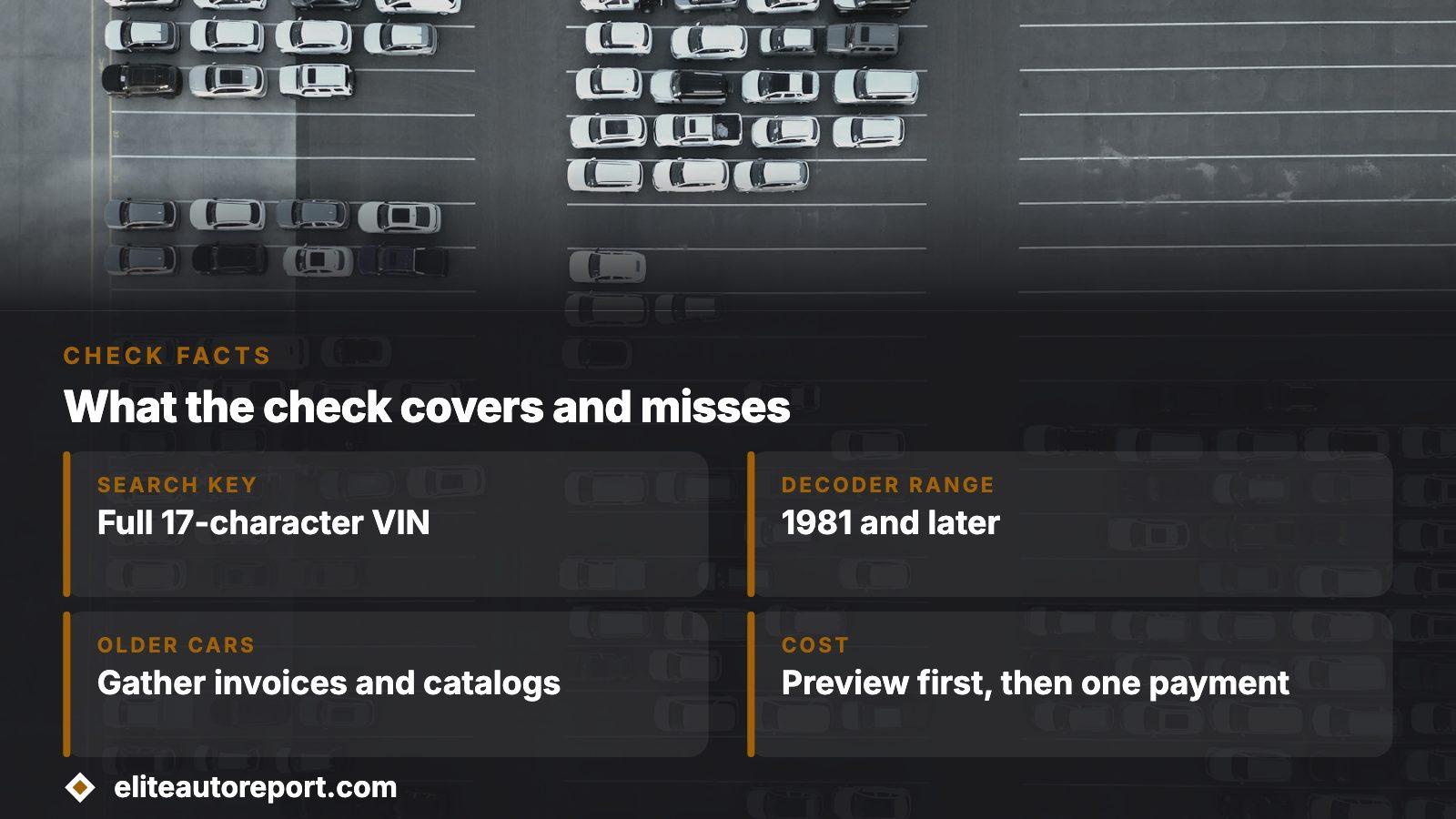
- Search key
- The full 17-character VIN
- Decoder range
- NHTSA's vPIC covers 1981 and later
- Maker recall lookup
- Searches the last 15 years by VIN
- Cost
- Free preview, then one payment
What a Lamborghini check surfaces that a listing will not
Each exotic's story is easy to tidy before the listing photos are taken. A history check pulls records the seller does not control. The federal title system, NMVTIS, gathers reports from state agencies, recyclers, salvage yards and insurers, so it can show an insurer's total-loss ruling or a hand-off to a salvage yard. The full report adds the sale record and the pictures from any auction where one is on file.
- Salvage, junk or flood brands in the title history
- Mileage readings logged over time, which makes a rollback or a long silence easy to spot
- Theft entries and insurer loss records
- Open recalls and the factory specification, for comparing against the car in front of you
Reading the 17 characters on a Lamborghini
The federal VIN rule puts the number in the cabin, legible through the glass to a viewer outside, next to the pillar on the left side of the windshield. It has 17 characters, built from digits and all letters but I, O and Q, so a lookalike for one of those three signals a misread. NHTSA's vPIC database files Automobili Lamborghini under three prefixes.
| Prefix | Type NHTSA lists |
|---|---|
| ZHW | Passenger car, Italy |
| ZA9A12 | Passenger car, Italy |
| ZPB | Multipurpose passenger vehicle |
Decodes of Gallardo and Huracan VINs began with ZHW, and an Urus began with ZPB. The seventh character is a quick sanity check: a number means the year code in position ten reads 1980 through 2009, a letter means 2010 through 2039. Entering the first 11 characters of a 2008 Gallardo with its year returned the model, a roadster body, a ten-cylinder engine and the Sant'Agata Bolognese plant. If a decode says roadster and the car on the lot is a coupe, ask why.
Older Lamborghinis and the 1981 line
NHTSA built vPIC for model year 1981 onward, and a pre-1981 year typed into the decoder brings back an invalid-year message. A classic's identity therefore rests on paperwork. NMVTIS adds a second gap: some states do not require titles for vehicles past a given age, so a title search has less to show.
- Gather every invoice, registration and auction catalog entry the seller can produce.
- Run whichever 17-character VIN the car does carry; a car from 1981 on sits inside the decoder's range.
Auction history and photos: reading a total-loss line
A total-loss line is not a verdict until you know why it was made. The auction photos show what was damaged, which is the part a bare label never tells you.
A total loss can be a recovered theft
NMVTIS explains that when 30 days pass without a stolen car being found, its insurer may record a total loss. If the car surfaces unharmed, that record is not withdrawn, and an insurer or an auction company may sell the car in sound working order. The sale photos help separate a recovered theft from a crash.
Then compare picture to car. A panel that looks freshly painted, uneven gaps or new fasteners near the pictured damage all call for repair invoices. An owner who says the car was never salvaged is making a claim until the records agree.
From an NHTSA owner complaint
A 2008 Gallardo owner told NHTSA in 2019 that the car ran sluggishly through a fast-food drive-thru, then shut down entirely, leaving only the radio working. Bystanders pushed it clear. The owner checked the battery and fuses, stressed that the car had "never been crashed or salvaged" and blamed software.
Matching records still say nothing about how the electronics behave today. That takes a test drive and a specialist's inspection.
Recalls on specific Lamborghini models
NHTSA lists campaigns by model and year range, so what is open depends on the car you are buying. A sample from its Lamborghini records:
| Model and years | Campaign | Problem |
|---|---|---|
| Aventador, 2012-2017 | 17V073 | Gasoline can reach the exhaust with a full tank |
| Aventador, 2012-2018 | 18V391 | Engine can stall during automatic downshifts |
| Aventador SV, 2015-2016 | 18V461 | Brake disc centering bolts can loosen |
| Gallardo, 2004-2006 | 12V430 | Power steering pipes can leak |
| Gallardo 2007-2009 and Murcielago 2006-2010, carbon ceramic brakes | 13V471, 13V470 | Rotor screws can fail after exposure to salt |
| Urus, 2019-2020 | 20V713 | A hot engine bay can harm the fuel line's quick connector |
Lamborghini's own recall page takes a VIN and searches campaigns from the last 15 years. The maker says recall repairs never expire and cost nothing at one of its dealers. Campaigns follow production windows, so a recalled model does not put your car on the list, and the VIN settles it.
Five steps from VIN to decision
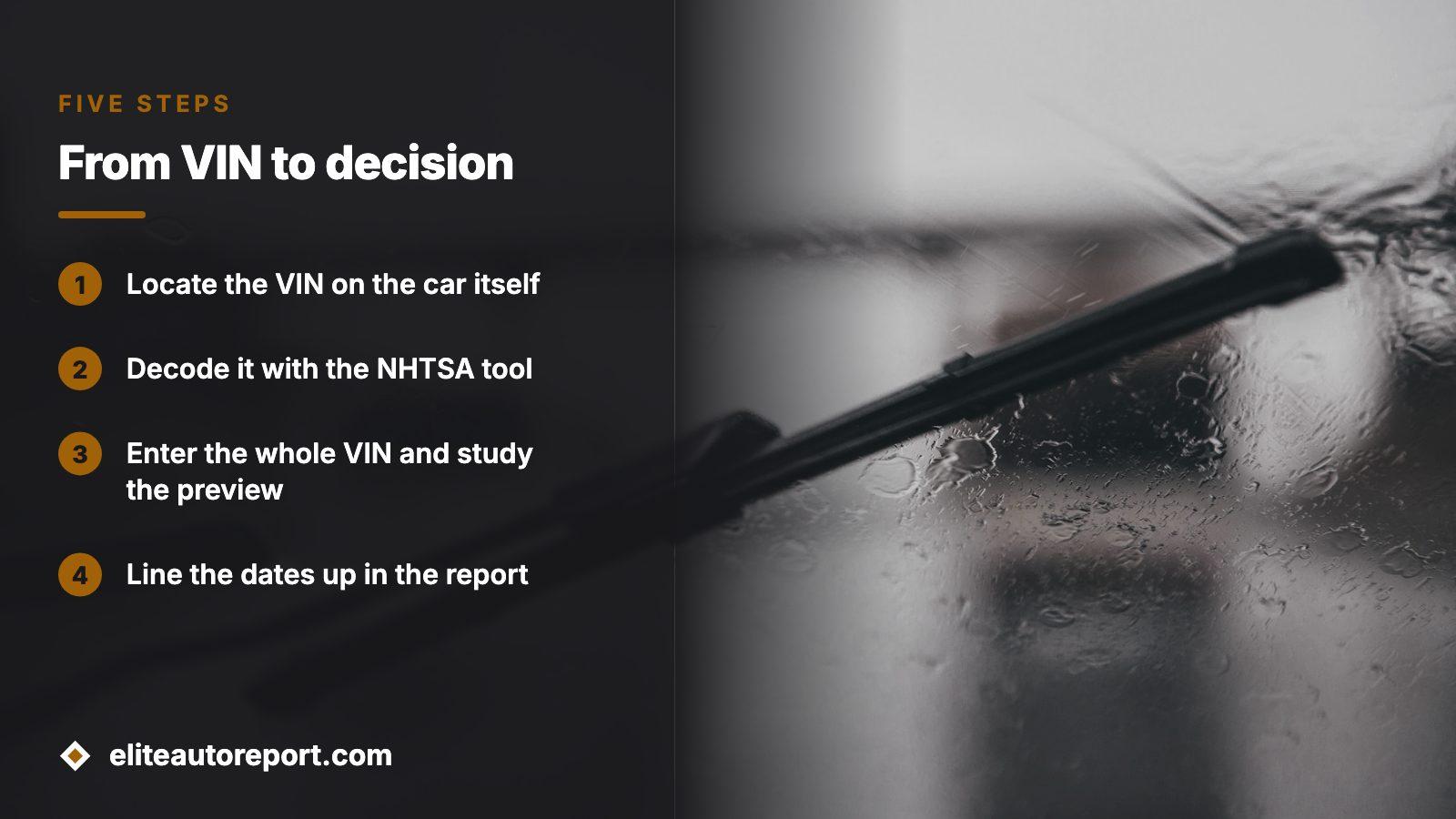
- Locate the VIN on the car itself and write down every one of its 17 characters. Hold them against the registration and the seller's documents first.
- Feed the VIN and the model year to NHTSA's decoder, then check that model, body style and engine fit the car.
- Enter the whole VIN on EliteAutoReport and study the free preview before you commit to a report.
- Open the report and line the dates up: sale, damage, repair, mileage readings. The gaps between them are where your questions belong.
- Carry the printout to a technician who services these cars, and ask the seller to explain every entry in writing.
Reading the result and the flags that matter
| Finding | What it can mean | Ask for |
|---|---|---|
| Salvage or total-loss entry | Repair judged too costly, or a theft claim settled | Auction photos and repair invoices |
| Brand from another state | States brand differently; NMVTIS keeps every reported brand | The issuing state's title record |
| Mileage that stalls or drops | A missed reading or a rollback | Dated service records |
| Nothing found | A clean car, or a gap in reporting | An inspection regardless |
An empty result is missing information, not good news. NMVTIS covers roughly 87 percent of the nation's vehicles, but only a majority of states report data to it, and its own page admits a search can come back falsely empty.
From an NHTSA owner complaint
A complaint filed with NHTSA in 2013 describes a 2004 Gallardo rented from a business for a few laps on a private track. On the seventh lap the brakes failed completely, the car left the circuit and crashed, and one person was hurt.
The record does not say what became of the car, so read it as a reason to ask, not a pattern. Ask any seller whether the car was rented or tracked, and compare the answer with the ownership and use entries in the report.
Cost, and the moves after the report
A free preview comes first. If the car merits more of your time, the full report is a single payment, available for one car or as a pack for several, and no subscription follows. Current amounts sit on the pricing page.
Take the report to the viewing. Have the seller explain each entry, hold your deposit until the answers arrive, and get a specialist to look at the areas the photos show. An entry nobody can explain belongs in the negotiation, or is a reason to leave.
Where this information comes from
- NHTSA vPIC: VIN decoder — which model years it decodes, how partial VINs and the plant field work
- 49 CFR part 565: VIN requirements — VIN length, where it sits in the car and what the seventh character signals
- NHTSA recalls API: Lamborghini campaigns — campaign lists by model and year; the same pattern covers Gallardo, Murcielago and Urus
- NMVTIS: information for consumers — where its records come from, total-loss labels on stolen cars and reporting gaps
- Lamborghini: recall campaign page — VIN lookup window, recall repairs at dealers and why similar cars can differ
- NHTSA owner complaint 11269079 — owner experience, paraphrased
- NHTSA owner complaint 10507192 — owner experience, paraphrased
Sources and photos: Facts checked against the sources above in November 2026. Photos by Miles Loewen, Thibault Valjevac and Iain on Unsplash; diagrams by EliteAutoReport.
Keep reading
- Auction History by VIN: Photos for Luxury, Exotic and Classic CarsWhat an auction history search covers and how to read the sale photos.
- Classic Car Title Search by VIN: What Turns Up and What Doesn'tSearching titles for older cars that the standard decoders skip.
- VIN Market Value for Luxury, Exotic and Classic Cars: A Five-Step CheckChecking a car's market value by VIN before you make an offer.
- Sample reportA finished report to look through before you buy one.
Frequently asked questions
Is there a free Lamborghini VIN lookup?
Partly. NHTSA's decoder reads make, model, engine and plant, and Lamborghini's recall page searches campaigns by VIN, but neither shows auction sales or title brands. EliteAutoReport covers those after a free preview; the report itself is paid once and never renews.
Can a VIN check show whether a Lamborghini was stolen or cloned?
It can show theft entries and insurer losses on file. Cloning is harder to spot: in one multistate case, authorities recovered about 250 stolen cars wearing VINs taken from matching vehicles. Decode the VIN, confirm the model and body style fit the car, and compare the records with the paperwork before paying.
Does a VIN check work on a Lamborghini built before 1981?
The decoder will not help, because NHTSA built it for 1981 and later. Some states also stop requiring titles on old vehicles, which leaves fewer title records. Gather invoices and registrations, run any 17-character VIN the car carries, and have a specialist verify what the paperwork claims.
Where do I look up open recalls for a Lamborghini?
Type the VIN into Lamborghini's recall page, which covers the last 15 years, then compare with NHTSA's list for the model year. The maker says recall repairs never expire and are done at no charge by its dealers. Ask the seller for dealer paperwork showing each repair was completed.
Does a clean Lamborghini VIN report mean the car is sound?
No. A clean report means nothing bad was recorded, and NMVTIS warns that gaps in state reporting can produce false negatives. Wear and electronics never appear in records at all. Pair the report with a specialist inspection and a long test drive
Now check the car itself
The guide explains what to look for. The report shows what this VIN has on record.