THE SHORT ANSWER
Treat the auction sheet as a seller-side snapshot from before export, not a clean-history guarantee. Ask for the original, have a translator read every note, and match the chassis number to the car in front of you. Then run the VIN through an auction history check on EliteAutoReport, which opens with a free preview before any single payment. Confirm the import paperwork separately with the federal agencies.
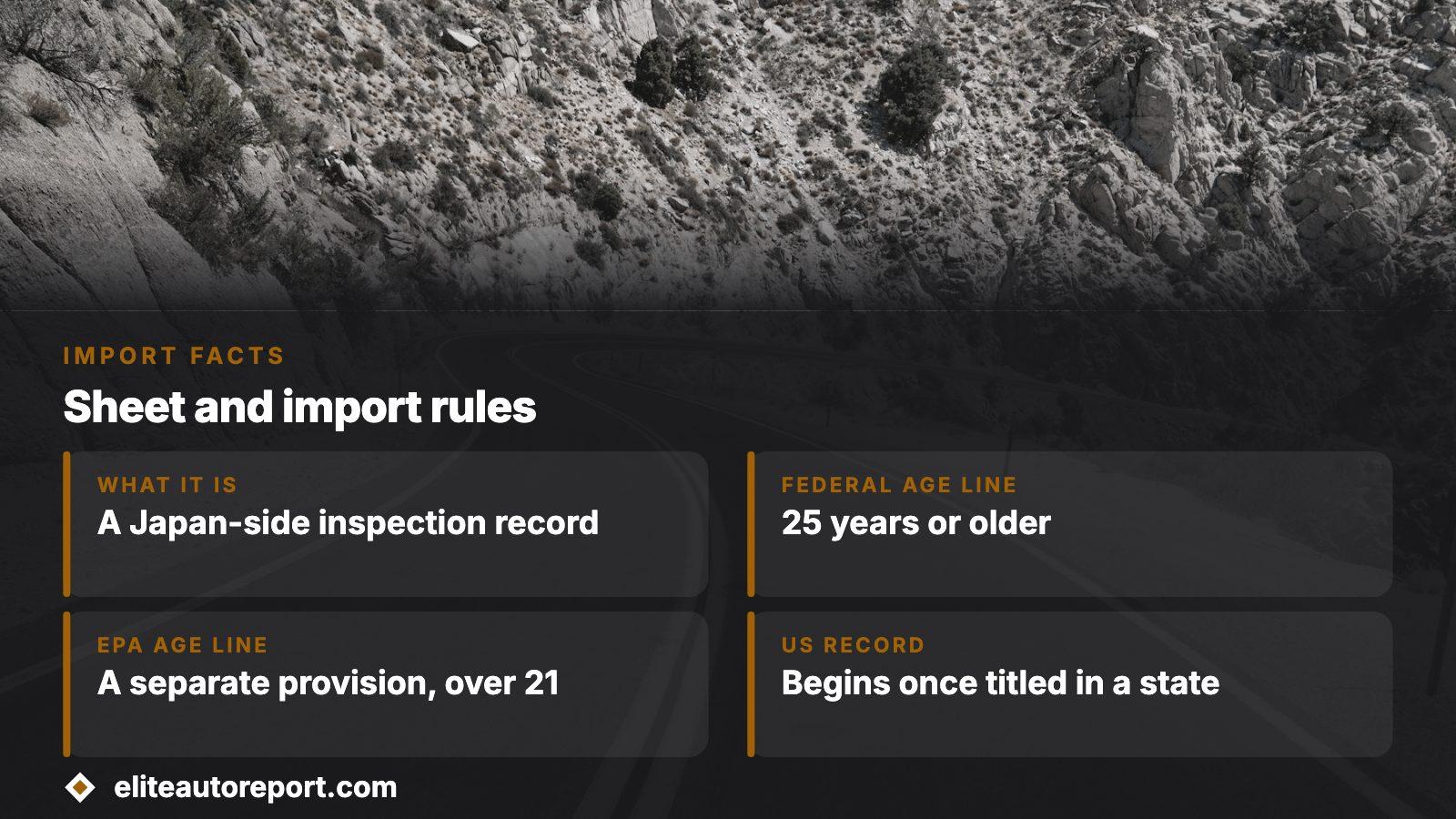
- What it is
- A Japan-side inspection record from the auction
- Federal age line
- Vehicles 25 or more years old have their own entry route
- EPA age line
- A separate provision exists for cars over 21 years old
- US record
- Begins only once the car is entered and titled in a state
What a Japanese auction sheet is, and what it is not
Exporters and enthusiasts use the phrase for the single page that an auction house in Japan produces for each lot. It carries an inspector's view of the body, interior and mileage, usually with a small diagram where marks are noted. Buyers abroad lean on it because the car itself is thousands of miles away.
What it is not: a title, a registration, a customs record or a history report. It is written for the sale, by people with a stake in the sale. Nothing on it is a government statement, and no US agency vouches for how Japanese auction houses grade cars. We could not find an official page that explains the grading scale, so read any scale an importer quotes as that importer's own explanation.
Treat it the way you would treat a seller's own description, only more detailed: useful, specific, and incomplete.
What the sheet cannot tell you about a car you will own here
The sheet is frozen at one auction date. It cannot say what happened during shipping, at the port, at the workshop that made the car road-legal, or at any later sale. It is also silent on anything that happens once a US title exists.
- Whether the car was repaired after the sheet was printed
- Whether the chassis number on the sheet is the number stamped on the car in your driveway
- Anything the seller or exporter chose not to photograph
- Liens, theft reports or title brands created on US soil
- Mileage claims made after the car entered the country
A car can have a tidy sheet and an untidy US record, and the reverse is equally possible. The two documents answer different questions, which is the reason a careful buyer wants both.
The federal import rules sit apart from the sheet
Whether a car can legally be in the country is a customs and safety question, and the sheet has no say in it. Under NHTSA's rule on declarations, the importer files a declaration with Customs at the time of entry, naming the route that applies. One route is for cars at the age of a quarter century or older, which may come in without matching today's federal safety standards.
Another route goes through a Registered Importer, needs a bond set at 150% of dutiable value, and depends on NHTSA first ruling the model and year eligible. That route is closed to a vehicle that counts as salvage or reconstructed, so a damage note on a sheet is not only a cosmetic matter for an importer.
EPA applies its own emission rules on top. Its provision for cars over 21 years old turns on the engine being identical to the one fitted at the factory, and the agency urges importers to phone its imports hotline before anything ships. A car arriving without the right arrangements risks seizure, forced export and fines.
Where a VIN check picks up the story
Here, the record begins at entry and state titling. From then on, a history report built on the full vehicle number can show what the sheet never could: a title brand added by a state, an insurer's total-loss claim, a theft record, a lien, and a later auction sale with photographs where one is on file.
That is the natural next step for a luxury, exotic or classic car, where one undisclosed repair changes the value by a lot. Start with the EliteAutoReport preview, which shows whether any record sits under the number, then judge whether one report payment is worth it for this car. No record found does not mean a clean car; it can mean a young US record, and that is worth saying to the seller out loud.
How to go through a sheet before you commit
Ask the seller for the original image, not a retyped summary, and for the auction name and lot number so the sheet can be matched to a sale. Then work through it in a set order.
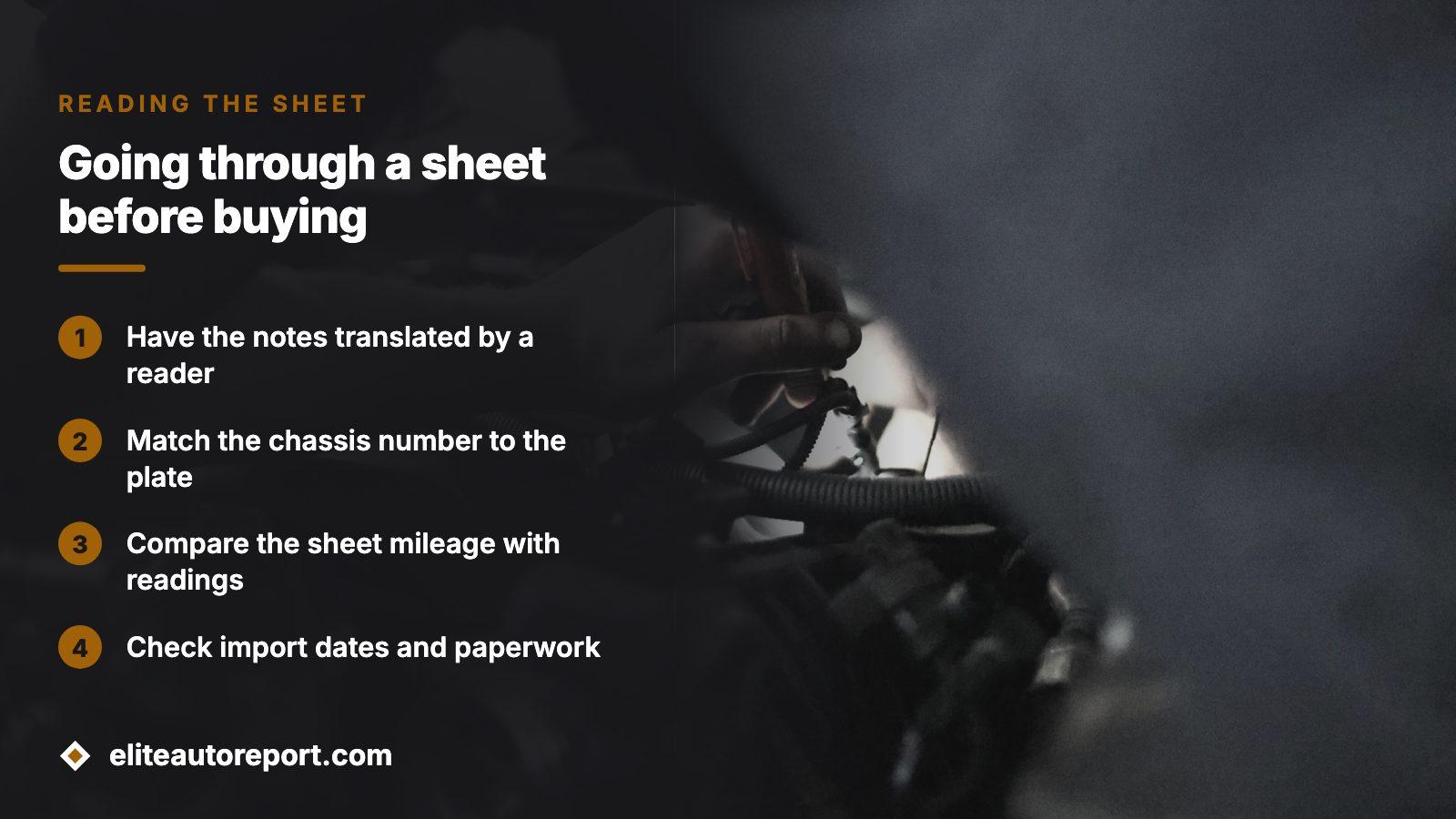
- Have the notes translated by a person who reads the language, not by a guess at the symbols
- Match the chassis number to the plate on the car and to the number on the US title or entry papers
- Compare the mileage on the sheet to the dash and to any later US reading
- Look at the body diagram and ask what each mark was, then find that area on the car
- Read the interior and under-hood notes for water, smoke, or replaced parts
Hold your money if anything fails to line up. A sheet belonging to some other car is worse than having no sheet.
Red flags worth stopping for
Most trouble comes from gaps and mismatches rather than from one dramatic line. A seller who cannot name the auction, a sheet with a different chassis number, or a car whose body marks do not match the diagram all point the same way: the paper may belong to another car, or the car has changed since.
| What you see | What to do |
|---|---|
| No sheet, only photos of one | Ask for the auction name and lot, and treat the car as undocumented until you get them |
| Chassis number differs from the car | Walk away until the seller explains it in writing |
| Repair noted, but the car looks flawless | Have a body shop measure paint and panel gaps |
| Mileage on the dash is lower than on the sheet | Do not proceed on the dash figure |
| Entry papers unavailable | Ask how the car entered, and check with the federal agencies before buying |
A damaged car that was imported on a route barred to salvage vehicles deserves even more questions, since the sheet and the entry route should tell the same story.
What it costs and what to do next
Reading a sheet costs only your time and a translator if you need one. On EliteAutoReport the VIN check opens with a free preview; one payment then covers the full report for that car, and nothing renews. Current prices are on the pricing page. If you are weighing several imports, a pack of reports covers more than one number.
Before you pay for anything, collect three things from the seller: the sheet, the US title or entry paperwork, and the full vehicle number. Run the check, compare it to the sheet line by line, then book an independent inspection. If the paperwork is in doubt, call NHTSA or the EPA imports hotline before the car is yours.
Where this information comes from
- eCFR: 49 CFR 591.5, declarations required for importation — the entry routes, including the age route and the salvage bar
- NHTSA: Importing a Vehicle — declaration form, eligible vehicle lists and Registered Importers
- EPA: Learn About Importing Vehicles and Engines — emission rules, ICI route and the older-vehicle provision
- VehicleHistory.gov: NMVTIS — what the federal title system is for
Sources and photos: Facts checked against the sources above in November 2026. Photos by Masjid MABA, Mustafa Sheikhmouss and Will Truettner on Unsplash; diagrams by EliteAutoReport.
Keep reading
- Auction History by VIN: Photos for Luxury, Exotic and Classic CarsHow a recorded sale shows up under a VIN.
- Car Auction Photos by VIN: Find Salvage Sale Pictures Before You BuyWhere sale pictures come from and what they show.
- Nissan GT-R VIN Check: Auction Photos, Titles and RecallsA popular import candidate, checked by VIN.
- Mk4 Toyota Supra Buyer's Guide: Records, Recalls and Red FlagsBuyer's guide for another car often bought from Japan.
Frequently asked questions
Is a Japanese auction sheet an official document?
No. It comes from the auction house, not from a government. It records an inspector's opinion at the time of the sale. That makes it helpful evidence about the car in Japan and no proof of a clean title, correct mileage or lawful entry into the United States.
Can I run a US VIN check on a car that has only a Japanese chassis number?
Not usefully before the car is entered and titled here. A US history report depends on records created in this country. Once a state title exists, the full number can be searched, and the preview shows whether anything is on file.
Does a good sheet mean the car can be imported?
No. Import eligibility is decided by the federal rules, not by the sheet. Check the entry route with NHTSA and the emissions side with EPA. A car that is old enough may have an easier route, but the paperwork still has to be filed correctly.
What if the seller will not show the original sheet?
Treat that as a warning. A retyped summary can leave out the marks that matter. Ask for the image, the auction name and the lot number. If the seller still refuses, price the car as undocumented or look elsewhere.
Who should translate the sheet?
Someone who reads the language and knows how these sheets are marked up, not a machine guess at the symbols. Ask the translator to read every note and diagram mark aloud, then compare each one to the car in person.
Now check the car itself
The guide explains what to look for. The report shows what this VIN has on record.