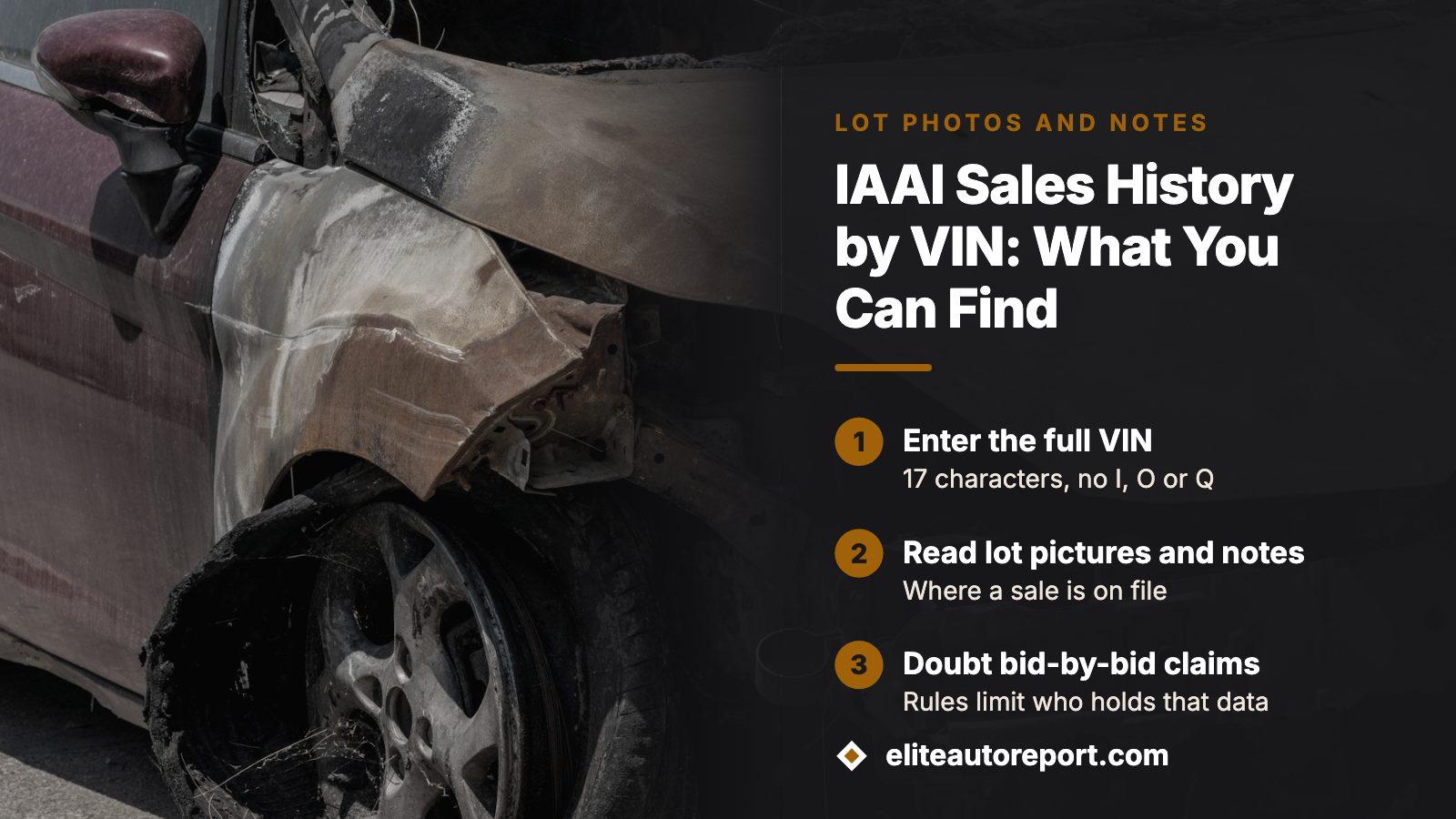
THE SHORT ANSWER
Put the whole VIN into EliteAutoReport and read the free preview. The auction section lives in the paid report, and where an IAA sale is on file it can show lot pictures and condition notes, not a promised list of every bid. IAA's published rules limit who may keep or pass on bid and price data, and I found no public archive of it, so be wary of any site that offers bid-by-bid history.
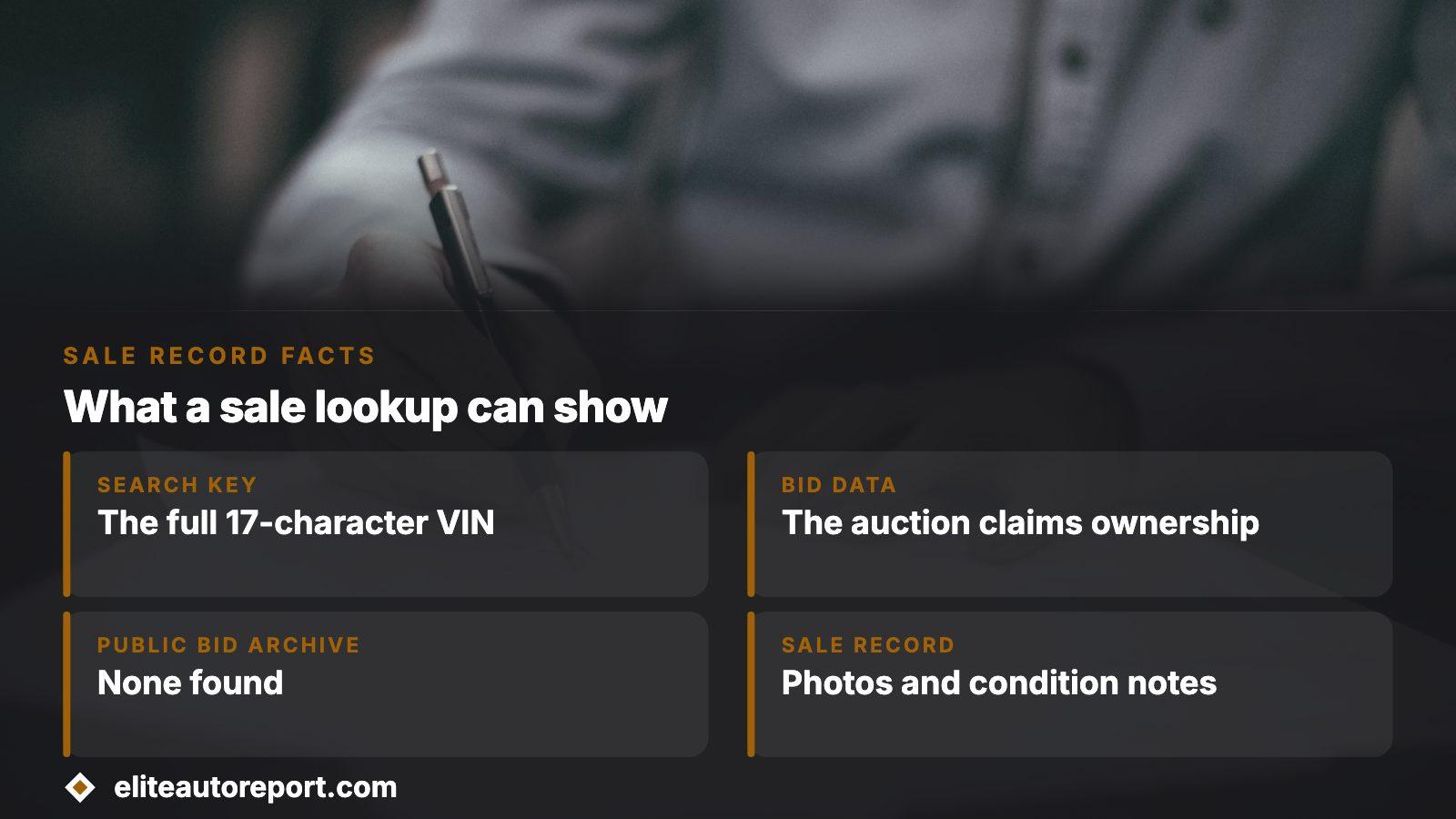
- Search key
- The full 17-character VIN
- Bid data owner
- IAA claims ownership of bid amounts and prices in its rules
- Cost
- Free preview, then a one-time payment per report or pack
What people mean when they ask for IAAI sales history
The search covers two different wishes. One is to learn whether a car ever went through an IAA lane, and what condition it was in when it did. The other is to learn what it sold for and how hard the bidding ran, usually so a buyer can judge an asking price.
The first wish can often be met from a VIN. The second runs into IAA's own terms, covered below. On a high-end or collector car the first answer carries more weight anyway: a past lane visit points to damage, a title change or a total-loss decision, and those move value much further than one hammer price.
What IAA says about its bid and price data
IAA's Auction Rules coin a term, Auction Data, for bid amounts, pricing and results, details lifted from product pages, and any audio or video of a sale. A registered buyer may use it for one purpose only, bidding. Keeping, passing on or reselling it requires IAA's written permission, and IAA says it and its licensors hold the ownership.
Read that as a buyer, not a lawyer. It means a stranger's list of what IAA cars fetched is not a neutral public record. If a site shows you bid-by-bid history, ask where the data came from. I opened IAA's vehicle information page too, and it describes imagery, a VIN decoder and history reports for registered buyers, with nothing about a public archive of past bids.
What a past sale record can hold
When a sale is on file for your VIN, these are the items worth looking for, and what each one cannot do for you.
| Item | What it tells you | Limit |
|---|---|---|
| Lot photos | The car as it sat before any later repair | IAA says images do not show full condition |
| Damage label | A first pointer to what the loss was | IAA says the label is not exhaustive |
| Title type at sale | Clear or salvage when listed | Brands can change later; check the state record |
| Sale date | Where the car sits in its timeline | A date does not say who bought it or why |
| Intake mileage | A reading to compare with later odometer entries | IAA disclaims responsibility for odometer discrepancies |
Why one sale price can mislead you
IAA says every vehicle is offered with reserve. A sale needs the consignor's approval, and a minimum bid may have to be met first. If the auctioneer closes without that, IAA may bring the consignor's counteroffers to the buyer, and a proxy bid can accept one automatically when it falls inside the buyer's set maximum.
The same rules let IAA reject or void bids, and cancel a sale before the buyer has the assigned title. So a bid on screen is not always a completed sale, and a completed sale is a poor stand-in for market value. A cheap result on a rare car may reflect heavy damage, a salvage brand or a hurried consignor, not a bargain you can repeat.
Steps for looking up one VIN
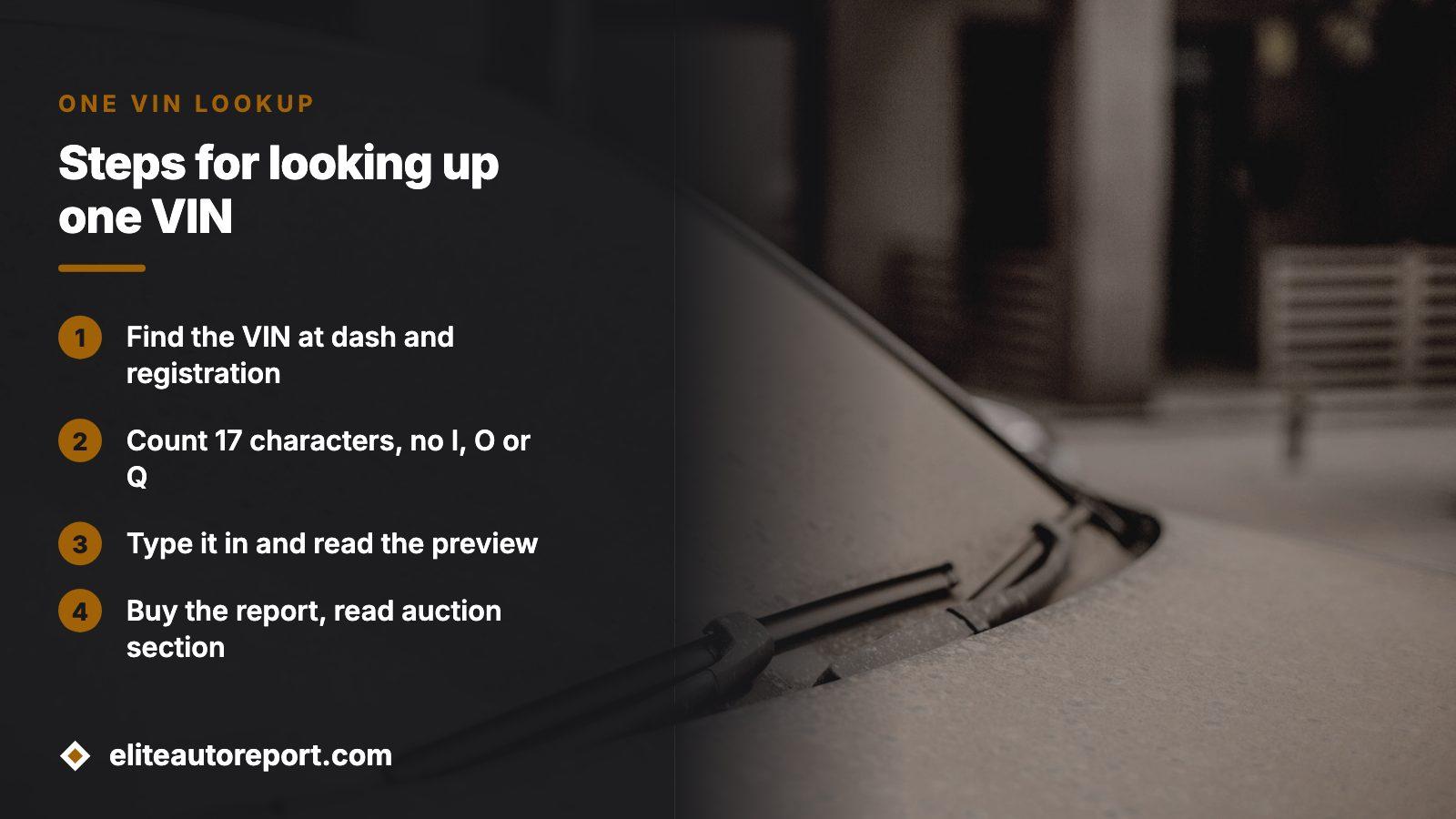
- Find the VIN where it shows through the glass at the dash, then find it again on the registration card. Both must match.
- Count the characters: 17 in all, with no I, O or Q anywhere. Any of those letters means a misread.
- Type it into EliteAutoReport and read the free preview.
- If you want to go on, buy the report and turn to its auction section. Note the sale date, title type, damage label and mileage.
- Hold those notes up to what the seller told you and to the odometer today. Raise any entry the seller left out.
Reading the result on a luxury, exotic or classic car
Start with the photos and ask what is missing. On a car with aluminum panels, carbon tubs or hand-built engines, a repair done by a general shop can look fine and still be wrong. IAA names electrical, suspension, frame and water damage among the places hidden harm can sit.
Then compare the sale date with the car's service story. A seller who says the car never had a claim but whose VIN has an IAA lot is worth a polite, direct question. Many such cars were insurer total losses that were repaired well, and the right response is a specialist inspection of that make, not a walk-away or a handshake.
A clear title is not a clean history
IAA's rules warn that a car with a clear title can still have a salvage history. They send buyers to vehiclehistory.gov and say the brand should be confirmed before any repair work starts.
Red flags in an auction entry
- A lot photo showing damage the seller's description leaves out.
- Intake mileage higher than the current odometer.
- A salvage-type title at sale and a clean-looking title now, with no rebuilt brand in between.
- A short gap between the sale date and the car appearing in a private ad.
- A website that promises full bid-by-bid history for any VIN without saying where it gets that data.
One flag is a reason to ask questions. Several together are a reason to pay for an independent inspection before you talk price.
The official records that sit beside an auction entry
Under federal rules an auction company has to keep four items per vehicle for five years from the sale: the previous owner (not counting the company), the buyer, the VIN, and the mileage shown when the company took possession. Photos and bid amounts are absent from that list, so the odometer is the figure a regulator expects to exist, and the price is not.
NMVTIS, the Justice Department's title database, covers a different slice. It reports title data, the latest odometer reading, brand history and some theft history. Its FAQ names salvage auctions as reporting businesses, and says insurers report total losses for the model year in progress plus four earlier ones. The consumer report is deliberately short and can miss a record, so read the state's own title file when you can.
What it costs and what to do next
Previewing a VIN carries no charge. The report is bought once, with no subscription, and the pricing page lists what one report or a pack runs now. Only the report holds the auction section, so the preview alone will not give you the whole record.
Once you have the entry, treat it as one input. Get a specialist inspection, read the state title record, and use any past damage to negotiate. A well-repaired car with a documented history can be a sound purchase, and a car with a hidden one rarely is.
Where this information comes from
- IAA: auction rules — how IAA defines and restricts auction data, reserve and counteroffers, bid rejection and title warnings
- IAA: vehicle information — the imagery, VIN decoder and history reports IAA describes for registered buyers
- NMVTIS: information for consumers — what the federal title database holds and why a short report can miss records
- NMVTIS: frequently asked questions — which businesses must report salvage and total-loss vehicles
- 49 CFR part 580: odometer disclosure requirements — what an auction company must keep for each vehicle it sells
Sources and photos: Facts checked against the sources above in November 2026. Photos by engin akyurt, JavyGo and Scott Graham on Unsplash; diagrams by EliteAutoReport.
Keep reading
- IAAI VIN Check: IAA Auction History for Luxury, Exotic and Classic CarsHow a VIN lookup of an IAA record works and how to read the photos.
- Copart Sales History by VIN: Find Out If a Car Was Sold ThereThe same question for the other large salvage auction.
- Car Auction Photos by VIN: Find Salvage Sale Pictures Before You BuyWhat lot photos can and cannot prove about a car.
- PricingWhat one report or a larger pack costs, paid once.
Frequently asked questions
Can I see IAAI bid history for any VIN?
Not as a public service that I could find. IAA's rules call bid amounts and prices its own data and limit registered buyers to using it for bidding. A report can still show whether a sale is on file and what the lot looked like, which is usually the more useful half.
Does IAAI sales history show the final price?
Do not count on it. IAA publishes no archive of past prices that I could open, and a price alone can mislead, since sales are with reserve and can be countered, voided or canceled before title passes. Condition, title type and mileage tell you more about a car.
Is there a free IAAI sales history check?
Parts of the picture cost nothing. EliteAutoReport gives a free preview, and federal tools such as NMVTIS list their approved providers. None of them is a free copy of IAA's bid log, and the full report is a paid step after the preview.
What if my VIN shows an IAA sale the seller never mentioned?
Ask when the sale happened, what the damage was and who repaired the car, and request the shop invoices. Then have a specialist for that make inspect it. Many cars with a past loss are fine, but the price should reflect the history.
Why does a sale price differ from what a car is worth?
A lot price reflects the damage, the title type, the reserve and the consignor's position on that day. Two identical models can sell far apart for those reasons, so use the entry to understand the car's history, not to set a value.
Now check the car itself
The guide explains what to look for. The report shows what this VIN has on record.