
THE SHORT ANSWER
An owner cannot get a true auction or salvage entry deleted, so treat any service that promises to scrub one with suspicion. A wrong entry can be fixed, but only by whoever filed it: the insurer or salvage yard for total-loss data, the state motor vehicle agency for title and odometer data, the reporting police agency for theft. Repairs and rebuilt inspections add lines to the record; they do not erase the earlier ones.
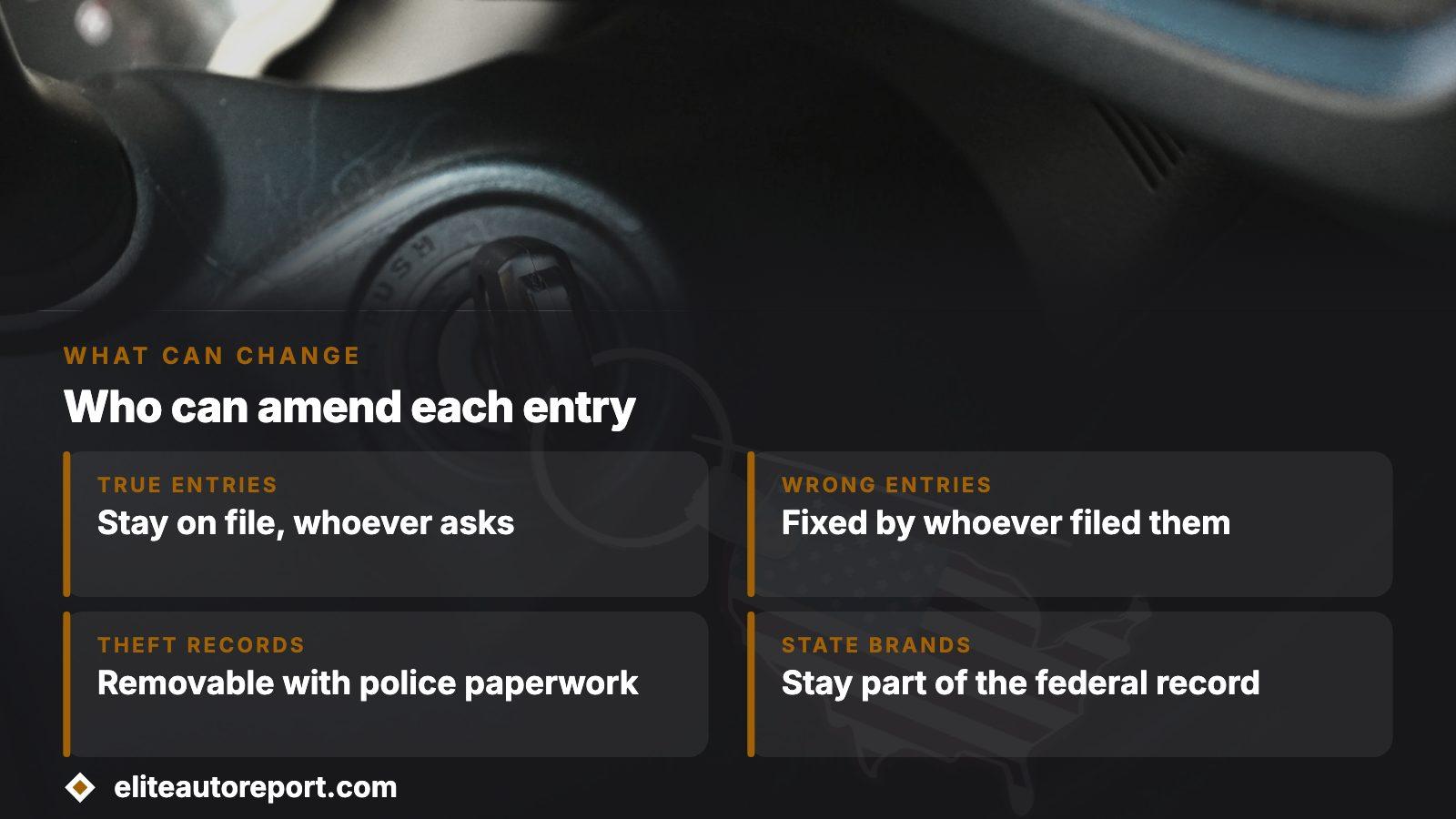
- True entries
- Stay on file, whoever asks
- Wrong entries
- Amended only by the business or agency that filed them
- Theft records
- Held by NICB, removable with police paperwork
- State brands
- Remain part of the federal record once applied
Why an auction record is so hard to remove
A car's history is a stack of reports written by other people, not a folder the owner controls. An insurer tells the National Motor Vehicle Title Information System, or NMVTIS, when it classes a car as salvage or a total loss. A salvage yard reports the cars it takes in, and a state titling office reports each brand it puts on a certificate. The company that ran the auction keeps its own sale entry and photos.
Because the owner is not the author, the owner cannot strike a line. The Justice Department's NMVTIS pages say a brand applied by a state becomes a permanent part of that car's record there. Its help pages describe amendments made by the reporting business, never removal on request, and the federal rules for insurers and yards include no appeal step.
Correcting is not deleting
A correction swaps a wrong statement for a right one, such as a repaired VIN or an updated outcome. Wiping a true statement is what most sellers want, and no official page we read provides for it.
Who can amend each kind of entry
Where a complaint goes depends on who wrote the entry. The Justice Department's contact page for NMVTIS divides the work as shown below, apart from the last row, which covers the sale listing.
| Entry that looks wrong | Who filed it | Who can change it |
|---|---|---|
| Junk or salvage intake | The yard or recycler that took the car | That business, through its reporting service |
| Insurer total loss | The insurance company | That insurer, by submitting an amendment |
| Title brand or odometer reading | The state titling agency | The motor vehicle agency of the same state |
| Theft record | The police agency that reported it | That agency, with paperwork NICB accepts |
| Auction listing, photos, sale entry | The company that ran the sale | Only that company; no public process found |
Theft entries live in NICB's system, not in the federal title system. NICB wants proof from the police agency that the car was recovered or that the entry was filed by mistake. The contact page gives no direct details for any of these parties, so you will have to find them.
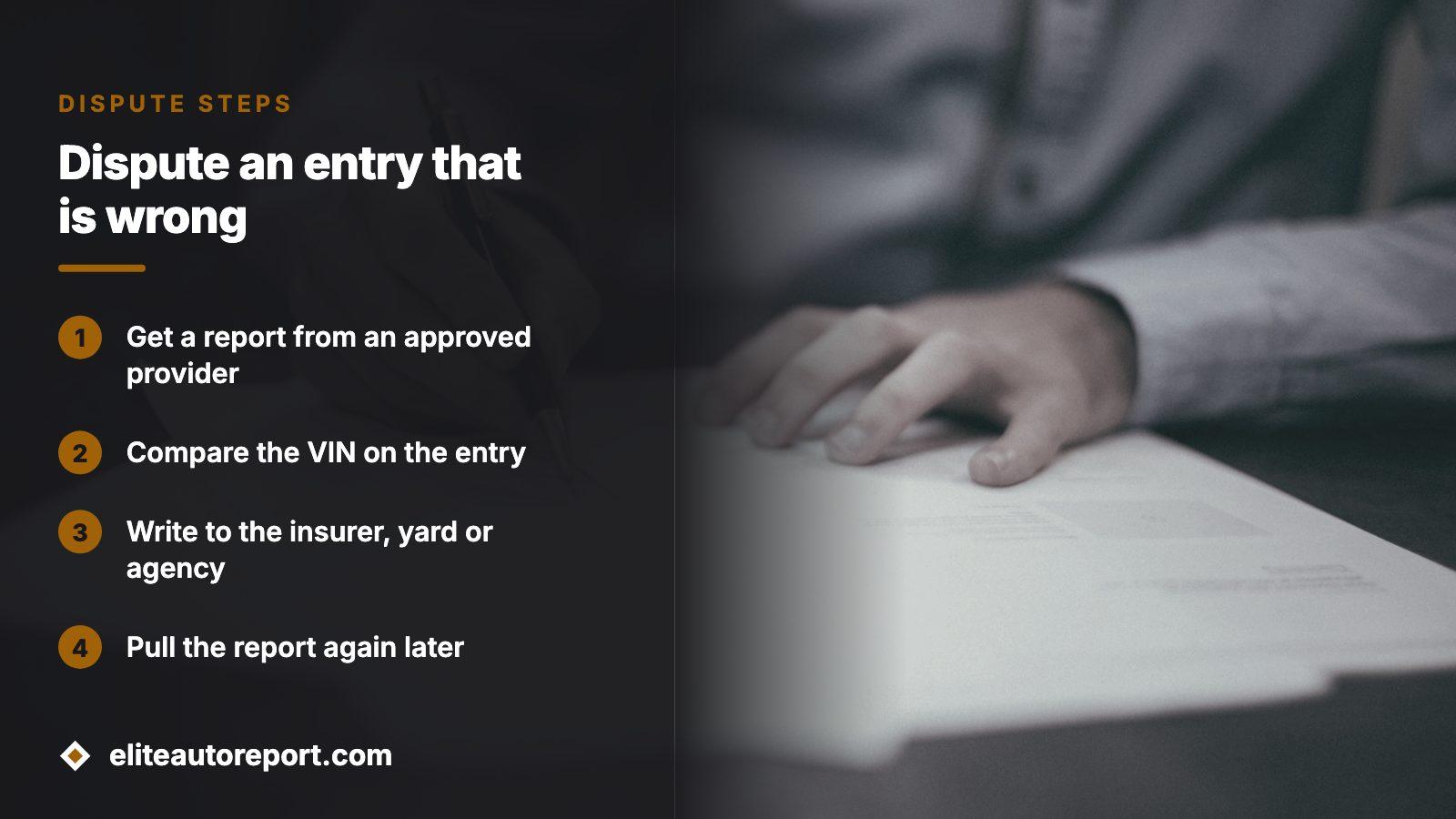
How to dispute an entry that is wrong
- Get a report from an approved NMVTIS data provider and note which business or agency is named beside the entry you dispute.
- Compare the VIN on the entry, character by character, with the car and its title. An entry filed under a mistyped number may belong to another car, and that fix goes through the reporting service that accepted the record.
- Write to the named insurer or yard, or to the state agency for title and odometer entries. Name the entry, say what is wrong, and attach proof such as the title, an invoice or a dated photo.
- For a theft entry, begin with the police agency, then give NICB the recovery or error paperwork it asks for.
- Pull the report again later. States send updates on different schedules, from real time to several days.
If the provider that sold you the report has a support desk, use it too; the federal FAQ names it first.
What changes a record without deleting it
Several events change how a car reads on paper, and each one adds to the file.
- A rebuilt inspection. Texas, for one, describes a rebuilt vehicle as a former salvage car that passed anti-theft and safety inspections. The title type changes, while the federal pages say a state-applied brand stays part of the car's record.
- A yard's update. A yard that first reported no outcome, or the wrong one, files a supplemental report once the car is sold, scrapped or crushed.
- A move to another state. The receiving state's own law decides how it titles the car, and federal rules do not force it to copy the old brand.
- A junk finding. Texas says a junk vehicle can never be titled or registered again, so no rebuild follows.
None of these is a deletion. A seller who says the history was cleaned usually means one of them, and each leaves a trail you can read. A clean-looking title issued recently in another state is a reason to look harder.
Why high-value and older cars read differently
On an expensive car, the pre-repair photo set is often the entry an owner would most like to lose. It shows the car as it arrived, before panels, glass and trim were replaced. The federal report rests on five indicators and photos are not among them, so the pictures sit with the company that ran the sale.
Age cuts the other way. Insurer reports reach back only a few model years, while yards report every model year, with enforcement concentrated on April 2009 onward. A classic written off long ago can carry no federal entry at all.
Silent gap or scrubbed record
From outside the two look identical. Dated photos, repair invoices and a specialist's inspection tell you which you face, so ask for them before talking price.
When a seller says the history was cleared
Official channels do not wipe a true entry, so a claim that one was removed is something to test.
- Ask what was removed, who removed it, and for the letter from the business or agency that amended it.
- Run the VIN yourself and read the sale dates, mileage readings and title types in order. A gap in the sequence deserves a question.
- Request the full state title record, which holds more than the federal report does.
- Ask for repair invoices that name the shop, plus photos from before and after the work.
- Book an independent inspection. The federal pages recommend one, and Texas advises doing it before any payment, a deposit included.
A seller who refuses all of these has answered you without a word.
If you are the one selling the car
A true entry cannot be wiped, so the practical goal is to make it harmless. Start by seeing what a buyer will see. EliteAutoReport's free preview takes the VIN, and the full report then shows any auction sale entries and photos on file beside title brands and odometer readings. The report is one payment, with packs for comparing several cars, and the pricing page has the details.
- Gather the paperwork: invoices naming the repair shop, photos from before and after the work, and a recent independent inspection.
- Disclose the sale yourself and hand over the documents before the buyer finds the entry.
- Correct anything genuinely wrong at its source, using the route above, before you advertise.
- Ask your state's motor vehicle agency what a seller has to disclose.
A dated paper trail answers the first question before the buyer asks.
Where this information comes from
- DOJ NMVTIS: Contacting NMVTIS Responses — Shows who amends salvage, total-loss, title, odometer and theft entries, and what NICB asks for.
- DOJ NMVTIS: Frequently asked questions — Backs the point that errors go back to the filer, that removal is not addressed and how reporting windows differ.
- DOJ NMVTIS: Information for consumers — Backs the permanence of state brands and the warning that coverage gaps can hide history.
- DOJ NMVTIS: State participation — Backs the rule that the receiving state's law decides how a moved car is titled.
- 28 CFR 25.55: Responsibilities of insurance carriers — Backs the insurer's monthly report, the model-year window and the absence of an appeal step.
- 28 CFR 25.56: Responsibilities of junk yards and salvage yards — Backs the yard's duty to file an update when a car's outcome changes.
- Texas DMV: Title Check, Look Before You Buy — Backs the rebuilt and junk definitions and the advice to inspect before paying.
Sources and photos: Facts checked against the sources above in November 2026. Photos by Anastasiia Nelen, Scott Graham and Jake Kling on Unsplash; diagrams by EliteAutoReport.
Keep reading
- Auction History by VIN: Photos for Luxury, Exotic and Classic CarsWhat an auction history check by VIN returns, photos included.
- Is It Bad if a Car Was Sold at Auction? Luxury, Exotic and Classic CarsWhether a sale at auction is a warning or routine, by type of sale.
- Sample reportA finished report to look over before you buy one.
- Car Auction Results Database: Where Classic Car Results LiveCollector and classic sales, which follow their own record trail.
Frequently asked questions
Can I delete my car's auction history?
Not a true entry. The federal title system's help pages describe corrections filed by the business or agency that reported an entry, and a state brand stays part of the car's record there. A wrong entry can be amended. Photos and listings held by an auction company are its own records, and we found no public process for removing them.
Who do I contact about a wrong salvage or total-loss entry?
The business named on the entry: the insurer for a total loss, the yard or recycler for a junk or salvage intake. Buy a report from an approved NMVTIS provider first so you can point to the exact line, then ask that business to submit an amendment. Keep your title, invoices and dated photos ready.
Does a rebuilt title wipe out the salvage record?
No. A rebuilt inspection changes the title type, and Texas describes rebuilt as a former salvage car that passed anti-theft and safety checks. The earlier brand stays in the federal record. A buyer sees a car that was written off and repaired, which is a different story from a car never damaged.
Can a theft record be taken off a car?
Yes, when it is wrong. Theft entries are not in the federal title system; they sit in the NICB database. NICB asks the police agency that reported the theft for proof that the car was recovered or that the entry was filed in error. Start with that agency, not with a history-report seller.
Is an old classic with no auction entry in the clear?
Not necessarily. Insurer reports reach back only a few model years, and yard reporting has been enforced mainly from April 2009 onward, so an older write-off may never have reached the federal record. Ask for the state title file, dated photos and service invoices, then have a specialist inspect the car.
Now check the car itself
The guide explains what to look for. The report shows what this VIN has on record.