
THE SHORT ANSWER
NHTSA holds 323 owner complaints for 1984 through 1996 Corvettes, with the heaviest counts in 1996, 1994 and 1990. Recalls cluster early: 1984 has six campaigns, while 1994 to 1996 show no General Motors campaign. Fire risks sit in the 1990 fuel lines and the 1992 and 1993 power steering hose. Confirm those repairs were done, then run the VIN for title brands, auction photos and odometer history.
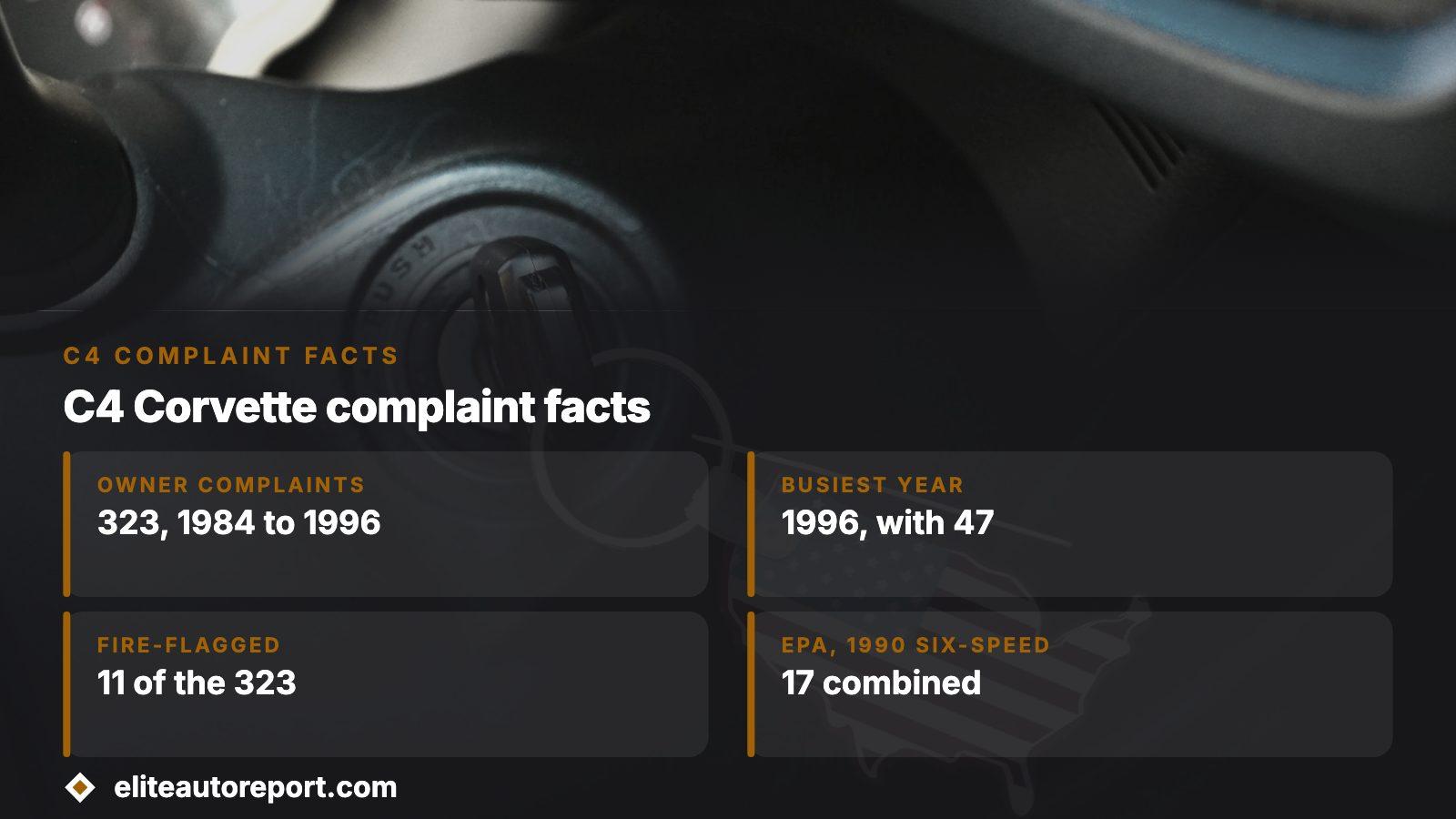
- Owner complaints, 1984 to 1996
- 323 at NHTSA
- Most complaints in one year
- 47, for 1996
- Fire-flagged complaints
- 11 of the 323
- EPA rating, 1990 six-speed
- 15 city, 23 highway, 17 combined
What the government files cover for these cars
Federal databases do not use the enthusiast label C4. They file everything under make Chevrolet, model Corvette and a model year, so I pulled each year from 1984 through 1996 and read the results myself. Production of this generation ran across those thirteen model years, and the record is uneven: some years have a long list of campaigns, others almost nothing.
Treat the numbers as signals, not failure rates. A complaint is an owner writing to NHTSA, often years after the event, and NHTSA does not know how many cars were on the road. Even so, a pattern that shows up in dozens of filings is worth a question to the seller.
Read the year off the VIN before you read the listing
Every C4 carries a 17-character number, and the tenth character is the model year. NHTSA's decoder turned partial patterns into the right year each time I tried: E gave 1984, K gave 1989, L gave 1990, N gave 1992 and S gave 1995. Each one also came back as a coupe with a 5.7 L eight-cylinder from the Bowling Green plant.
Decoder errors about an incomplete number only mean the pattern was partial. A full number that decodes to the wrong year, or to something other than a V8 Corvette, is a different matter, and it should stop the conversation until the seller explains.
Recalls worth asking about, year by year
General Motors campaigns listed for these cars are mostly small and old, which means paperwork may be thin. The table keeps only the ones that matter for a car you might drive home.
| Campaign | Model years | What NHTSA says |
|---|---|---|
| 83V064000 | 1984 | Caliper bolts were coated with a slippery material and could loosen. Dealers fit new bolts. |
| 85V118000 | 1984 | Rear differential cross shaft snap rings can be lost, which could lock the rear wheels. |
| 86V120000 | 1986 | Hard braking can damage the master cylinder center valve and cost the front brakes. |
| 88V017000 | 1988 | A missing weld could let a wheel center separate from the rim. |
| 90V032000 | 1988 and 1989 | The rear wheel tie rod can fatigue and fracture, risking loss of control. |
| 90V008000 | 1990 | Fuel line ends have the wrong flare and could leak into a fire in the engine bay. |
| 92V160000 | 1992 and 1993 | A cracked power steering inlet hose can throw flammable fluid around the engine bay. |
| 91V143000 | 1984 to 1991 | Seat belt retractors can jam so the belt will not pull out. |
Years 1994 through 1996 show no General Motors campaign in the API. That is a point in their favor, though not a clean bill of health, as the complaint counts below show.
Where owners complained most
Counts by model year read: 1984 has 22, 1985 has 16, 1986 has 17, 1987 has 21, 1988 has 17, 1989 has 15, 1990 has 39, 1991 has 24, 1992 has 8, 1993 has 22, 1994 has 40, 1995 has 35 and 1996 has 47. Two things stand out. The 1992 car is the quietest in the file, and the last three years are the noisiest.
Across all 323 filings, seat belts are named most often at 64, then the electrical system at 48 and service brakes at 37. Air bags appear 25 times, which is worth knowing because the later cars were the ones fitted with them. Fires are rarer: 11 complaints carry the fire flag, four of them for 1996.
The steering hose in an owner's words
Recall 92V160000 exists because a high-pressure hose can break and soak the engine bay in flammable fluid. The complaint file shows what that looks like from the driver's seat.
From an NHTSA owner complaint
A 1993 Corvette owner wrote that assist vanished at highway speed after a hose split, and fluid went everywhere under the hood. By the owner's account, the dealer was aware of the problem and nothing had been fixed. A recall on paper does not prove the car in front of you ever got the part.
On a 1992 or 1993 car, look at the hose, the pump connection and the area around the exhaust for oily residue, and ask for a repair order that shows the replacement.
Electrical faults and the fire flag
Eleven fire complaints is a small number against 323, but the stories are consistent: wiring, a fuse box, a starter that kept cranking. Several happened with the car parked.
From an NHTSA owner complaint
A 1995 Corvette owner reported the car was parked with the engine off when it began to burn. A fire marshal pointed to an electrical malfunction near the battery and fuse box area, and the car was totaled. Few buyers get a warning like that, so inspect the wiring with the car cold.
Look for melted insulation, amateur splices behind the fuse box and aftermarket stereo or alarm wiring, and treat a car with a history entry for a fire or total loss as a different purchase.
Engines, gearboxes and what they burn
Every C4 in the EPA files is a 5.7 L V8 with rear-wheel drive. The 1984 car came with a four-speed automatic or a four-speed manual and is rated 13 city, 20 highway and 15 combined with the manual. By 1990 EPA lists a six-speed manual at 15 city, 23 highway and 17 combined, plus a four-speed automatic at 15, 22 and 17. For 1996 the six-speed manual is rated 15, 24 and 18.
- Expect the 1990 car to want premium gasoline, per the EPA listing.
- Confirm the transmission matches what the listing says, since automatics and manuals have different problems.
- Compare dated odometer readings, because low mileage on a car this old needs evidence.
What auction and title history adds to a C4
These cars changed hands often, were raced, and many were crashed. A clean-looking Corvette can still have gone through a salvage auction, and the photos from that sale show the damage before the repair. EliteAutoReport pairs a VIN with auction sale records and photos, plus title brands, odometer readings and theft entries where they exist.
The federal title system keeps a running record of junk, salvage and flood labels from any state, plus odometer readings and total loss history. Its own guidance suggests a mechanic's inspection as well. The preview tells you whether records exist; the full report is a one-time payment, with details on the pricing page.
A sensible order of checks
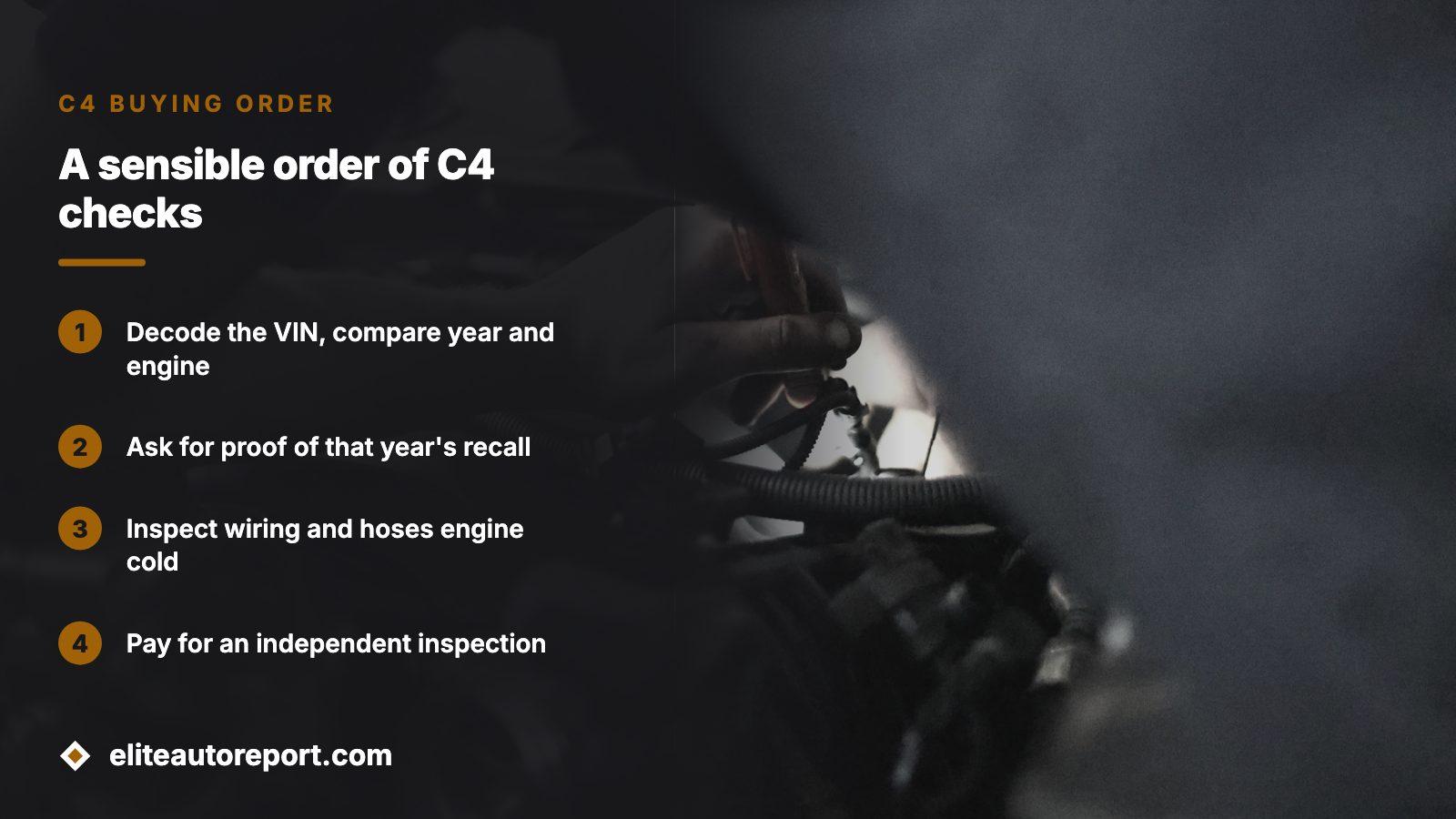
- Decode the VIN and compare the year and engine with the advert.
- Run the history report and read title, auction, photo and odometer entries.
- Ask for proof that the recall for that year was done, especially fuel lines in 1990 and the steering hose in 1992 and 1993.
- Inspect the wiring and hoses under the hood with the engine cold.
- Pay for an independent inspection before any money moves.
Paperwork problems are the cheapest to find, so let them end a bad deal early.
Where this information comes from
- NHTSA recalls API: 1990 Chevrolet Corvette — campaigns, dates and remedies for the years covered
- NHTSA complaints API: 1994 Chevrolet Corvette — owner complaint counts and components by year
- NHTSA owner complaint 839723 — owner experience, paraphrased
- NHTSA owner complaint 893829 — owner experience, paraphrased
- NHTSA vPIC VIN decoder — how the tenth character maps to the model year
- EPA fueleconomy.gov: 1990 Chevrolet Corvette — engine, gearbox and mileage ratings
- NMVTIS: understanding a vehicle history report — what the federal title database records
Sources and photos: Facts checked against the sources above in November 2026. Photos by Mohamed Gado, Mustafa Sheikhmouss and Jake Kling on Unsplash; diagrams by EliteAutoReport.
Keep reading
- Corvette VIN Check: Auction History, Photos, Liens and Recallsrun the number on any Corvette generation
- C5 Corvette Buyer's Guide: Steering Lock, Recalls and Auction Recordscompare the next generation's record
- Matching Numbers Classic Car: How to Verify the Claim Before You Payconfirm engine and body belong together
- Car Auction Photos by VIN: Find Salvage Sale Pictures Before You Buysee how sale photos show past damage
Frequently asked questions
Which C4 Corvette years are best to buy?
The files cannot name a best year, but they show where to look. The 1992 car has the fewest complaints at 8. The 1994 to 1996 cars show no General Motors recall, though they draw the most complaints. Condition and documented history matter more than the year.
Does the 1990 Corvette have a fuel line recall?
Yes. Campaign 90V008000 covers 1990 cars with fuel feed and return lines that have the wrong flare on the ends. The ends could crack and leak fuel, risking an engine bay fire. Ask for a repair order showing new lines were fitted.
Are C4 Corvettes likely to catch fire?
NHTSA lists 11 fire-flagged complaints among 323, mostly electrical or fluid related. That is a complaint count, not a rate. It is enough to justify inspecting wiring and the steering hose before you buy.
Can a VIN report show if a Corvette was crashed?
It can show auction sales, photos, title brands and odometer entries where records exist. Older cars sometimes have sparse files, so a clean result is one input. The preview shows whether records are on file before you pay for the full report.
What does a C4 Corvette get for mileage?
EPA rates the 1990 six-speed manual at 15 city, 23 highway and 17 combined. The 1996 six-speed manual rates 15, 24 and 18. The 1984 manual is rated 13, 20 and 15. Real figures depend on condition, tires and modifications.
Now check the car itself
The guide explains what to look for. The report shows what this VIN has on record.