THE SHORT ANSWER
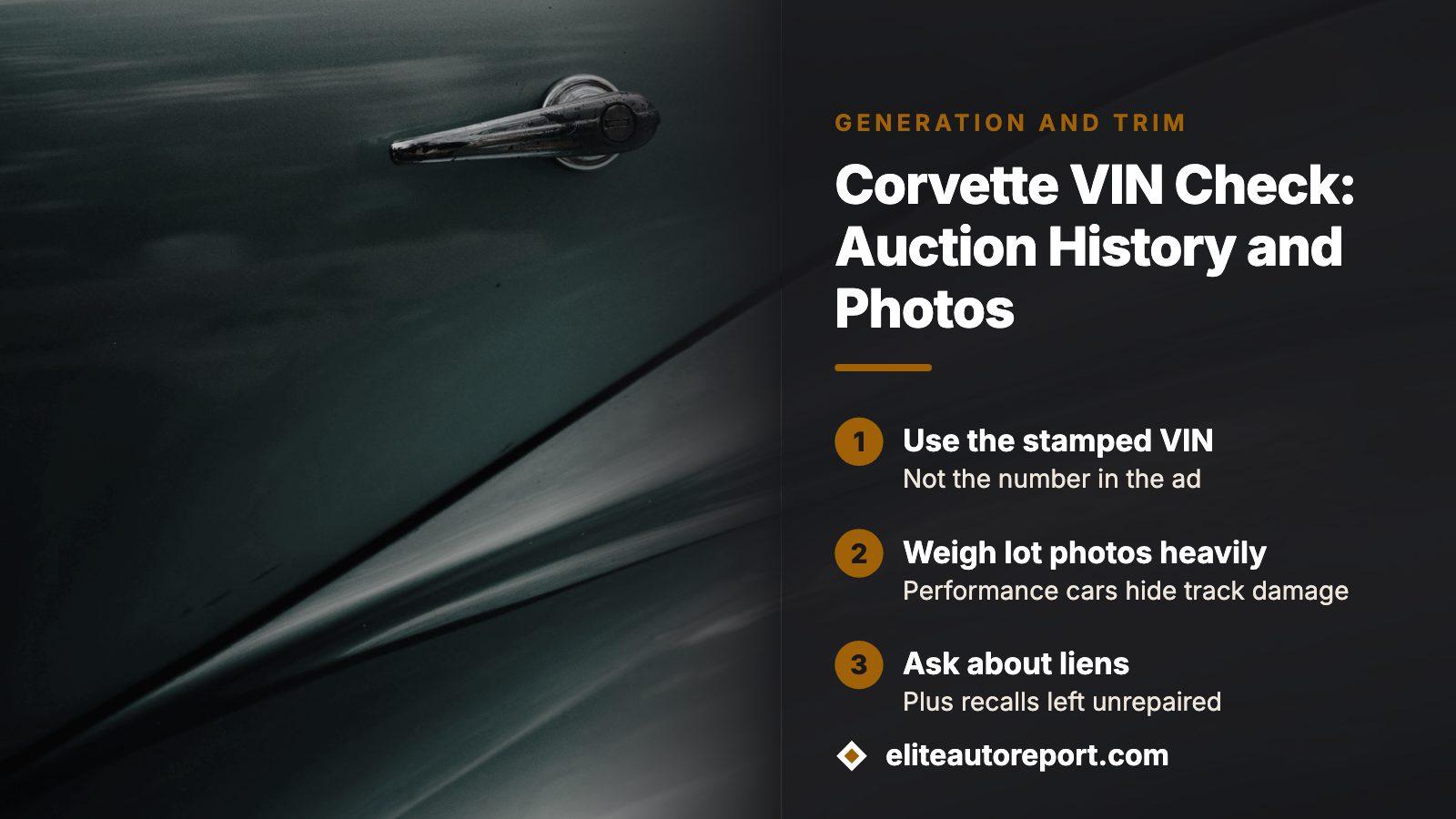
Start with the number stamped on the car itself, not the one in the ad, and confirm it decodes to the generation, engine and trim you were promised. Then scan for auction listings, salvage or rebuilt brands, liens, erratic mileage and unrepaired recalls. On a performance car the lot photos carry the most weight. The preview comes at no charge; the report itself is one payment.
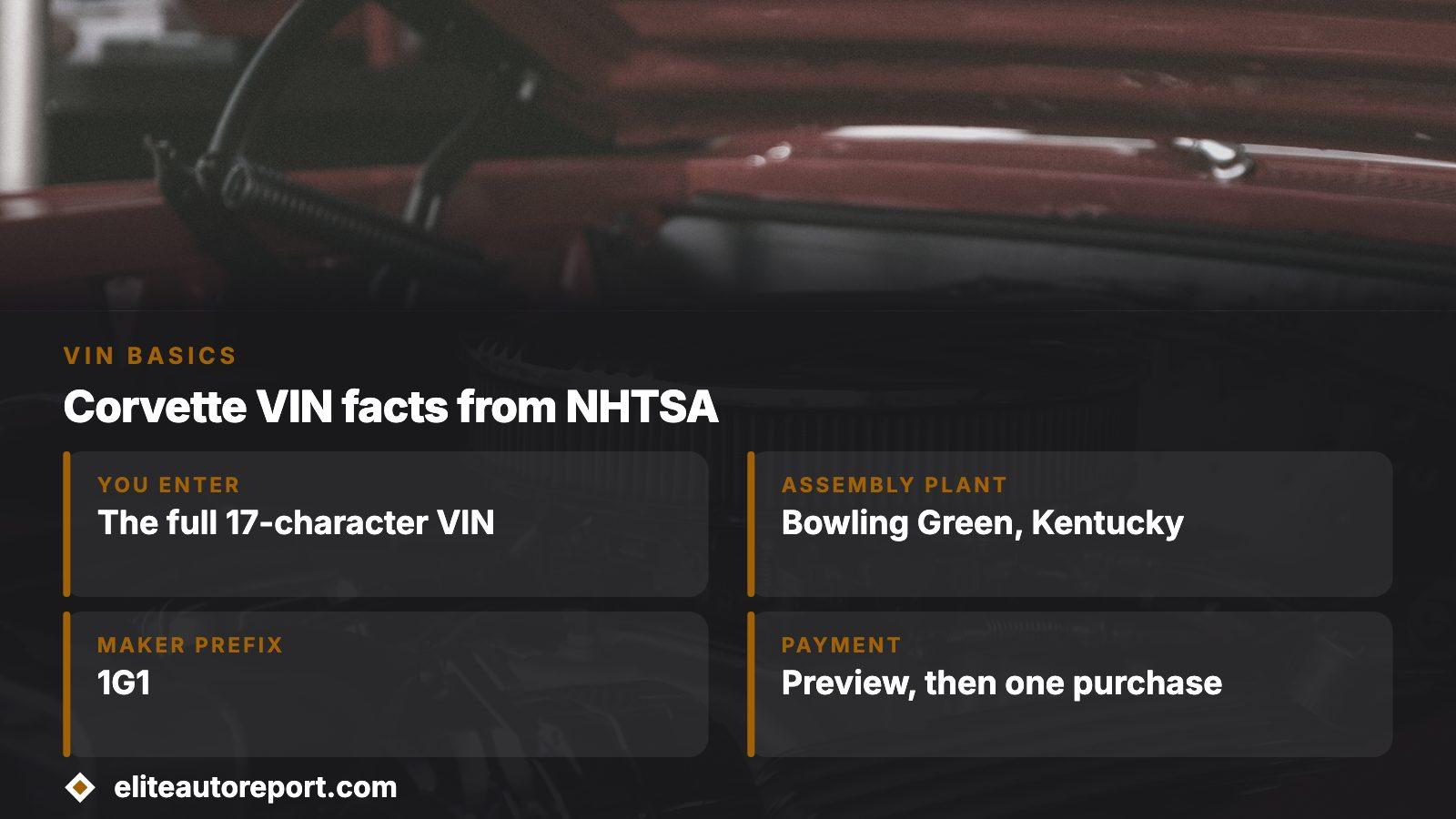
- What you enter
- The full 17-character VIN
- Assembly plant in NHTSA decodes
- Bowling Green, Kentucky
- Maker prefix on those VINs
- 1G1
- Cost
- Free preview, then one payment
What the record can show about a Corvette
Corvettes are bought by people who like to drive them hard, and sold by people who sometimes know exactly how hard. A VIN lookup pulls together records no seller controls. Federal title data is fed by state titling agencies, insurers, scrapyards and recyclers, all required to report. On top of that, this site adds auction sales and their photographs where a car passed through a yard.
- Salvage, junk, rebuilt or flood labels, and which state issued them
- A total-loss decision by an insurer, even when the car was later repaired and retitled
- Auction entries and the pictures from the lot
- Odometer readings from different dates, so gaps and reversals stand out
- Liens that were never cleared, plus theft entries
- Open recalls and the factory specification for the exact VIN
A clean result helps but is no verdict. The federal title system says repair histories are outside its scope, so a car can come back tidy and still deserve a lift and a flashlight.
Why the auction photos matter more on a Corvette
Composite panels, low noses and costly wheels make even a modest impact expensive, and many damaged cars are repaired well enough to pass a quick walk-around. A title brand says a car was once written off. The photos show what that looked like: crushed corners, deployed bags, water lines, a missing nose. That separates a rebuilt car you can price sensibly from one to leave alone.
Compare every picture with the car in front of you. Panel gaps that differ from the lot photos, paint that looks newer on one corner, or a part that shows original damage in the listing all deserve a direct question. If the car sold at auction but carries no brand, ask why it was there. Dealers move cars through yards for ordinary reasons, but you should hear this one.
Find the VIN and check what it decodes to
Find the number on the Corvette itself, at the dash corner under the windshield on the driver's side, then set it beside the title and registration. A character resembling I, O or Q is a misread, because none of those three is ever used. Then see whether the decode fits the sales pitch. NHTSA's public decoder returned the following for Corvette patterns, run with the check digit as a wildcard.
| Pattern tested | Model year | Trim returned |
|---|---|---|
| 1G1YB2D7*E5 | 2014 | LT1 coupe |
| 1G1YP2D6*G5 | 2016 | Standard 1LZ with Z06 |
| 1G1Y12D7*H5 | 2017 | Grand Sport Premium 3LT |
| 1G1YU2D6*J5 | 2018 | Z06 Premium 3LZ |
| 1G1YW2D7*K5 | 2019 | Grand Sport Standard 1LT |
Every one returned a 6.2 liter eight-cylinder engine and Bowling Green, Kentucky, as the plant. If a car sold as a Z06 decodes as a base model, stop and sort that out before anything else. One 2020 pattern came back with no model at all, which shows that a thin decode is a reason to ask questions rather than proof of fraud.
Open recalls that show up on late-model Corvettes
NHTSA publishes recall data, and several Corvette campaigns touch safety hardware, so an open item is worth looking for by VIN. Dealers fix these without charge, but only on cars named in the campaign. A few from the database:
| Campaign | Model year | Issue | Vehicles |
|---|---|---|---|
| 14V570000 | 2015 | Driver air bag backing plate can crack | 89 |
| 14V568000 | 2015 | Rear parking brake cable only partly seated | 783 |
| 15V031000 | 2015 | Rear toe link ball joint not tightened properly | 43 |
| 18V360000 | 2019 ZR1 | Air bag sensing module can fault under hard braking | 498 |
| 20V489000 | 2020 | Drivable with the front lid unlatched | 7,071 |
Campaign 17V437000, which covers 2014 through 2017 Corvettes among other GM models, has a remedy tied to crash history: cars that had a previous air bag deployment get a replacement module instead of a software reflash. A deployment you were never told about is the kind of thing that sits behind a repair record.
A lien nobody mentioned
From an NHTSA owner complaint
A 2016 Z06 owner reported to NHTSA in 2020 that the previous owner's loan was still attached to the car when it changed hands, and that the engine was also giving trouble. The filing does not describe the outcome.
The lesson is narrow and practical. An open lien means the lender can still assert a claim, and the seller may be unable to deliver a clean title. Run the VIN before you pay, and ask for the lender's payoff letter if one appears. Never leave a deposit on the promise that paperwork will follow.
Reading the results and the red flags
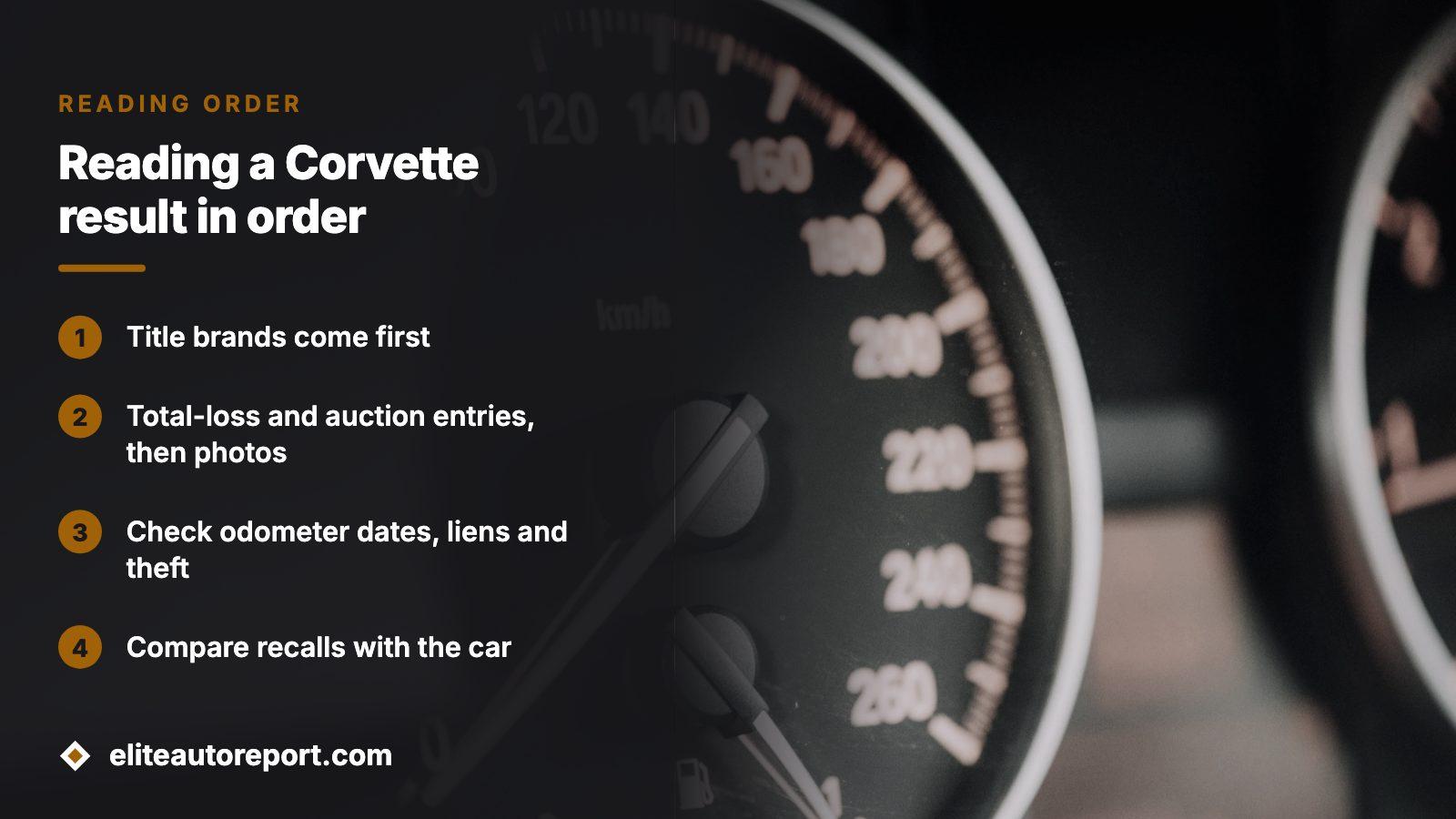
Work through the report in this order, since the early items can end the conversation fast.
- Title brands first. Salvage, junk, flood or rebuilt changes both value and insurability.
- Total-loss and auction entries, then the photos that go with them.
- Odometer dates. Mileage that falls, or stays flat for years on a car that was clearly in use, needs an explanation.
- Liens and theft entries, which have to be cleared before a sale.
- Open recalls and the factory spec, compared with the car you are inspecting.
Two clean items do not outweigh one bad one. A rebuilt brand with good photographic evidence of a minor repair can be acceptable at the right price. A flood entry on a car with expensive electronics rarely is.
What buyers of used Corvettes run into
From an NHTSA owner complaint
A 2017 Corvette owner wrote to NHTSA that he bought the car used in August 2021 with no known defects. Within weeks a tire shop found three cracks on the inner flange of each rear wheel, and he said other owners reported the same thing.
A VIN report will not reveal cracked wheels, and it does not claim to. It can tell you whether the car was tracked, wrecked or sold at auction, so your inspector knows where to look. Back the history up with a hands-on check from a technician who knows these cars.
Older Corvettes and the limits of a decoder
The decoder tests above all came from 1984 and later, and a 1984 pattern named the car as a Corvette built in Bowling Green. I could not confirm from the sources I read how serial formats work on the earliest generations, so do not count on an online decode for a classic. With a collector car, get the title and every document the seller has, and expect the VIN search to return less than it does for a recent one.
Still, run the check on any number you can read cleanly: a brand or a lien matters on a classic as much as on a C7.
Pricing and your next step
You can type in a VIN and read the preview without paying. Going further means buying a single report once, with bigger packs for people comparing cars. No subscription renews. The pricing page shows the current amounts.
- Check the number on the car against the paperwork.
- Read the preview, then decide whether the full record justifies buying it for this car.
- Hire an independent inspector if the history shows an auction sale or a repair.
- Leave any deal where the seller resists a VIN check.
Where this information comes from
- NMVTIS: understanding a vehicle history report — what federal title data covers and who reports it
- NHTSA vPIC VIN decoder — model years, trims and plant for the Corvette patterns
- NHTSA recalls — where to look up open campaigns by VIN
- NHTSA owner complaint 11377670 — owner experience, paraphrased
- NHTSA owner complaint 11432856 — owner experience, paraphrased
Sources and photos: Facts checked against the sources above in November 2026. Photos by Anshul Gurjar, CHUTTERSNAP and Victor Hughes on Unsplash; diagrams by EliteAutoReport.
Keep reading
- Car Auction Photos by VIN: Find Salvage Sale Pictures Before You BuyHow to find and read lot photos for a specific car.
- C5 Corvette Buyer's Guide: Steering Lock, Recalls and Auction RecordsA buyer's guide to an older generation.
- Salvage Auction Title Codes: How to Read Them on a Luxury or Classic LotWhat the brands on a title actually mean.
- Dodge Viper VIN Check: Auction Photos, Title Brands and RecallsAnother American performance car worth checking.
Frequently asked questions
Can I run a Corvette VIN lookup for free?
You can begin without paying, and the preview indicates whether records exist. Detailed entries and lot pictures belong to the paid report. NHTSA offers its own free open-recall search by VIN, a sensible extra step on any car you are considering.
Does a Corvette VIN check show if the car was wrecked?
It shows what was recorded: total-loss entries, salvage and rebuilt brands, and auction sales with photos. A small collision repaired privately and never reported will not appear, so the check lowers the risk without removing it. A Corvette specialist's inspection covers the remainder.
Where is the VIN on a Corvette?
At the dash corner under the windshield on the driver's side, and it should agree with the title and registration. Use the number on the vehicle, never one typed into an advertisement. If characters differ between documents, hold off on any payment.
Why would a Corvette be at an auction?
Reasons run from dealer trade-ins and fleet sales to insurance total losses and repossessions, and the VIN record shows which one when the sale was reported. Auction history is not automatically bad, but it should arrive with an explanation and photos you can hold against the car.
Does the check cover older Corvettes?
Coverage is strongest on later cars with a standard 17-character number. I could not confirm how well the earliest generations decode, so run any VIN you can read and treat a thin result as a cue to ask for paperwork, not as a clean bill.
Now check the car itself
The guide explains what to look for. The report shows what this VIN has on record.