THE SHORT ANSWER
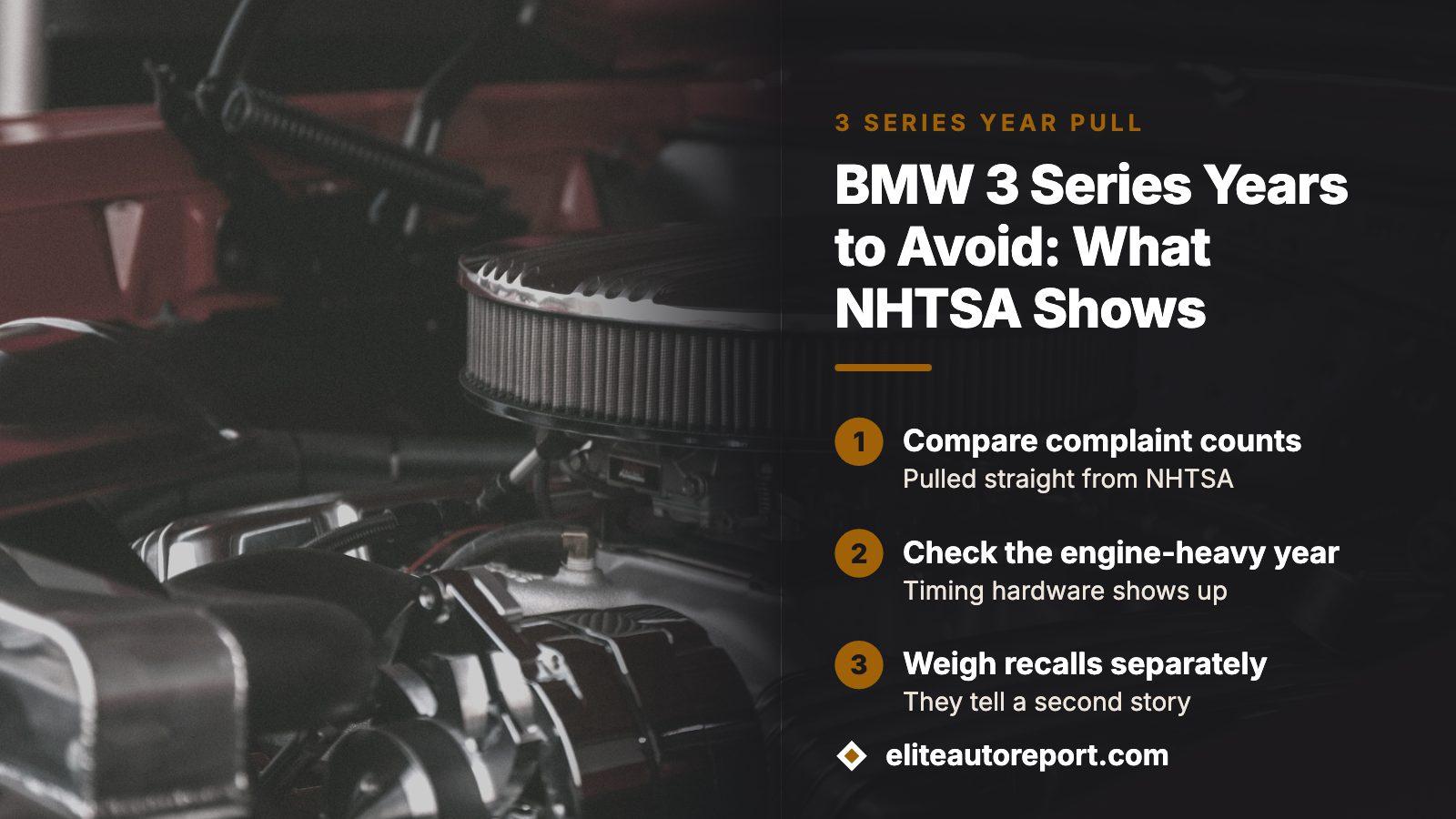
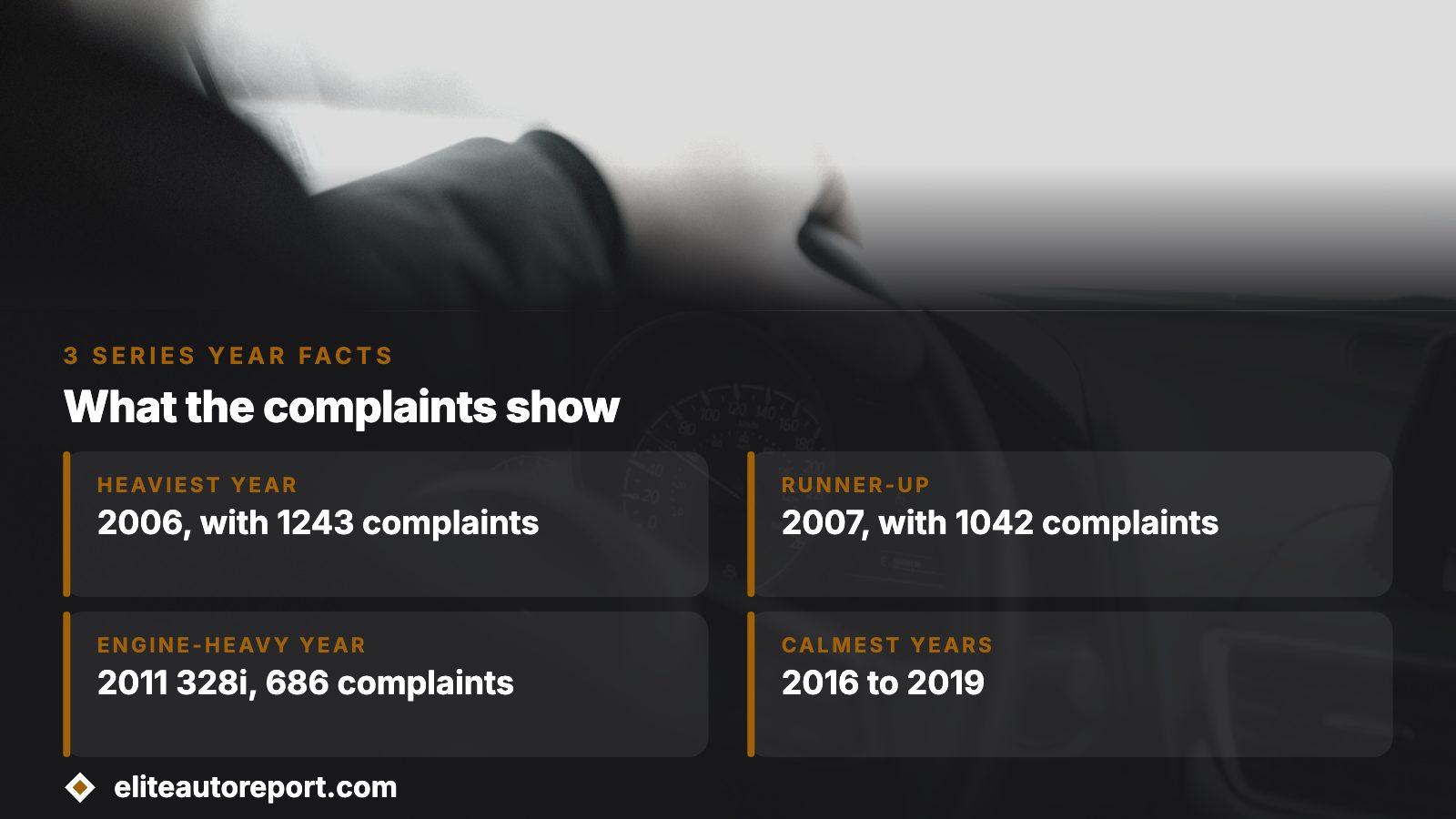
Treat 2006 and 2007 as the years to avoid unless the paperwork is spotless: they hold 1243 and 1042 owner complaints, led by air bag and electrical faults. The 2011 328i is third, with 686 complaints about the engine and its timing hardware. Model years 2016 to 2019 draw far fewer filings. Whatever year you pick, run the VIN before paying.
- Heaviest year
- 2006, with 1243 complaints
- Runner-up
- 2007, with 1042 complaints
- Engine-heavy year
- 2011 328i, with 686 complaints
- Calmest years pulled
- 2016 to 2019, 93 down to 41
How these counts were pulled
NHTSA does not file every 3 Series under one name. Complaints on 2005 through 2010 sit under the label 3 SERIES, those on 2011 through 2015 sit under trims such as 328i and 335i, and 2016 through 2019 return to 3 SERIES. A search that uses only one spelling therefore reports zero for several years, which is a quirk of filing and says nothing about the cars.
The figures below come straight from NHTSA's complaints and recalls interfaces, queried model year by model year under each label. Complaints are unchecked owner reports, and NHTSA does not divide them by sales volume. Use them to see where owners ran into problems; they are not a failure rate.
Complaints by model year at a glance
| Model year | Filing name | Owner complaints |
|---|---|---|
| 2005 | 3 SERIES | 227 |
| 2006 | 3 SERIES | 1243 |
| 2007 | 3 SERIES | 1042 |
| 2008 | 3 SERIES | 691 |
| 2009 | 3 SERIES | 388 |
| 2010 | 3 SERIES | 274 |
| 2011 | 328i | 686 |
| 2012 | 328i | 144 |
| 2013 | 328i | 289 |
| 2014 | 328i | 152 |
| 2015 | 328i | 125 |
| 2016 to 2019 | 3 SERIES | 93, 75, 60, 41 |
The 335i adds more on top for 2011 (147 complaints), then thins out to 34, 65, 20 and 10 over 2012 to 2015. The 2011 figure for the two trims together is why that year sits close to the worst of the older cars.
2006 and 2007: seat sensors, wiring and fuel pumps
Of the 1243 filings on the 2006 car, 667 name the air bag system. Many point to the mat in the front passenger seat that decides whether that air bag is live. Campaigns 13V564000 and 17V428000 cover it: the mat can crack, and a failed one would switch the passenger air bag off in a crash. The dealer repairs or replaces it at no charge.
The 2007 pile is more mixed: 290 electrical, 226 air bag, 163 engine and 124 fuel system filings, with 61 mentioning fire. Two 2017 campaigns matter here. One covers overheating wiring in the heating and air conditioning airflow system. The other covers a short-circuiting heater on the crankcase ventilation valve. Both carry a fire warning, and the fix is free.
From an NHTSA owner complaint
One 2006 3 Series owner reported that a dealer admitted the seat-mat problem matched the recall, but declined a free repair since that VIN was excluded, quoting 2100 dollars instead. Recall eligibility is decided per VIN, so put the question to the dealer in writing.
The 2011 328i and its timing hardware
On the 2011 328i, 224 filings name the engine and another 184 name engine cooling, far above any later year. Recall 14V176000 explains much of it: bolts holding the housing of the VANOS camshaft timing unit can work loose and break, which can cut power or stall the engine. Dealers swap four bolts on each unit at no cost.
Free repair only helps if it was done. A car that skipped the campaign, or lost oil pressure afterward, can end up with a bill larger than the car's value. Request the shop invoice showing the bolt replacement, and have an independent BMW mechanic read the engine fault memory.
From an NHTSA owner complaint
A 2011 328i filing describes the oil pressure light lighting up on startup, then a stall. A mechanic traced it to failed VANOS bolts, and the car stayed unfixed over the cost. That happened around 157,637 miles, so on a high-mileage example, ask pointedly whether that work was done.
Recall counts tell a second story
Campaign totals for a trim and year show how often the maker had to step in. The 328i carried 6 campaigns for 2007, 5 for 2008, 6 for 2009 and 2010, and 7 for 2011. The 2014 328i reached 8, the highest of the cars pulled, then fell to 4 for 2015. The 335i peaks at 7 campaigns for 2011.
- Campaign counts include repeated and expanded campaigns, so a high count can reflect a thorough maker response.
- Open campaigns are the ones to chase: a finished repair no longer matters, an unfinished one does.
- Recall 24V513000, filed in July 2024, concerns a sport or M-sport steering wheel fitted in place of the original, whose inflator can explode in deployment. It reaches 2006 to 2011 sedans, so inspect the steering wheel itself.
NHTSA's recalls page refused a plain request from my tool, so every campaign above was read from its recalls interface.
2016 to 2019 and the middle years
From 2016 the complaint tally under 3 SERIES drops to 93, 75, 60 and 41. Filing names split again here, though: the 2019 330i alone carries 9 recall campaigns, while the 3 SERIES label for the same years shows none. Look up the exact trim named on your car, not just the family name.
The middle years, 2012 to 2015, run from 125 to 289 complaints on the 328i, with 2013 the soft spot at 289, led by engine filings. None looks as heavy as 2006, 2007 or 2011, though no year is free of campaigns. A fewer-complaints year is a better starting point, not a guarantee.
What a VIN check settles that the counts cannot
A year's reputation is an average. One sedan may carry a salvage brand, an auction run with front-end damage photos, an altered mileage reading or a theft entry, and none of that shows in NHTSA counts. For European luxury cars that change hands through dealer lots and auction yards, that earlier trail often decides the price.
EliteAutoReport starts with the auction side: sale records and photos tied to the VIN, then brands on the title, mileage history and any unfinished recalls. Start with the preview at no cost; the complete report is a single purchase, and nothing renews. Run the VIN on an older 3 Series before the test drive, not after.
The federal NMVTIS database holds title brands, the newest odometer figure and insurer total-loss determinations. It puts its reach at 87 percent of U.S. vehicles, though barely over half the states feed it records, so a clean result can still hide a past. Auction and photo records help fill that hole.
Five steps before the money changes hands
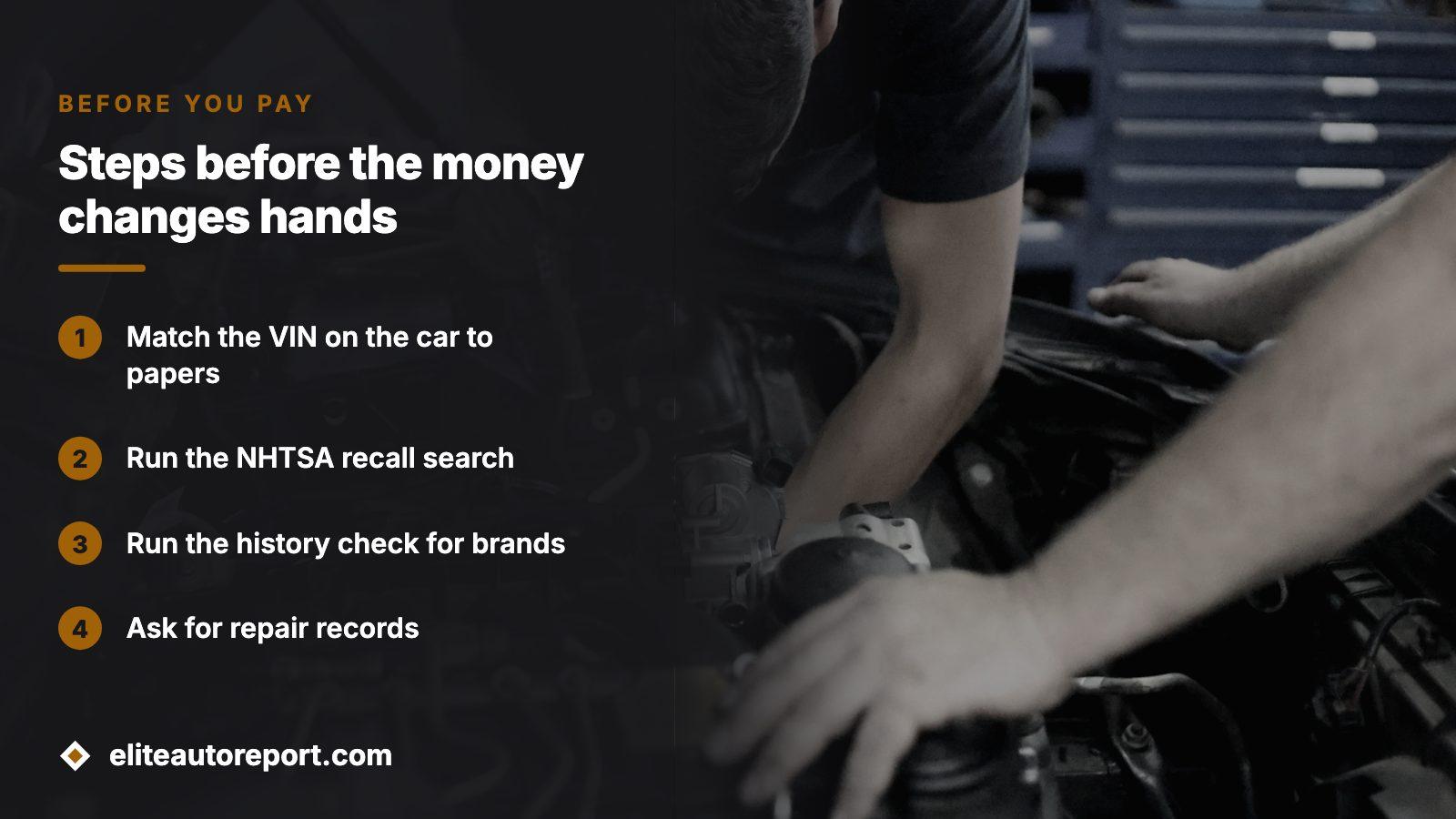
- Compare the VIN stamped on the car with the one on the title paperwork.
- Run NHTSA's recall search on that VIN and note every open campaign.
- Run the history check and look for brands, auction photos and odometer jumps.
- Request invoices for the VANOS bolts, the seat mat and the wiring or heater recalls that apply to the year.
- Pay an independent BMW mechanic to read fault codes and check for oil leaks.
If a seller resists the VIN check or the inspection, walk away. A third-party sedan with a clean record costs little to verify.
Where this information comes from
- NHTSA complaints API: 2011 BMW 328i — owner complaint counts and components for the 328i years
- NHTSA complaints API: 2006 BMW 3 Series — owner complaint counts for the older 3 Series years
- NHTSA recalls API: 2011 BMW 328i — dates, campaign numbers and what dealers fix
- NHTSA owner complaint 11727018 — owner experience, paraphrased
- NHTSA owner complaint 11616440 — owner experience, paraphrased
- NMVTIS consumer information — federal title data, plus the gaps it admits to
Sources and photos: Facts checked against the sources above in November 2026. Photos by Victor Hughes, Mustafa Sheikhmouss and Miles Loewen on Unsplash; diagrams by EliteAutoReport.
Keep reading
- BMW X5 years to avoid, ranked by NHTSA complaints and recallsSame exercise for BMW's SUV, with its own filing quirks.
- BMW M3 VIN Check: Auction Photos, Titles and Recalls by YearThe performance version needs a closer history check.
- BMW E30 Buyer's Guide: Federal Records and Auction TrailAn older 3 Series generation with its own recall trail.
- Salvage Auction Title Codes: How to Read Them on a Luxury or Classic LotDecode the title and auction labels you may find on a used BMW.
Frequently asked questions
Which model year of the BMW 3 Series is worst?
By NHTSA owner complaints, 2006 leads with 1243, followed by 2007 with 1042. The 2006 pile leans on air bag filings, mostly the passenger seat sensor. These are unverified reports with no sales weighting, so use them to decide what to inspect rather than to rule a car out.
Is a 2011 BMW 328i a bad buy?
It drew 686 complaints, many about the engine, and a recall covered loosening VANOS bolts. A car with proof the bolts were replaced and a clean history is a different story from one with no service record. Ask for the invoice and a mechanic's check.
Which 3 Series years are the safest bet?
On filing counts alone, 2016 to 2019 look calmest, with 93, 75, 60 and 41 complaints. Check the exact trim name for recalls, since the 2019 330i alone has 9 campaigns. Fewer complaints lower the odds of trouble but do not replace a VIN check.
Why do some model years show zero complaints?
NHTSA files the 3 Series under different names by year. Searching 328i for 2007 through 2010 returns none, because those complaints sit under 3 SERIES. Always search both the family name and the trim before concluding a year is clean.
Does a VIN check show recalls and accident history?
Depending on what was reported, it can surface open recalls, title brands, mileage readings and auction records with photos. No source catches everything, as NMVTIS itself warns about states that do not report. Pair the report with an inspection by an independent mechanic.
Now check the car itself
The guide explains what to look for. The report shows what this VIN has on record.