THE SHORT ANSWER
Read the VIN off the bike, test that it follows the federal pattern, then run it for title brands, salvage events and auction sales with photos. The national reporting duties for insurers and salvage yards are written around four-wheeled automobiles, so a bike's trail is patchier. Treat a hit as a lead for inspection and a miss as unfinished work: pull the state title record and examine the machine. Begin with the free preview.
- VIN length
- 17 characters, last four numerals on a motorcycle
- Decoder range
- NHTSA's tool targets model years 1981 and later
- Reporting duty
- Insurer and salvage-yard rules cover four-wheeled automobiles
What a bike's history can show, and where it goes quiet
A history report bundles separate record feeds, and a motorcycle sits unevenly across them. Set each feed against the gap you should expect.
| Record | What it can show | Gap to expect on a bike |
|---|---|---|
| Title brands | Salvage, junk or flood branding applied by a state | The national title system must cover common automobiles only, though several states may report motorcycles too |
| Total-loss and salvage events | An insurer's write-off decision, or a transfer to a salvage yard | The duty on insurers and yards is written for four-wheeled automobiles and only encouraged for other vehicles |
| Auction sale and photos | Sale date, damage notes and pictures of the bike before repair, where an entry exists | No entry for a bike repaired privately, sold direct or never run through a recorded sale |
| Odometer readings | Dated mileage points to set against the clock | Few readings on a bike that is ridden little or rarely changes hands |
The third row is this page's focus. On a bike with an expensive badge, pre-repair photos may be the last unretouched view of the frame, forks and tank.
Step 1: Read the VIN off the bike and the title
Federal rules require the maker to mark the VIN on a component meant to stay with the bike, repairs aside, or on a label or plate permanently attached to one. A number on something that unbolts freely deserves suspicion. Photograph whatever stamping or plate you find and read it one character at a time.
Then lay the title or registration beside the photo. Every character should agree. A number lifted from an advert or a text message proves nothing until it matches the metal. If bike and paperwork disagree, settle that first, since a search on the wrong number returns the wrong machine's story.
Step 2: Test the number before you search
A few quick tests catch most typing slips and doctored numbers.
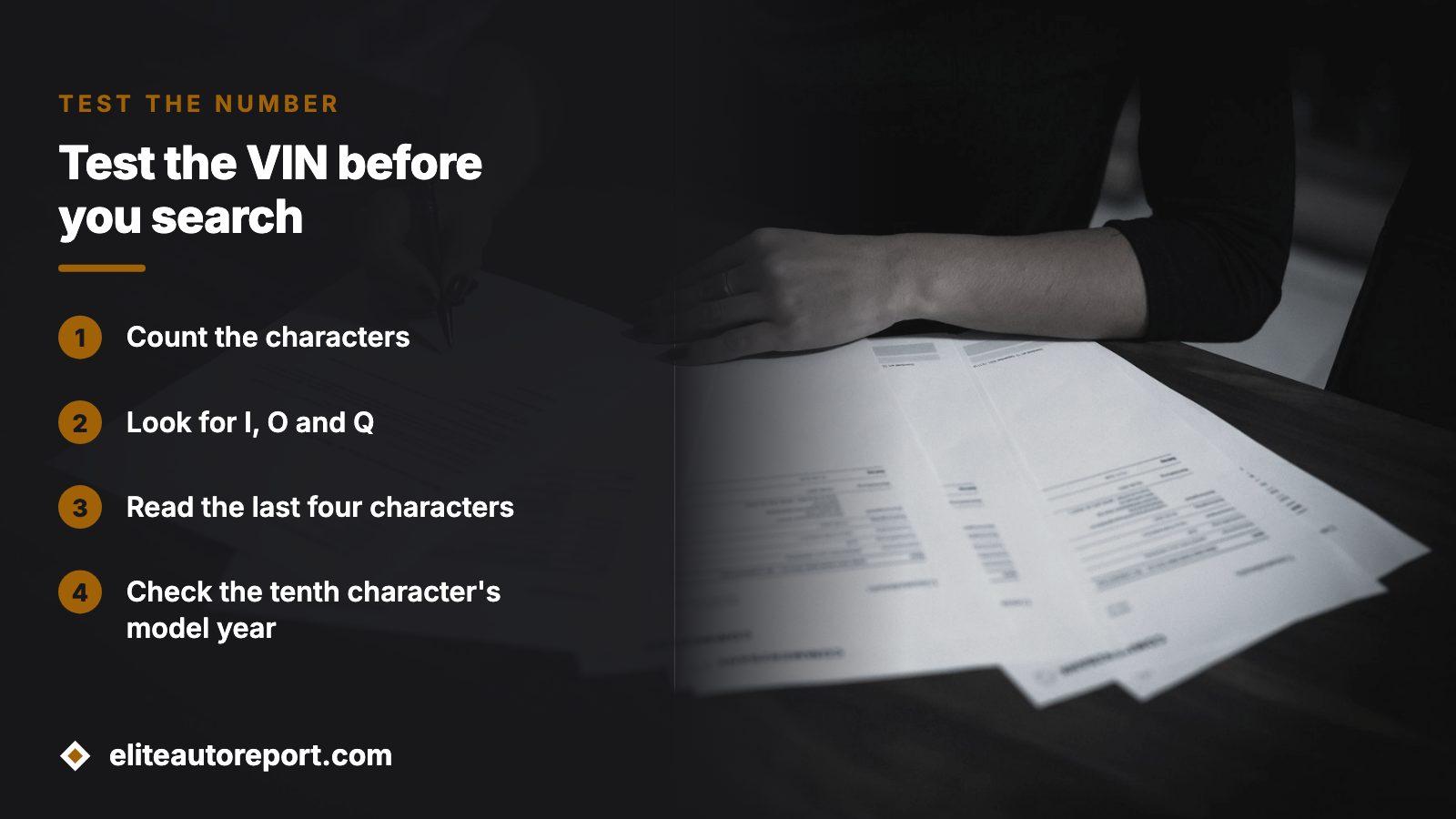
- Count the characters. Federal rules fix the length at 17, so a shorter string is usually an engine number, a part number or an older frame number.
- Hunt for I, O and Q. The federal alphabet omits all three, so a VIN containing one was misread or is wrong.
- Read the last four characters. On a motorcycle they must all be numerals, since only cars and lighter trucks get a longer numeric tail.
- Check the tenth character, which stands for the model year, against the title.
- Decode it with NHTSA's vPIC tool and compare make, year and engine with the seller's claims.
The decoder is built for 1981 and later model years and skips older bikes, which collector catalogues identify by frame and engine numbers instead. Step 5 covers those.
Step 3: Run the check and look for an auction entry
Enter the VIN and EliteAutoReport looks for auction sales on record for that bike. A free preview comes up before any purchase. Buying the complete motorcycle report is a single transaction, never a subscription, and the rates sit on the pricing page. A sale, where one exists, appears beside the title and mileage history, damage records and recalls, so you can sort events by date.
Expect fewer hits than on a car. The federal duty on insurers and salvage yards applies to automobiles, a term tied to a statute describing four-wheeled vehicles. For other vehicles with VINs, the rules only encourage reporting. A bike can be written off or sold for parts and leave a faint trail. Several states may report motorcycles to the national system as well, but do not assume yours does.
Step 4: Read the entry and the photos
An entry is short: a sale date, damage notes, the mileage logged that day and pictures. The date is the anchor, and every later repair, title event and advert should fit after it. Take the photos to the bike and compare.
- Fork legs, handlebars and the frame around the steering head, for any bend, weld or fresh paint the photos can explain.
- Tank, fairing and bodywork, for paint that differs from the factory finish elsewhere.
- Engine cases and exhaust, for scrapes in the lot pictures that have since vanished.
- Mileage at sale against the dash today and every other dated reading.
Fresh parts do not prove a hidden wreck, but each one deserves an invoice. An entry does not prove damage either. A stolen bike that an insurer wrote off can be recovered untouched and still be sold through a pool, so read the photos before the label.
Step 5: On classic and exotic bikes, match frame and engine numbers
At Bonhams, a collector motorcycle's lot title carries its frame number and engine number, and the lot page may add a registration. Those are the numbers to search when a pre-1981 bike has no modern VIN. The text beside them can run ahead of the facts.
When the catalogue contradicted itself
A 1949 Vincent Black Shadow sold at the Las Vegas Motorcycle Auction on 26 January 2017 for US$112,125, premium included. The lot description spoke of matching numbers. A saleroom notice then said one frame component was of unknown origin and that the crankcase numbers corresponded to a Rapide engine built in mid-1948.
| Detail on a 1948 Black Shadow lot | Question it raises |
|---|---|
| Numbers called matching, with two digits of the rear frame number unreadable | Who read the number for the sale, and what papers back the match? |
| Speedometer reset at 999 miles in 1986, reading 35,557 when catalogued | What mileage evidence exists from before the reset? |
| UK registration issued in 1983, after a restoration | What identity did the bike carry before that date? |
Step 6: Confirm with the state title record
A national history is meant to be brief. The Justice Department's consumer page describes its title report as intentionally concise, built around five indicators, and cautions that a search may return a false negative. Coverage reaches around 87 percent of the US vehicle population, and more than half of the states contribute data.
State law varies, so a bike treated as salvage in one state may never have been branded in another. The same page tells buyers to pull the record the state itself holds, because the national version leaves some entries out. Ask your state's titling office what it shows for motorcycles.
What a full report costs, and your move after it
Looking at the preview is free for any motorcycle VIN. When you want the whole EliteAutoReport report, you pay a single time, either for one bike or as part of a multi-report set, with no renewal later. Current rates are on the pricing page, and a sample report lets you see a finished one first.
- Save the auction photos and the report the day you run it.
- Put every date in order: sale, title events, mileage readings and registration.
- Send the photos to a specialist in that marque and ask for a hands-on look before any deposit.
- Request the state title record and ask for repair invoices that match any entry.
- Walk away if the bike, the title and the report cannot be reconciled.
Where this information comes from
- NMVTIS: information for consumers — what the national title record holds, its coverage gaps and the advice to check the state record
- 49 CFR part 565: VIN requirements — the 17-character format, allowed characters, numeric tail and where the VIN must be marked
- 28 CFR part 25: NMVTIS reporting duties — what insurers and salvage yards must report, and the encouraged-only wording for other vehicles
- 49 U.S.C. 32901: definitions — the statute that describes an automobile as a four-wheeled vehicle
- NHTSA vPIC: VIN decoder — the model-year range the decoder is meant for
- Bonhams lot 205: 1949 Vincent Black Shadow — a collector lot whose saleroom notice qualified the matching-numbers claim
- Bonhams lot 212: 1948 Vincent-HRD Black Shadow — registration, speedometer and frame-number notes on a collector lot
Sources and photos: Facts checked against the sources above in November 2026. Photos by Haberdoedas, Dimitri Karastelev and Andres Siimon on Unsplash; diagrams by EliteAutoReport.
Keep reading
- Auction History by VIN: Photos for Luxury, Exotic and Classic CarsHow a VIN auction search works for any vehicle, with notes on reading the photos.
- Car Auction Results Database: Where Classic Car Results LiveWhere collector houses keep their results and how to read the prices.
- Sample reportSee what a completed report looks like before paying.
- PricingReport and pack options, paid once with no renewal.
Frequently asked questions
Does a motorcycle VIN check show auction history?
It can, when the bike went through a recorded sale and the entry carries its VIN. EliteAutoReport shows dates, damage notes and photos where they exist. A bike repaired privately or sold direct leaves no entry, so an empty result proves less than it seems.
Is there a VIN check for a motorcycle built before 1981?
Not in the usual way. NHTSA's decoder is meant for 1981 and later model years, and history searches run on a 17-character VIN. An older bike is identified by frame and engine numbers, which Bonhams prints in each lot title. Search there, then check the title.
Can I trust the mileage on an older motorcycle?
Treat it as a claim until dated records back it. A Bonhams lot page for a 1948 Vincent notes a speedometer reset at 999 miles in 1986 and a reading of 35,557 when catalogued, so the figure says little about distance ridden. Compare the title, the history and service invoices.
Does a total-loss record mean the motorcycle is wrecked?
Not always. The Justice Department's page says an insurer may apply that label to a stolen vehicle that is later recovered in good order, and states differ on branding. A total-loss line tells you to look closer, not what the damage was. Ask for auction photos and the state record.
Is the national title record enough for a motorcycle?
No. The Justice Department calls it intentionally concise, and a clean result can still be a false negative because not every reporting entity feeds it. Motorcycles fit less well, since the requirement is written for common automobiles. Pair it with the state record and an auction search.
Now check the car itself
The guide explains what to look for. The report shows what this VIN has on record.