THE SHORT ANSWER
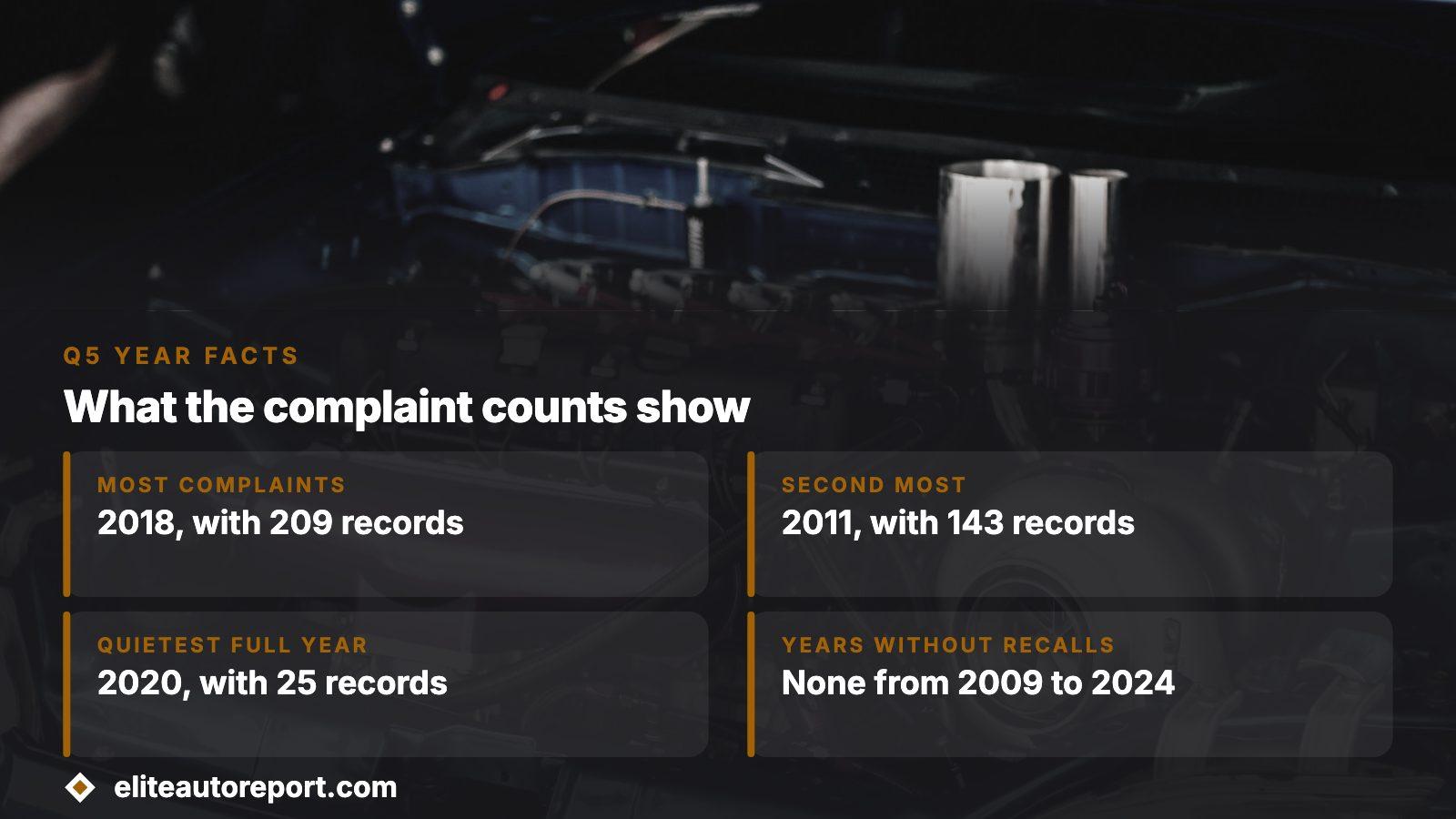
Skip 2011 first: 143 complaints, a fuel pump flange recall and an air bag inflator recall. 2018 drew the most complaints of any year, 209, many about water reaching electronics. 2010, 2014 and 2015 each sit near 100 complaints, with engine oil and steering as the themes. Years from 2019 onward are quieter, but no year is recall-free.
- Most complaints
- 2018, with 209 records
- Second most
- 2011, with 143 records
- Quietest full year
- 2020, with 25 records
- Recall-free years
- None between 2009 and 2024
How these years were ranked
All figures below were pulled by us from two NHTSA public databases, filtered to one Q5 model year at a time. A complaint is an owner telling the agency something went wrong. It is not a verified defect, and a popular year naturally collects more of them, so counts are a screening tool and not a verdict.
We then read what the complaints and recalls actually said, because 100 complaints about a sticky trim piece mean less than 100 about stalling. That second step is what separates the years below.
Complaint counts, year by year
| Model year | Owner complaints | Recall records |
|---|---|---|
| 2009 | 31 | 6 |
| 2010 | 100 | 4 |
| 2011 | 143 | 5 |
| 2012 | 4 | 6 |
| 2013 | 92 | 5 |
| 2014 | 106 | 5 |
| 2015 | 100 | 6 |
| 2016 | 78 | 5 |
| 2017 | 42 | 5 |
| 2018 | 209 | 6 |
| 2019 | 53 | 5 |
| 2020 | 25 | 6 |
| 2021 | 75 | 8 |
| 2022 | 0 | 4 |
| 2023 | 39 | 5 |
| 2024 | 20 | 4 |
Two entries look odd. The 2012 row shows only 4 complaints and 2022 shows none, far below their neighbors. We could not confirm why, so read those as thin data, not proof of a trouble-free year.
2010 and 2011: air bags and fuel pumps
In 2011 the largest complaint group was air bags, at 67 records, followed by engine at 42 and fuel at 25. The 2010 year looks similar, with air bags at 50 and fuel at 29.
The recalls explain part of that. A 2016 campaign, 16V660000, covers a fuel pump flange that can crack and leak, with a fire risk. NHTSA records a second flange campaign, 18V818000, in November 2018. Another, 17V001000, covers sunroof drains that can soak the foam around a side air bag inflator and corrode its canister, so the inflator could fracture.
Before buying either year, confirm all three campaigns were completed. An unrepaired 2011 is the single riskiest Q5 on this list.
2018: the water problem
No other year comes close on volume. Electrical complaints led at 74, ahead of unknown or other at 45, engine at 31 and suspension at 25. In 58 of the 209 records the owner mentions water or the sunroof.
Recall 21V947000, filed December 2021, ties in. A spill on the back seat, or water entering at a poorly sealed seam under the floor, can soak a gateway control module so it quits, and engine power then drops without warning. Dealers fit a cover over the module and seal the seam. The same year also carries brake master cylinder, wheel arch trim and body clip recalls from 2019.
From an NHTSA owner complaint
An owner of a 2018 Q5 reported that the sunroof drain failed and let water into the car. A dealer confirmed the cause, and the owner put the damage at about 6,000 dollars, suspecting a design flaw rather than wear.
The takeaway: on a 2018, look for a damp rear carpet, a musty smell and an open or unfinished gateway module recall before you talk price.
2014 and 2015: engine oil and steering
These two years logged 106 and 100 complaints. Engine led both, at 36 and 38, with steering next at 17 and 14. In 2015, 29 of the 100 records mention oil.
From an NHTSA owner complaint
The owner of a 2015 Q5 said the engine used about a quarter of oil every 300 miles, then went into limp mode and needed a tow. A mechanic said it needed a new engine at 85,000 miles, even with oil changed every 5000 miles.
One account is not a trend, but the oil mentions across dozens of records are. The 2013 to 2017 Q5 with the 2.0 turbo engine also has a coolant pump recall, 17V002000, with a follow-up in 2018, 18V229000, that replaces the pumps. Ask for service records showing oil top-ups and the pump work.
The calmer years
- 2020 has 25 complaints, the lowest among full production years.
- 2024 shows 20 and 2023 shows 39, and the youngest cars have simply been on the road for less time.
- 2017 at 42 and 2019 at 53 are well under their older neighbors.
- 2021 has 75 complaints and the most recalls, 8, including an engine inspection campaign, 22V753000, so check its status.
Lower counts do not clear a car. They only mean fewer owners went to the trouble of filing.
Why the VIN matters more than the year
A good 2018 beats a neglected 2020. Water-damaged luxury crossovers do reach auction lots, and a sunroof leak that wrecked electronics can end up as an insurance total loss that gets rebranded and resold. Auction photos, where they exist, show what the seller's listing leaves out.
Run the VIN through our free preview first. The paid report then adds auction records with photos, title brands, odometer readings and open recalls, in one place. Pricing is on the pricing page, as a single payment.
A short checklist before you pay
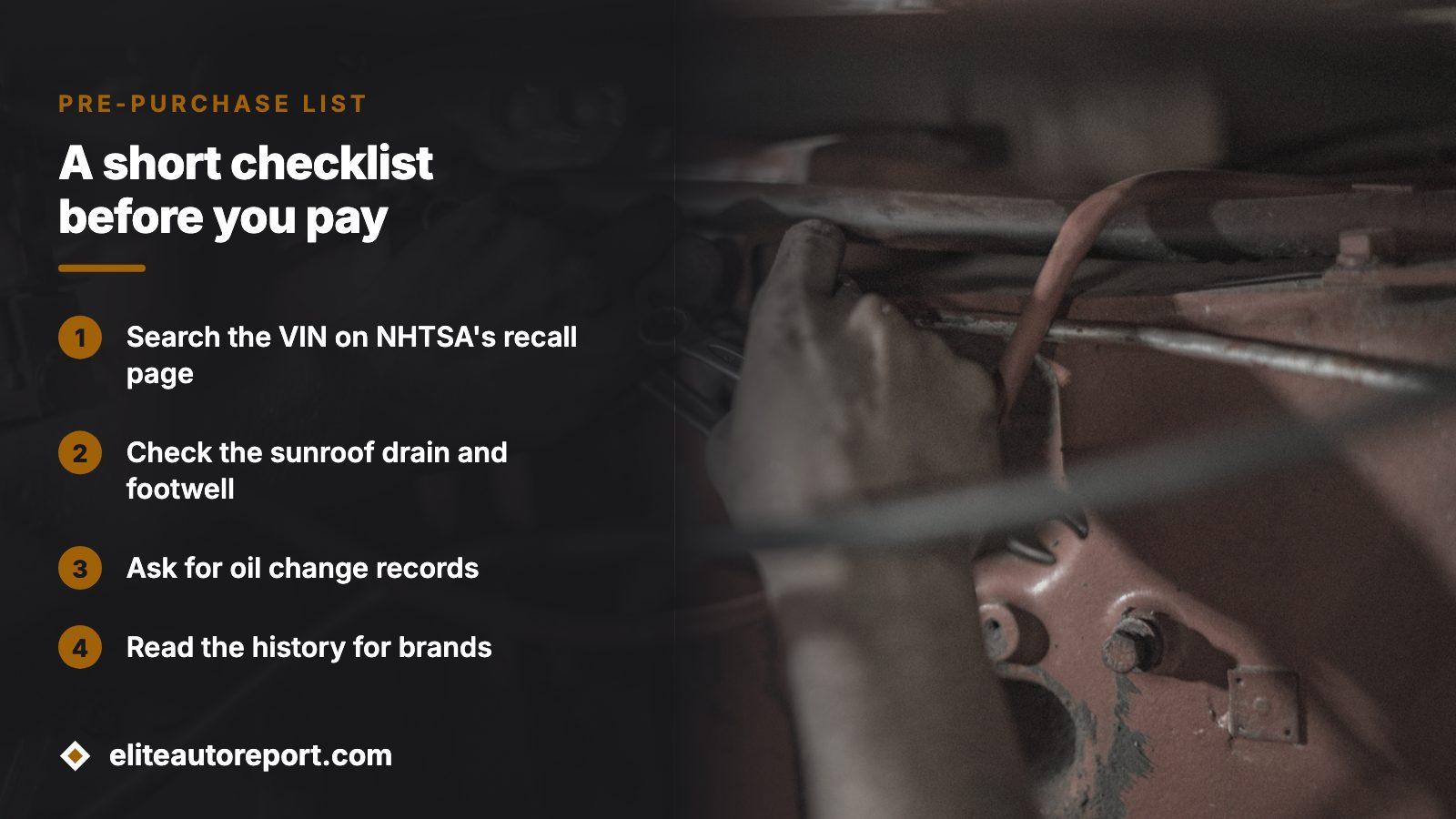
- Search the VIN on NHTSA's recall page and confirm each campaign above that applies to the car was completed.
- Pull the sunroof drain and the rear footwell: look for stains, damp padding or rust on seat bolts.
- Ask for oil change records and note any top-up habit.
- Run a VIN check for title brands, auction history and photos.
- Have an independent Audi mechanic scan for stored electrical faults.
Walk away if the seller will not let you do the third and fifth steps.
Where this information comes from
- NHTSA: 2018 Audi Q5 complaints and recalls — complaint and recall counts for the busiest year
- NHTSA: recalls lookup — where to confirm open campaigns by VIN
- NHTSA owner complaint 11767491 — owner experience, paraphrased
- NHTSA owner complaint 11702822 — owner experience, paraphrased
- VehicleHistory.gov: NMVTIS — federal title history system for buyers
Sources and photos: Facts checked against the sources above in November 2026. Photos by Max Tokarev, Nina Mercado and Willian Cittadin on Unsplash; diagrams by EliteAutoReport.
Keep reading
- Audi A4 years to avoid, from NHTSA complaint and recall countsThe same count-based approach applied to Audi's sedan.
- Most Reliable Audi: What Federal Complaint and Recall Counts ShowWhich Audi models hold up best.
- Flood Damage Car Check Before You Bid: A Step-by-Step Guide for Auction CarsHow water-damaged cars end up for sale.
- Auction History by VIN: Photos for Luxury, Exotic and Classic CarsWhat an auction record and photos show about a car.
Frequently asked questions
What is the worst year for the Audi Q5?
By volume it is 2018, with 209 NHTSA complaints. By severity of recalls, 2011 is hard to beat because it combines fuel pump flange campaigns with a sunroof drain and air bag inflator campaign. Neither is a certain lemon; condition and completed repairs matter more.
Is a high-mileage Audi Q5 worth buying?
It can be, if records show regular oil changes, completed recalls and no water damage. Complaints about oil use and engine failure at 85,000 miles exist for 2015, so mileage alone is not the test. Service history is.
Are newer Q5 years safe from problems?
No. 2021 has 8 recall records, including an engine inspection campaign, and 2025 brought a hybrid battery software recall. Newer years simply have fewer complaints so far. Check each VIN against NHTSA's recall tool.
Do recalls mean I should avoid a car?
Not by themselves. A completed recall is a repaired car. The risk is a recall left open, which a VIN-based lookup reveals in seconds. Audi dealers perform recall repairs at no charge.
Can a VIN check show if a Q5 was water damaged?
It can show title brands, insurance total losses and auction records with photos, which are the usual trail. It cannot see a damp carpet, so pair it with an in-person inspection.
Now check the car itself
The guide explains what to look for. The report shows what this VIN has on record.